The behaviour of complex physical systems, particularly those exhibiting chaotic properties, increasingly suggests a connection to the seemingly abstract world of random quantum mechanics. Thomas Schuster, Fermi Ma, and Alex Lombardi, alongside Fernando Brandao and Hsin-Yuan Huang, investigate how closely physical systems can mimic truly random quantum operations, known as Haar-random unitaries. This research addresses a critical gap in existing theory, demonstrating that standard methods for approximating these random operations fall short when considering the complex queries inherent in experiments exploring gravity and information scrambling. The team constructs new ‘strong’ unitary designs and pseudorandom unitaries that accurately reproduce the behaviour of truly random operations even under these demanding conditions, achieving optimal circuit depth for a given number of qubits. These results provide compelling evidence supporting the fast scrambling conjecture, a key idea in black hole physics, by demonstrating that observable features of these systems align with random behaviour at predictable timescales.
Random Quantum Circuits Approximate Unitary Designs
Scientists investigate the properties of random quantum circuits, exploring their ability to mimic truly random quantum behavior, central to understanding quantum chaos, complexity, and developing new quantum algorithms. Researchers focus on how these circuits scramble quantum information, examining correlations within the system using advanced mathematical tools, including Weingarten calculus and free probability, to analyze their statistical properties and relationship to random matrix theory. This work connects quantum randomness to classical cryptography, exploring potential applications in secure communication and computation. A key focus is demonstrating that random quantum circuits approximate unitary designs, essential for creating reliable quantum algorithms. The research emphasizes the mathematical foundations of these concepts, utilizing advanced tools to rigorously analyze the circuits’ properties and potential applications.
Luby-Rackoff Ensemble for Fast Quantum Scrambling
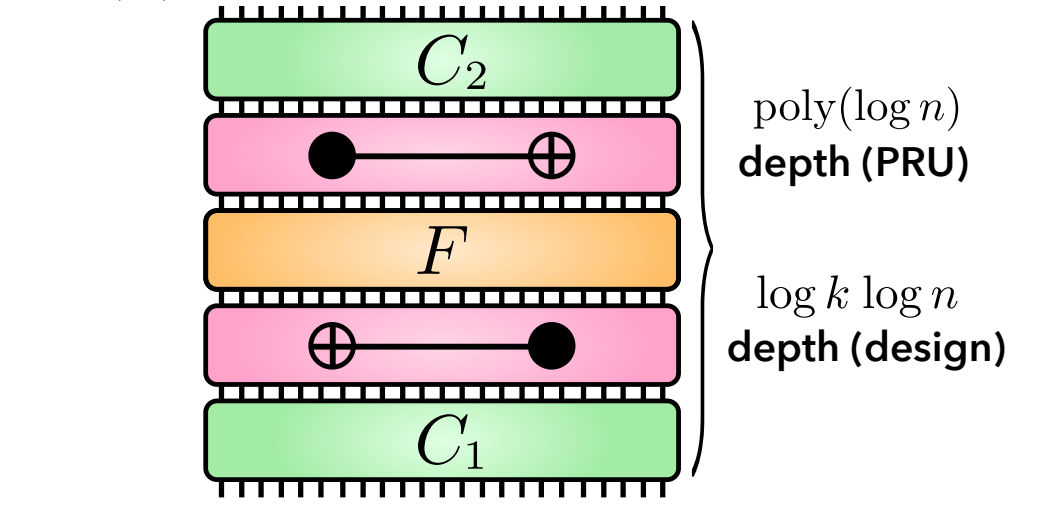
Scientists developed a new method for constructing random quantum circuits, called the Luby-Rackoff-Function-Clifford (LRFC) ensemble, to study fast scrambling and optimize quantum simulations. This ensemble creates versatile unitary operators by combining specific types of quantum gates, mimicking truly random quantum operations, and achieves optimal circuit depth, minimizing computational resources. Researchers replaced complex functions within the circuit with either exact or quantum-secure pseudorandom functions, depending on the application. To create strong unitary designs, scientists replaced random functions with functions replicating random behavior for a limited number of quantum experiments, achieving minimal circuit depth using a specific number of ancilla qubits. For creating strong pseudorandom unitaries, they employed quantum-secure pseudorandom functions, ensuring indistinguishability from random functions in quantum experiments. The team proved that the LRFC circuit forms a strong unitary design with quantifiable error, demonstrating its effectiveness in simulating fast scrambling dynamics, and established a lower bound for circuit depth, proving optimal scaling.
Optimal Quantum Scrambling with Logarithmic Circuit Depth
Scientists achieved a breakthrough in understanding quantum information scrambling, constructing random quantum circuits and pseudorandom unitaries robust under a comprehensive set of queries. This research addresses limitations in characterizing scrambling, specifically the need to access not only the quantum transformation, but also its inverse, conjugate, and transpose. These new constructions achieve optimal circuit depth for systems of qubits, representing a significant advancement. Experiments demonstrate that strong unitary designs can form in minimal circuit depth using circuits composed of independent two-qubit gates.
Furthermore, the team constructed strong pseudorandom unitaries in minimal circuit depth without ancilla qubits, a crucial improvement for modeling physical quantum dynamics. This eliminates the need for auxiliary systems with specific initialization and finalization conditions, aligning the framework more closely with natural physical processes. The results provide an operational proof of the fast scrambling conjecture from black hole physics, confirming that observable features of the fastest scrambling systems reproduce random behavior at logarithmic times.
Fast Scrambling Emerges in Standard Quantum Circuits
This work establishes a robust framework for understanding how quickly physical systems can resemble random quantum behavior, crucial in areas like black hole physics and quantum information scrambling. Researchers constructed strong unitary designs and pseudorandom unitaries robust under complex transformations, achieving optimal circuit depth for a given number of qubits. Importantly, these strong unitary designs emerge naturally in quantum circuits composed of standard two-qubit gates, and strong pseudorandom unitaries can be created without additional ancilla qubits. These findings provide an operational confirmation of the fast scrambling conjecture, demonstrating that observable features of rapidly scrambling systems align with random quantum behavior at logarithmic timescales. The research advances the understanding of quantum chaos and provides a concrete link between theoretical models and physical systems exhibiting fast scrambling, laying the groundwork for exploring similar phenomena in more complex quantum systems.
🗞 Strong random unitaries and fast scrambling
🧠 ArXiv: https://arxiv.org/abs/2509.26310