Researchers developed a method to characterise qubit noise with millisecond resolution over extended periods. The technique disentangles overlapping fluctuations originating from charge parity and two-level systems in transmon qubits, offering insights for improved qubit calibration, error mitigation and error correction protocols.
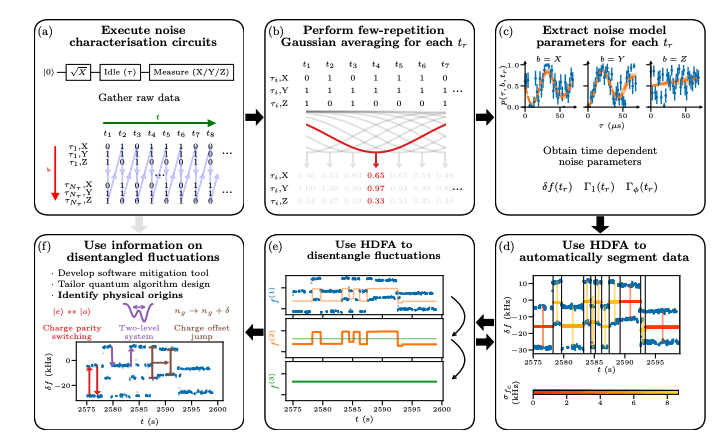
Understanding and mitigating noise is paramount to realising the potential of quantum computation. Fluctuations in qubit frequency, arising from a complex interplay of stochastic processes within the quantum device and its environment, introduce errors that limit the coherence and fidelity of quantum operations. Researchers at the National Physical Laboratory, alongside colleagues from Royal Holloway, University of London, have developed a novel framework to characterise and disentangle these fluctuations with unprecedented temporal resolution. Their approach, detailed in a recent publication titled ‘Fast-tracking and disentangling of qubit noise fluctuations using minimal-data averaging and hierarchical discrete fluctuation auto-segmentation’, combines a minimal-measurement noise characterisation technique with an automated tool for segmenting overlapping noise sources. The team, comprising Abhishek Agarwal, Lachlan P. Lindoy, Deep Lall, Sebastian E. de Graaf, Tobias Lindstr¨om, and Ivan Rungger, demonstrate the efficacy of their method on transmon qubits, identifying the origins of fluctuations as overlapping charge parity and two-level-system switching, and paving the way for improved qubit control and error management.
Characterising Noise Sources in Superconducting Qubits
Superconducting qubits represent a leading technology in the development of quantum computers. However, maintaining the delicate quantum states necessary for computation is hampered by environmental noise, limiting qubit coherence – the duration for which a qubit retains its quantum information. Recent research focuses on identifying and characterising the origins of this noise, with particular attention paid to the role of two-level systems (TLS) – atomic-scale defects within the materials comprising the qubits.
The research confirms that material imperfections, specifically TLS within alumina and aluminium oxide – commonly used in qubit fabrication – contribute significantly to qubit decoherence. These TLS act as fluctuating dipoles, interacting with the qubit and inducing transitions that destroy quantum information.
A novel framework has been developed to achieve high-resolution characterisation of this noise. This framework distinguishes between different types of fluctuations – discrete, abrupt changes (jumps) and continuous, gradual drifts – without requiring manual intervention. Crucially, it achieves millisecond-scale temporal resolution in tracking qubit frequency fluctuations over extended periods. This level of precision allows researchers to correlate specific noise events with potential underlying causes.
The framework successfully links observed fluctuations to two primary sources: charge parity fluctuations – changes in the number of excess charges trapped in the material – and switching events within individual TLS. These switching events represent the TLS transitioning between its two energy states, induced by external stimuli or thermal fluctuations.
This work builds upon established understanding of material imperfections and their impact on quantum systems, referencing foundational research by Anderson et al. (1972) – which highlighted the importance of defects in solids – and Phillips (1987) – which explored the role of defects in low-temperature physics.
The implications extend beyond fundamental understanding. The detailed noise characterisation provided by this framework offers practical benefits for quantum computer development. The data generated can be used to refine qubit calibration procedures, improving the accuracy of quantum operations. Furthermore, it facilitates the development of more effective error mitigation strategies – techniques to reduce the impact of noise on computations – and informs the design of more robust error correction codes – algorithms to detect and correct errors arising from noise.
👉 More information
🗞 Fast-tracking and disentangling of qubit noise fluctuations using minimal-data averaging and hierarchical discrete fluctuation auto-segmentation
🧠 DOI: https://doi.org/10.48550/arXiv.2505.23622