Researchers with the ALICE Collaboration at the Large Hadron Collider have found evidence that a state of matter resembling the earliest moments of the universe, quark-gluon plasma, can arise even in collisions of comparatively small particles like protons. Previously, physicists believed that generating quark-gluon plasma required the extreme energy of heavy ion collisions; however, this new analysis of proton-proton and proton-lead collisions reveals a similar pattern of anisotropic flow, where particles emerge with a directional preference. This flow is stronger in baryons, particles composed of three quarks, than in mesons with only two. “This is the first time we have observed, for a large interval in momentum and for multiple species, this flow pattern in a subset of proton collisions in which an unusually large number of particles are produced,” says David Dobrigkeit Chinellato, Physics Coordinator of the ALICE experiment, suggesting that an expanding system of quarks may form even in smaller collision systems.
Anisotropic Flow Distinguishes Baryons and Mesons in Multiple Collisions
This observation challenges earlier assumptions that quark-gluon plasma formation required the extreme conditions generated only by collisions of larger nuclei like lead. Researchers initially proposed that smaller systems lacked the necessary temperature and pressure, but recent evidence suggests otherwise. A crucial aspect of this research centers on the differing behavior of baryons, composed of three quarks, and mesons, containing only two; the ALICE team meticulously isolated particles exhibiting collective flow to analyze this distinction. The analysis revealed that, mirroring observations in heavy-ion collisions, baryons demonstrated a stronger anisotropic flow than mesons at intermediate momenta, a phenomenon explained by a process called quark coalescence, where quarks within the quark-gluon plasma combine to form larger particles. The team validated these findings by comparing the observed flow to simulations incorporating quark-gluon plasma formation and quark coalescence; models accurately reflecting these processes successfully reproduced the observed patterns, while those omitting them failed. Kai Schweda, ALICE Spokesperson, anticipates further refinement of these models with data from oxygen collisions recorded in 2025, which promises a deeper understanding of quark-gluon plasma evolution across varying collision systems and its implications for the earliest moments of the universe.
ALICE Collaboration Validates Quark Coalescence Models of QGP Evolution
The search for quark-gluon plasma, the state of matter theorized to have existed moments after the Big Bang, has expanded beyond collisions of massive lead nuclei; recent investigations at the Large Hadron Collider suggest quark-gluon plasma may also form in smaller systems. The ALICE Collaboration published findings in Nature Communications detailing a consistent pattern observed across proton-proton, proton-lead, and lead-lead collisions, providing further evidence for quark-gluon plasma creation even in less energetic interactions. Initial assumptions held that the extreme temperatures and pressures necessary for quark-gluon plasma formation were unattainable in smaller collisions, but accumulating data challenges this view.
The measurement of anisotropic flow, specifically quantified by the second coefficient ($\nu_2$), relies on tracking the angular distribution of emitted particles. This coefficient mathematically characterizes the deviation from perfect radial symmetry, transforming the raw particle momentum data into a measurable metric of the system’s initial eccentricity and subsequent hydrodynamic expansion. Analyzing $\nu_2$ across different collision systems allows researchers to map the Equation of State (EoS) of the hot, dense matter, providing crucial constraints for lattice quantum chromodynamics (LQCD) calculations that predict the properties of the strongly interacting medium.
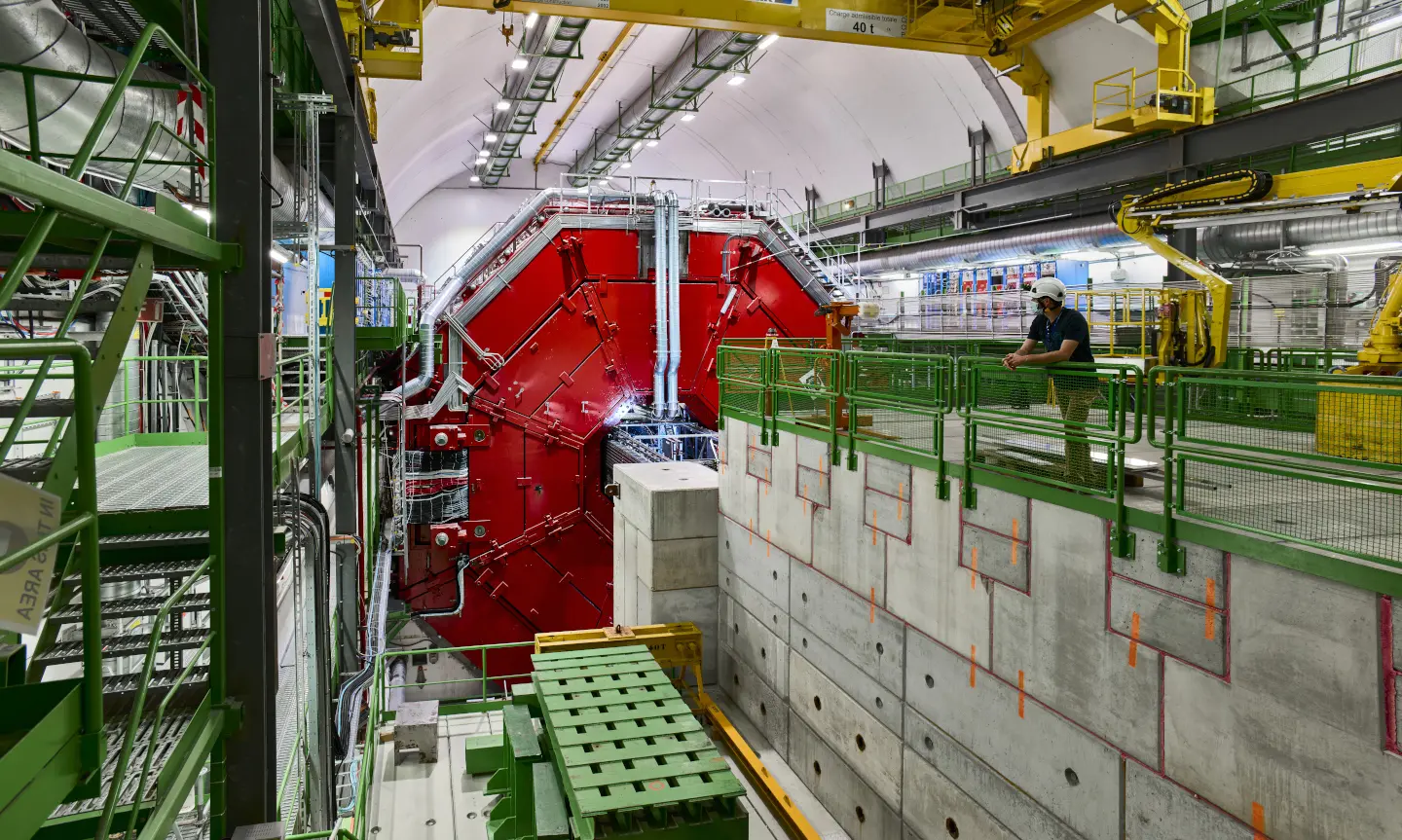
From an experimental perspective, the ALICE detector utilizes a multi-layered tracking system, including Time Projection Chambers (TPC) and the Inner Tracking System (ITS), to precisely determine the momentum and trajectory of thousands of charged particles created in each collision event. These detectors must operate under extreme electromagnetic conditions, requiring sophisticated trigger systems and data acquisition pipelines capable of handling petabytes of raw data, which is critical for distinguishing subtle, collective flow signals from random background noise.
The observed difference in flow between baryons and mesons points toward a sophisticated phenomenon known as the recombination mechanism. In the dense medium, the individual constituent quarks are theorized to act as quasi-particles, temporarily surviving the thermalization process. When the system cools, these quarks combine (or “coalesce”) rather than hadronizing individually, a process that strengthens the final collective flow and enhances the baryon-to-meson ratio observed in the resultant hadronic spectrum.
Understanding the transition between the hadronic phase (normal matter) and the QGP phase is a primary goal of this field. Current theoretical models predict a “critical point” in the QCD phase diagram, an exotic region where the system might undergo a first-order phase transition. Pinpointing the kinematics and particle species exhibiting flow properties near this predicted critical point represents a major frontier challenge for both accelerator physics and relativistic heavy-ion research.
We expect that, with the oxygen collisions that were recorded in 2025, which bridge the gap between proton collisions and lead collisions, we will gain new insights into the nature and evolution of the QGP across different collision systems.
Kai Schweda, ALICE Spokesperson