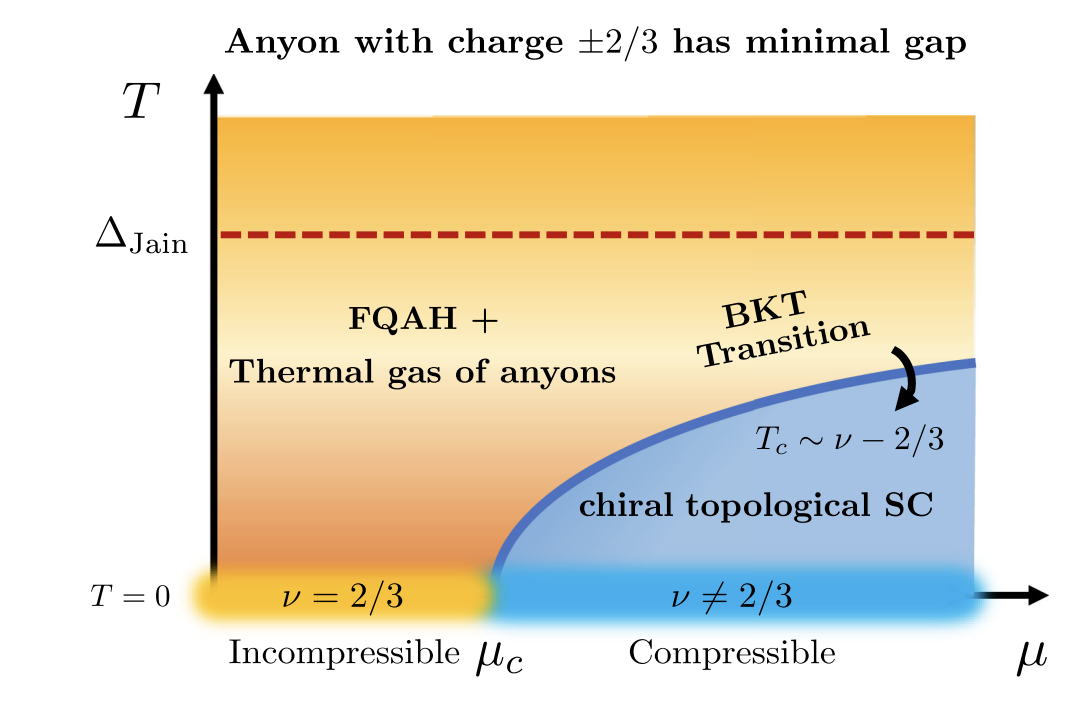
Researchers have developed a comprehensive theoretical framework to understand the behavior of electrons within fractional quantum anomalous Hall (FQAH) insulators when those materials are doped with additional charge carriers. This work predicts that increasing the density of charge carriers leads to the formation of mobile anyons, exotic particles with fractional electric charge, which then organize into novel metallic and superconducting phases. The team discovered that these anyons, unlike those in traditional quantum Hall systems, possess a nontrivial dispersion, meaning their energy isn’t suppressed by a strong magnetic field and they can move more freely within the material. Experiments reveal that at low doping levels, these anyons become localized due to disorder and interactions, creating the quantum Hall plateau characteristic of the FQAH state.
However, as doping increases, the kinetic energy of the anyons overcomes these localization effects, potentially leading to a delocalized many-body state and the destruction of the plateau. This behavior differs significantly from doped Mott insulators, due to the unique properties of FQAH states, including broken time-reversal symmetry and the presence of fractionally charged anyons. The team’s analysis shows that these anyons fractionalize lattice translation symmetry, meaning their movement is linked to specific phases, and can be labeled by Bloch momenta within the material’s Brillouin zone. At a filling fraction of 2/3, the framework predicts the emergence of a Fermi liquid metal, while at more general Jain filling fractions of p/(2p+1), a wider variety of phases, including higher-charge superconductors and generalized composite Fermi liquids, become possible. These findings provide a proof-of-principle that exotic itinerant phases can be stabilized by correlations intrinsic to the FQAH setup, opening avenues for exploring novel many-body phenomena and potentially designing new superconducting materials.
Topological Matter and Quantum Hall Systems
This extensive list of references details research heavily focused on topological phases of matter, including topological insulators, quantum Hall effects, and related phenomena. This is a very active area of condensed matter physics, exploring materials with exotic electronic properties protected by topology. Many papers focus on understanding the fractional quantum Hall effect (FQHE), which arises in two-dimensional electron systems at strong magnetic fields, and the concept of composite fermions, which are central to understanding many FQHE states. The references also suggest research into materials where electron-electron interactions are dominant, leading to emergent phenomena that cannot be explained by single-particle theories.
A significant number of papers deal with systems that do not behave like conventional metals, exhibiting unusual properties and often associated with quantum criticality. The concept of duality, mapping one physical system to another, and the emergence of gauge fields, like electromagnetism, are recurring themes throughout the research. Understanding how materials transition between different phases at zero temperature is a key focus, as is recent research on moiré materials, which exhibit correlated phenomena. The study of anyons, particles that exhibit non-Abelian exchange statistics, is also present, with implications for topological quantum computation. Key terms appearing frequently include topological insulators, the quantum Hall effect, composite fermions, non-Fermi liquids, quantum criticality, duality, emergent gauge fields, anyons, and moiré materials.
Mobile Anyons and Emergent Superconductivity
This research establishes a comprehensive theoretical framework for understanding the behavior of electrons in fractional quantum anomalous Hall insulators when these materials are doped with additional charge carriers. The authors demonstrate that introducing these carriers leads to the formation of mobile anyons, exotic particles that exhibit unusual exchange statistics, and predicts that these anyons can give rise to novel metallic states and even superconductivity. Importantly, the work clarifies the conditions under which such anyonic states can emerge from realistic electron systems, addressing a long-standing question in the field of topological matter. The study rigorously examines the constraints on the underlying theory, specifically focusing on the allowed couplings between background fields and the anyonic action.
By carefully considering the quantization of Chern-Simons coefficients and the spin-charge relation, the authors derive precise conditions for the emergence of these anyonic states, ensuring consistency with fundamental physical principles. This detailed analysis provides a robust foundation for predicting and interpreting experimental observations in these materials. The authors acknowledge that their framework relies on certain theoretical assumptions and that further research is needed to explore the full range of possible behaviors and to connect the predictions to specific material properties. Future work could focus on investigating the impact of interactions between anyons and exploring the potential for observing these exotic states in real-world experiments, potentially paving the way for novel electronic devices.
🗞 Doping a Fractional Quantum Anomalous Hall Insulator
🧠 DOI: http://link.aps.org/doi/10.1103/kcm5-hx56