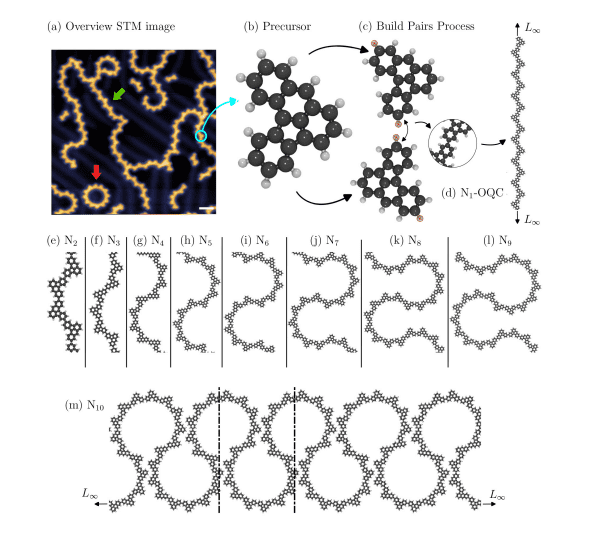
Organic quantum chains represent a fascinating new class of carbon-based nanostructures exhibiting unusual electronic properties, and researchers are now gaining a deeper understanding of their potential. L. L. Lage, A. B. Félix, and D. S. Gomes, alongside M. L. Pereira Jr. and A. Latgé from the University of Brasília, have investigated the electronic behaviour of these quasi-one-dimensional structures, revealing a robust energy gap consistent with experimental observations. Their calculations demonstrate the existence of emergent hierarchical states within the chains, characterised by unique patterns of electron localisation, and suggest that these chains exhibit promising characteristics for future carbon nanodevices. This work advances the field by providing fundamental insights into the behaviour of organic quantum chains and paving the way for their application in advanced nanotechnology.
Topological Nanomaterials and Electronic Structure Calculations
Scientists investigate novel nanomaterials, including two-dimensional structures and those with unique geometries, to determine their electronic and structural characteristics. They explore topological properties, such as the presence of Dirac cones, which dictate how electrons move through the material, and study topological insulators and semimetals, examining how protective electronic states can be disrupted by imperfections. This research encompasses a broad range of studies focused on nanomaterials, condensed matter physics, and computational materials science, with a strong emphasis on understanding electronic structure and simulating material behavior. A core technique employed is density functional theory, a computational method used to calculate electronic structure, band gaps, and material properties, often enhanced with hybrid functionals for improved accuracy. Researchers also utilize molecular dynamics simulations to model how materials behave dynamically at the atomic level, employing both classical simulations using force fields and coarse-grained methods to reduce computational demands. These simulations rely on pseudopotential methods to simplify calculations and, for large systems, linear scaling techniques to improve efficiency, all facilitated by parallel computing algorithms.
Organic Quantum Chain Stability and Electronic Structure
Scientists thoroughly investigated the electronic and transport properties of newly synthesized organic quantum chains, beginning with a detailed assessment of their structural stability. They employed molecular dynamics relaxation combined with density functional theory to optimize the structures of these chains, ensuring accurate modeling of their behavior. This combined approach revealed a robust and nearly constant energy gap of 2. 0 eV across various chain configurations, aligning with experimental observations. The study pioneered a detailed analysis of emergent hierarchical states within the chains, identifying distinct localization behaviors within sets of localized bands.
To achieve this, scientists utilized the Green function formalism and a decimation method to establish numerical periodicity in momentum space, enabling precise calculations of the local density of states. This technique allowed researchers to map the delocalized electronic contribution across the system and understand the distribution of electrons within the chain structures. Researchers established a specific parametrization scheme, revealing the formation of new localized states with increasing unit cell size while maintaining the protected energy gap of approximately 2. 0 eV. They analyzed the ballistic conductance plateaus of several chains, focusing on an energy range where band separations created mini-bands, and observed a hierarchical structure in the conductance sequences. By analyzing the length of these plateaus, researchers demonstrated a consistent trend between chain size and the evolution of features on the conductance curves, providing insights into the potential of these materials for carbon nanodevices.
Organic Chains Exhibit Robust Electronic Structure
Scientists have achieved a detailed understanding of Organic Quantum Chains, newly synthesized carbon-based nanostructures exhibiting unique electronic and transport properties. The research team first assessed the structural stability of these chains using molecular dynamics relaxation combined with density functional theory, establishing a foundation for further investigation. Calculations reveal a robust and nearly constant energy gap across various chain configurations, confirming agreement with experimental data and demonstrating inherent stability within the structures. The study identified emergent hierarchical states within the chains, characterized by distinct localization behaviors within sets of localized bands, revealing complex internal electronic organization.
Researchers discovered a distinct class of localized states, termed compact localized states, arising from the specific lattice geometry of the chains, where wavefunction amplitudes are non-zero only within a strictly finite region. This extreme localization is an intrinsic property of the system, resulting from destructive quantum interference and the presence of flat bands in the energy spectrum. Investigations into transport responses involved analyzing scenarios where the one-dimensional chain is coupled to carbon corrals, mirroring experimental setups. The team observed the emergence of localized states of different natures, including Fano antiresonance phenomena and bound quantum states in the continuum, creating a unique set of properties directly observable in electronic responses. Specifically, the research demonstrates the potential for bound states in the continuum, where a perfectly localized mode exists within a continuum state, exhibiting no dip in conductance values. These findings highlight the potential of chains as promising systems for application in carbon nanodevices and pave the way for designing new devices that harness the robustness and quantum interference of these unique states.
Organic Chains Exhibit Hierarchical Conductance Channels
This research presents a detailed theoretical analysis of organic quantum chains, newly synthesized carbon-based nanostructures, combining molecular dynamics and density functional theory to accurately model their structural and electronic properties. Calculations reveal a robust and consistent energy gap across different chain configurations, aligning well with experimental observations, and demonstrate the formation of hierarchical conductance channels within the electronic spectra due to the quasi-one-dimensional nature of these systems. The confinement within these chains is enhanced by incorporating multiple precursors, leading to a partitioning of electronic states and the creation of a hierarchy of pseudo-gaps that promote controlled electronic transitions. Furthermore, the investigation identified compact localized states and robust localized states within the chain, persisting even with increased complexity, and explored the behavior of these chains when coupled to quantum corrals. This coupling results in prominent interference effects and the formation of bound states, suggesting potential for engineering specific electronic properties. The team proposes these systems as promising building blocks for carbon-based nanodevices, exhibiting both structural stability and tunable electronic characteristics.
👉 More information
🗞 Emergent Hierarchy in Localized States of Organic Quantum Chains
🧠 ArXiv: https://arxiv.org/abs/2510.02231