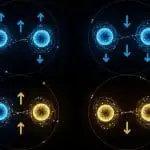
The Quantum Speed Limit (QSL) is a fundamental concept in quantum mechanics that has far-reaching implications for various fields, including quantum information processing, sensing, and metrology. At its core, the QSL describes the minimum time needed to transform between basis states, setting a maximum speed at which computations can be performed. This limit is closely tied to the energy-time uncertainty principle, which dictates that there is a fundamental limit on how precisely one can know both the energy and time of a quantum system.
In practical terms, the QSL has significant implications for the design of quantum sensors, such as those used in magnetic resonance imaging (MRI) machines. These sensors rely on advanced control sequences to maximize sensitivity and precision but are not usually optimized for temporal resolution. The QSL provides a fundamental limit on how quickly these sensors can respond to environmental changes.
The study of the QSL has been extensive across various fields, including quantum information processing, optimal control, thermodynamics, and metrology with respect to quantum clocks. By understanding this concept, researchers can develop more efficient and precise quantum sensors, which have numerous applications in medicine, materials science, and environmental monitoring.
What is the Quantum Speed Limit?
The Quantum Speed Limit (QSL) is a fundamental concept in quantum mechanics that describes the minimum time needed to transform between basis states. This limit was first introduced by Mandelstam and Tamm, who showed that it is not an uncertainty relation due to non-commutativity but rather a statement about intrinsic time scales of quantum systems.
The QSL is closely related to the energy-time uncertainty principle, which was formulated by Heisenberg and later formalized by Robertson and Bohr. The energy-time uncertainty principle states that there is a fundamental limit on how precisely one can know a quantum system’s energy and time. This limit is given by the equation ΔEΔt ≥ ℏ/2.
The QSL, on the other hand, describes the
The QSL, on the other hand, describes the minimum time needed to transform between basis states, which is closely related to the variance of the Hamiltonian (H).
What are Quantum Sensors, and How Do They Relate to the QSL?
Quantum sensors capitalize on advanced control sequences to maximize sensitivity and precision. However, protocols are not usually optimized for temporal resolution. In this context, the QSL sets a fundamental limit on quantum sensing’s time resolution.
The best possible time resolution is closely related to the QSL, which describes the minimum time needed to transform between basis states. A bipartite control sequence consisting of two phase-shifted pulses reaches the QSL. This means that the QSL limits the temporal resolution of quantum sensing.
This concept’s practical implementation is discussed based on the example of the spin-1 qutrit of a nitrogen vacancy (NV) center in diamonds. The energy-time uncertainty principle and the QSL are fundamental concepts in quantum mechanics, and understanding them is crucial for the development of quantum sensors.
What is the Significance of the QSL in Quantum Information Processing?
The QSL has significant implications for quantum information processing. It sets a maximum speed at which computations can be performed, thereby permitting the derivation of an upper bound on the computational limits of the universe.
Further, the QSL has been studied in the field of quantum optimal control, where it is used to determine the minimum time needed to perform a given task. The QSL also has implications for quantum thermodynamics and metrology concerning quantum clocks.
In addition, the finite time of qubit operations sets a fundamental limit on the speed at which quantum computations can be performed. This limit is closely related to the QSL, which describes the minimum time needed to transform between basis states.
What are the Key Concepts in Quantum Mechanics that Relate to the QSL?
The key concepts in quantum mechanics that relate to the QSL include:
The key concepts in quantum mechanics that relate to the QSL include:
- The energy-time uncertainty principle
- The von Neumann equation with the projection operator
- The Schrödinger equation and its integrability
- The concept of a quantum speed limit (QSL)
- The relationship between the QSL and the variance of the Hamiltonian
These concepts are fundamental to understanding the QSL and its implications for quantum information processing.
What are the Implications of the QSL for Quantum Computing?
The QSL has significant implications for quantum computing. It sets a maximum speed at which computations can be performed, thereby permitting the derivation of an upper bound on the computational limits of the universe.
Further, the finite time of qubit operations sets a fundamental limit on the speed at which quantum computations can be performed. This limit is closely related to the QSL, which describes the minimum time needed to transform between basis states.
The QSL also has implications for quantum optimal control and quantum thermodynamics. In addition, it has been studied in the field of metrology with respect to quantum clocks.
What are the Open Questions and Future Directions in Research on the QSL?
Despite significant progress in understanding the QSL, there are still open questions and future directions in research on this topic. Some of these include:
- The relationship between the QSL and other fundamental limits in quantum mechanics
- The implications of the QSL for quantum computing and quantum information processing
- The development of new methods for deriving the QSL and its applications
- The study of the QSL in more complex situations, such as open quantum systems and systems with quantum entanglement.
These are some of the key questions and directions that researchers are currently exploring in their studies on the QSL.
Publication Date: 2024-11-19
Authors: Konstantin Herb and Christian L. Degen
Source: Physical Review Letters
DOI: https://doi.org/10.1103/physrevlett.133.210802