

Researchers simulated a frustrated transverse-field Ising model—a strongly correlated quantum system—using a variational eigensolver on a 16-qubit trapped-ion processor. Results accurately reproduced the system’s magnetic phases, validated against exact diagonalization, demonstrating reliable simulation potential despite current quantum hardware limitations.
Understanding the behaviour of interacting quantum systems remains a significant challenge in condensed matter physics, with classical computational methods often failing to model strongly correlated materials exhibiting complex magnetic phases accurately. Researchers are now exploring the potential of quantum computers to overcome these limitations. A team from Los Alamos National Laboratory – Ammar Kirmani, Elijah Pelofske, Andreas Bärtschi, Stephan Eidenbenz, and Jian-Xin Zhu – detail their investigation into simulating a frustrated transverse-field Ising model using a trapped-ion quantum computer. Their work, entitled ‘Variational Quantum Simulations of a Two-Dimensional Frustrated Transverse-Field Ising Model on a Quantinuum H1-1 Trapped-Ion Quantum Computer’, demonstrates the successful recovery of magnetic phases within this complex system using the Variational Eigensolver (VQE) algorithm, and highlights the capabilities of current quantum hardware in tackling problems beyond the reach of classical computation.
Variational Quantum Eigensolver Simulates Frustrated Magnetism on Trapped-Ion Hardware
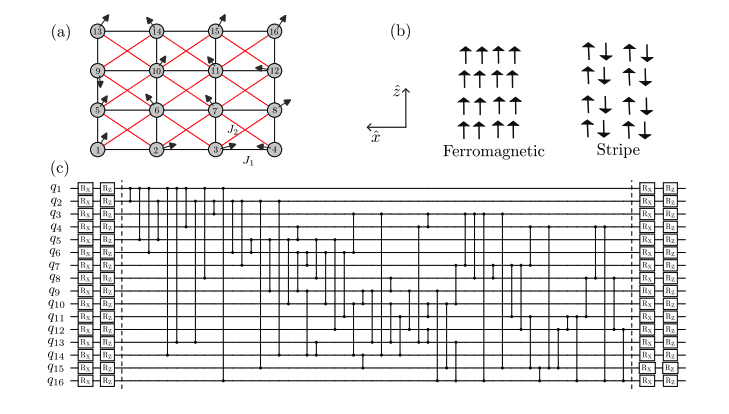
Researchers have successfully simulated a frustrated transverse-field Ising model (TFIM) using the Variational Eigensolver (VQE) algorithm on Quantinuum’s H1-1 trapped-ion quantum computer. This work demonstrates the potential of Noisy Intermediate-Scale Quantum (NISQ) devices to investigate strongly correlated systems – a computational challenge for classical methods – and opens new avenues for materials discovery. A 16-qubit model of the TFIM was implemented on the H1-1 processor, utilising periodic boundary conditions to represent a two-dimensional lattice and accurately capture the system’s behaviour.
The TFIM, characterised by competing ferromagnetic and antiferromagnetic interactions, exhibits a rich phase diagram currently under active investigation. Simulating such systems is crucial for understanding materials displaying complex magnetic properties and phase transitions, and provides insights into novel quantum phases of matter. Researchers trained VQE circuits to identify the ground state – the lowest energy configuration of the system – and meticulously validated the results against established computational methods. Comparison with exact diagonalization – a classical method providing definitive solutions for small systems – validates the VQE approach and quantifies associated errors, ensuring the reliability of the quantum simulation.
Crucially, the VQE algorithm accurately identifies the dominant magnetic phases of the frustrated model, demonstrating its capability to handle complex quantum systems. Subsequent execution of the optimised VQE circuits on the H1-1 processor, without employing error mitigation techniques, yields near-perfect recovery of these magnetic phases, confirming the robustness of the approach. This is evidenced by accurate determination of the ground-state energy, its derivative, and spin correlation functions, providing strong evidence for the fidelity of the quantum simulation. These results indicate that trapped-ion processors, like the H1-1, can reliably simulate strongly correlated systems, even within the limitations inherent to the VQE algorithm and the current generation of quantum hardware.
The ability to accurately simulate these systems could have significant implications for materials science, condensed matter physics, and the development of novel quantum technologies, and promises to accelerate the discovery of new materials with tailored properties. Error measures derived from the comparison with exact diagonalization provide a quantitative assessment of VQE’s performance and guide the development of more accurate quantum algorithms. Future work will concentrate on extending the system size to investigate finite-temperature effects and explore the emergence of more intricate phases, pushing the boundaries of quantum simulation.
👉 More information
🗞 Variational Quantum Simulations of a Two-Dimensional Frustrated Transverse-Field Ising Model on a Trapped-Ion Quantum Computer
🧠 DOI: https://doi.org/10.48550/arXiv.2505.22932


