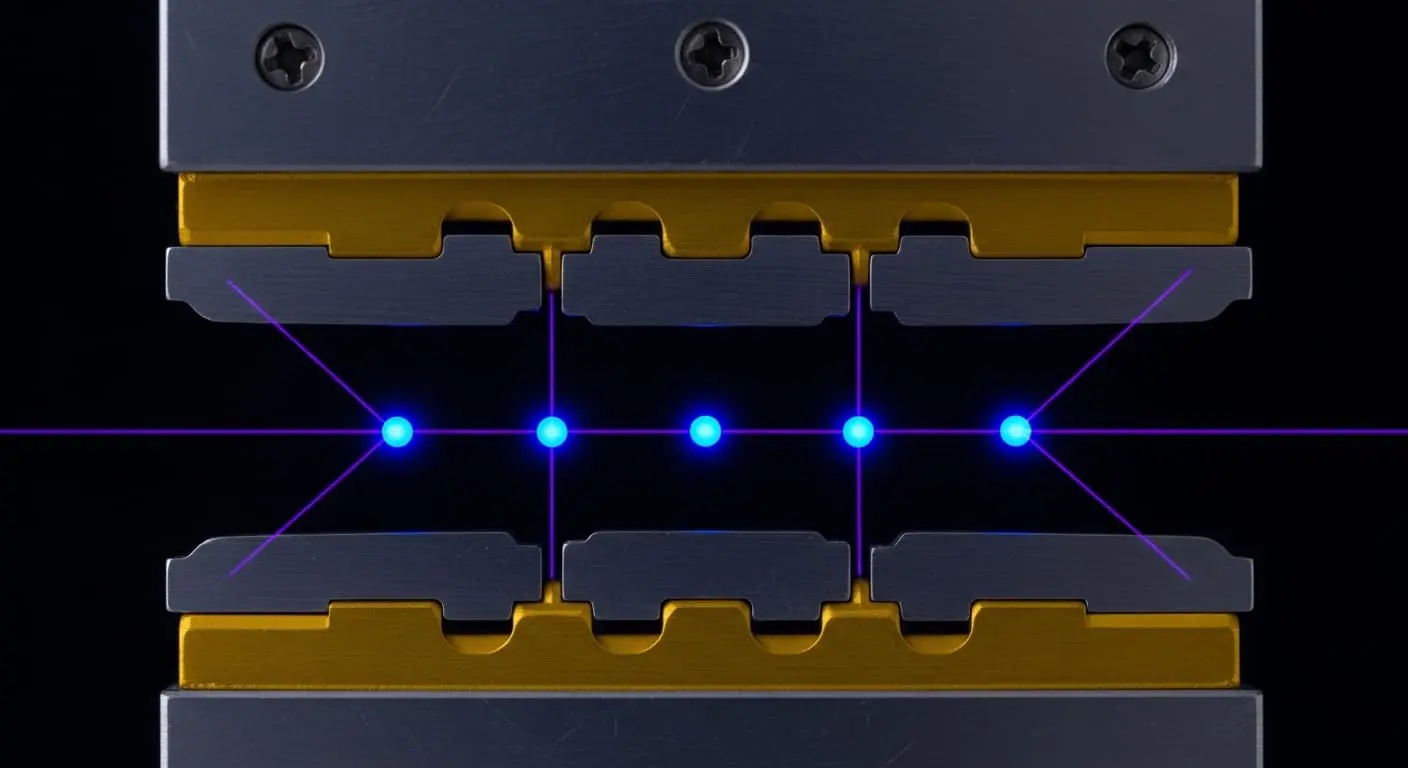
Marek Kuchař and Michal Macek at Charles University and collaborators from the Czech Academy of Sciences detail protocols for realising quantum criticality within a single trapped ion oscillating in a radio-frequency Paul trap. The work identifies specific excited states within the Extended Rabi Model, showing how these states can serve as indicators of quantum phase transitions. By mapping theoretical parameters to experimental setups and simulating realistic conditions, the research offers a pathway towards observing and characterising these transitions, potentially advancing our understanding of quantum criticality and superradiance.
Extended coherence times enable observation of excited-state quantum phase transitions in a
Motional dephasing rates, a key limitation in trapped ion experiments, have been reduced to 100 milliseconds, granting access to previously unobservable excited-state quantum phase transitions. This improvement, detailed in work scheduled for publication on March 31, 2026, opens avenues for exploring quantum criticality driven by excited-state quantum phase transitions (ESQPTs) in a single 40Ca+ ion. Prior limitations confined investigations to ground-state transitions, but this new capability expands the scope of research.
Specific excited states within the Extended Rabi Model are proposed, identifying observable characteristics to confirm these transitions and mapping theoretical parameters directly onto existing experimental setups. Simulations confirm the feasibility of these protocols, accounting for realistic experimental imperfections and unitary state evolutions. These states occur between critical ESQPT energies within the model’s superradiant phase, defining ESQPT witness observables to confirm these transitions. Altering qubit-phonon coupling strength demonstrates the feasibility of driving the system across critical points, referencing values from existing state-of-the-art setups. The team directly mapped theoretical control parameters onto experimental parameters of a trapped ion setup, enabling precise calibration and analysis; however, current simulations address unitary evolution and relevant open-system corrections, but do not yet demonstrate sustained coherence necessary for complex quantum computations.
Radio-frequency pulse shaping and the Extended Rabi Model Hamiltonian
Precise control of a trapped ion’s motion and internal state underpinned this work, with a technique involving carefully shaped radio-frequency pulses employed to manipulate the ion’s quantum state. The Extended Rabi Model (ERM) Hamiltonian, a mathematical recipe describing how a single atom interacts with light and vibrations, served as the foundation for this control. This model functions akin to a detailed instruction manual for a tiny mechanical system, allowing researchers to finely tune the interaction between the ion’s internal energy levels and its vibrational motion within the trap.
A single trapped ion oscillating within a radio-frequency Paul trap was utilised to investigate excited-state quantum phase transitions. Carefully shaped radio-frequency pulses, guided by the Extended Rabi Model Hamiltonian, manipulated the ion’s internal state during the experiments. Simulations referenced existing setups with a motional dephasing rate of 100 milliseconds, qubit dephasing of 10 milliseconds, and a motional heating rate of 3.3 per second per nth-Fock component. Focusing on a single ion created the simplest and most durable system for observing these quantum phenomena.
Inducing quantum phase transitions in a single trapped ion for demonstrably precise control
Scientists are edging closer to harnessing the subtle power of quantum criticality, potentially unlocking new technologies reliant on exquisitely controlled atomic behaviour. This work details protocols for inducing these transitions, sudden shifts in a quantum system’s properties, within the isolated environment of a single trapped ion, a promising platform for building future quantum devices. Realising quantum criticality demands exceptionally precise control, a feat notoriously difficult even in simplified systems, and this work offers a key pathway forward.
Theoretical parameters directly correspond to the capabilities of existing trapped ion technology, providing concrete instructions for experimentation. Prioritising demonstrability over scalability, this focus on a single, durable ion sidesteps many of the complexities inherent in multi-particle quantum systems, establishing a vital foundation for future, more ambitious designs. This work establishes experimentally feasible protocols for inducing and observing quantum criticality via excited-state quantum phase transitions (ESQPTs) within a single trapped ion, representing a significant advancement beyond previous ground-state investigations.
Protocols were proposed to pinpoint observable characteristics indicative of excited-state quantum phase transitions by identifying specific excited states within the Extended Rabi Model, defining several ESQPT witness observables. Demonstrating the feasibility of these protocols using existing state-of-the-art technology, the team mapped theoretical control parameters to a trapped ion setup, enabling probing of excited-state quantum criticalities. Such precision may unlock applications in quantum sensing and state manipulation.
Scientists demonstrated experimentally feasible protocols for inducing and observing quantum criticality via excited-state quantum phase transitions within a single trapped ion. This research matters because achieving precise control over quantum systems is essential for developing future quantum technologies. By focusing on a single, resilient ion, the team simplified the process of observing these transitions and defined observable characteristics to confirm their occurrence. The authors mapped theoretical parameters to existing technology, providing a pathway for experimental verification of these findings.
👉 More information
🗞 Probing excited-state quantum phase transitions with trapped cold ions
🧠 ArXiv: https://arxiv.org/abs/2603.28509