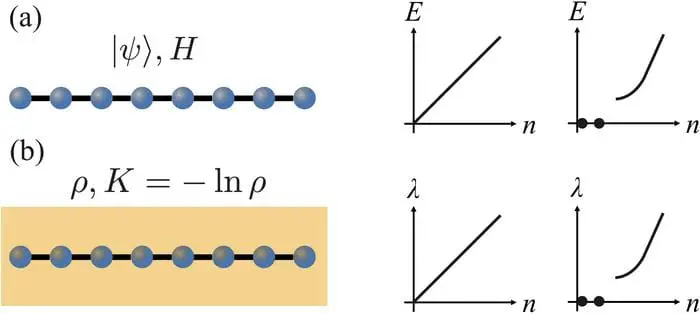
In condensed matter physics, a fundamental concept has been reinvigorated to accommodate the complexities of open quantum systems. The Lieb-Schultz-Mattis (LSM) theorem, a cornerstone of quantum magnetism and strongly correlated physics, has been generalized to encompass systems that interact with their environment, where energy conservation is no longer guaranteed.
By considering the entanglement Hamiltonian, researchers have demonstrated that the LSM theorem’s topological constraints can be extended to open quantum systems, shedding light on the behavior of entanglement in the presence of environmental interactions. This theoretical advancement, recently published in the National Science Review, has significant implications for our understanding of quantum many-body systems and paves the way for further exploration of topological physics in mixed states, with potential applications in experimental platforms such as cold atoms, trapped ions, and superconducting qubits.
Introduction to the Lieb-Schultz-Mattis Theorem
The Lieb-Schultz-Mattis (LSM) theorem is a fundamental concept in condensed matter physics, providing crucial constraints on the low-energy physics of systems based on symmetry and basic microscopic data. This theorem states that a spin chain with half-integer spin and translation and rotation symmetry cannot have a non-degenerate gapped ground state. The LSM theorem has significant implications for understanding quantum magnetism and strongly correlated physics, guiding the search for quantum spin liquids in experimental condensed matter physics.
The original LSM theorem has been extensively generalized to various scenarios, including higher dimensions, discrete symmetries, and fermionic systems. However, its applicability diminishes when considering open quantum many-body systems, where interactions with the environment lead to non-conservation of energy. This raises questions about the possibility of establishing an LSM-type theorem for open quantum systems, which is essential for understanding the behavior of entanglement in the presence of environmental interactions.
Recent research has focused on generalizing the LSM theorem to open quantum systems, considering the entanglement Hamiltonian as a key concept. The entanglement Hamiltonian is a natural approach when system-environment coupling renders the system short-range correlated. This line of inquiry is based on the idea that the LSM theorem concerns general properties such as symmetry and the Hilbert space, rather than microscopic details.
Generalization to Open Quantum Systems
The generalization of the LSM theorem to open quantum systems has been achieved by considering the entanglement Hamiltonian. In this context, the non-degenerate minimum of the entanglement spectrum cannot have a spectral gap from other states when the system-environment coupling renders the system short-range correlated. This work extends the topological constraints imposed by the LSM theorem to open quantum systems and to entanglement Hamiltonians, shedding light on the behavior of entanglement in the presence of interactions with the environment.
The conditions under which the open system LSM theorem holds have been clarified. Similar to the original LSM theorem, the system should have half-integer spin and translation and rotation symmetries. However, in open quantum systems, there are two types of symmetries: strong (similar to the canonical ensemble) and weak (similar to the grand canonical ensemble). The open system LSM theorem requires weak symmetry. Additionally, the system-bath coupling must render the system short-range correlated, which is a condition that suffices to guarantee the short-rangeness of the entanglement Hamiltonian.
The research team has used techniques from quantum information theory, such as quantum conditional mutual information, to demonstrate that this condition validates the open system LSM theorem. Numerical simulations have also been carried out to verify the open system LSM theorem, considering quantum spin ladder models that simulate the system-bath coupling and focusing on scenarios of gaplessness and degenerate ground states. The numerical results agree well with the open system LSM theorem, providing further evidence for its validity.
Implications for Quantum Simulation Platforms
The generalization of the LSM theorem to open quantum systems has significant implications for experimental platforms, including cold atoms, trapped ions, superconducting qubits, and NV centers. These platforms are developing rapidly, and system-bath coupling plays a crucial role in their operation. The open system LSM theorem provides a framework for understanding the behavior of entanglement in these systems, which is essential for the development of quantum simulation and computation technologies.
The ability to simulate and control complex quantum systems is critical for advancing our understanding of quantum phenomena and for developing new technologies. The open system LSM theorem offers a powerful tool for analyzing and predicting the behavior of these systems, taking into account the effects of environmental interactions. By providing a deeper understanding of the interplay between system-bath coupling and entanglement, this work has the potential to inform the design and operation of quantum simulation platforms.
Analytic Proof and Numerical Verification
The research team has provided an analytic proof of the open system LSM theorem, using techniques from quantum information theory to demonstrate that the condition of short-range correlation suffices to guarantee the theorem’s validity. Additionally, numerical simulations have been carried out to verify the open system LSM theorem, considering a range of scenarios and system parameters.
The combination of analytic and numerical approaches provides strong evidence for the validity of the open system LSM theorem. The analytic proof offers a rigorous demonstration of the theorem’s underlying principles, while the numerical simulations provide a practical verification of its predictions. This dual approach ensures that the results are both theoretically sound and experimentally relevant, making the open system LSM theorem a valuable tool for understanding and analyzing complex quantum systems.
External Link: Click Here For More