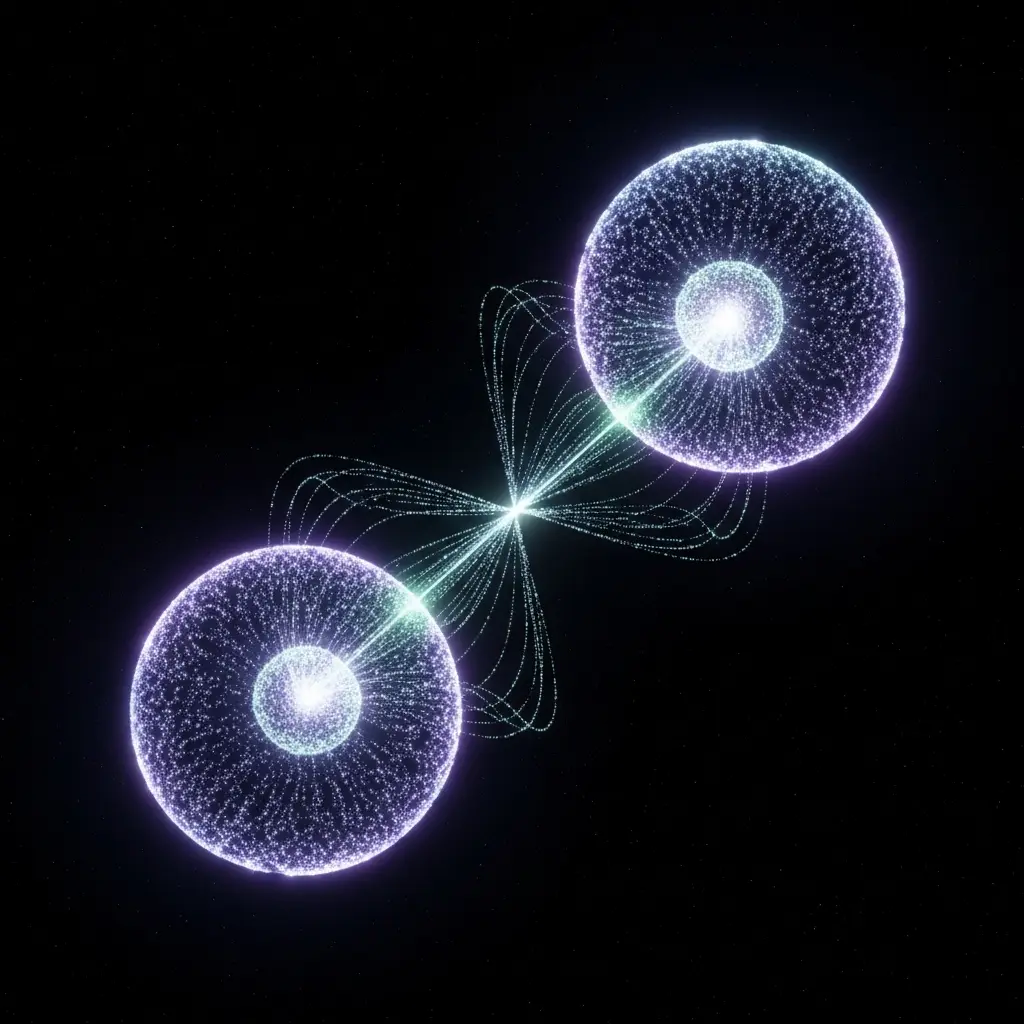
Researchers are attempting to unlock the fundamental dynamics of Loop Quantum Gravity (LQG) by breaking down complex spin network states into simpler geometrical building blocks. Mehdi Assanioussi from the National Centre for Nuclear Research, alongside Etera R Livine from Univ Lyon, Ens de Lyon, Université Claude Bernard, CNRS, Laboratoire de Physique, and colleagues, have focused on the ‘candy graph’ , a basic network of two nodes connected by multiple edges , to explore Hamiltonian dynamics. This research is significant because it provides the first analytical solutions for LQG evolution on such a simplified structure, revealing oscillatory and divergent modes reminiscent of bouncing cosmological trajectories. By demonstrating these behaviours on a single loop, the team establishes a crucial template for investigating the dynamics of more complex spin network architectures and furthering our understanding of quantum gravity itself.
Providing analytical solutions to this evolution equation, they identified distinct oscillatory modes, representing bounded behaviours, and divergent modes, reminiscent of trajectories observed in bouncing cosmological models. By focusing on the dynamics of this simplified candy graph model, scientists can identify basic dynamical building blocks and investigate their behaviour in both decoupled and coupled regimes. This approach offers a pathway to systematically analyse the Hamiltonian dynamics, crucial for understanding the phase diagram of possible Planck-scale dynamics and ultimately, the consistency of LQG. Furthermore, the inclusion of a boundary in the candy graph model allows for the study of boundary data effects on bulk dynamics, which is vital for investigating the holographic properties of the theory and the propagation between bulk and boundary states. The team envisions this candy graph as a fundamental template, analogous to the harmonic oscillator in quantum field theory, serving as a proof-of-concept for the basic dynamical mechanisms within LQG.
Candy Graph Hamiltonian Dynamics in LQG
This elementary configuration allows for curvature development around the bulk loops and accommodates both non-trivial boundary data and dynamics on the open edges. In the canonical approach, researchers followed the Dirac prescription, attempting to define a quantum operator acting within the Hilbert or diffeomorphism spaces. The study considered a specific graph-preserving prescription to define the Hamiltonian, beginning with the scalar constraint in Ashtekar-Barbero variables given as H(N) = 1 2κβ2 Z Σ d3x N(x) εijkEa i (x)Eb j(x)F k ab(x) p | det E(x)| + 1 −sβ2 p | det E(x)| R(x). The integral over Σ was regularized via a Riemannian sum over a partition C comprised of cells ∆, evaluating the lapse N(x) at points x∆ within each cell.
Densitized triads were replaced by fluxes, and the curvature of the connection was approximated by holonomies along closed loops αIJ(∆). The partition was then adapted to the chosen graph, matching cells to vertices and splitting cell boundaries into surfaces dual to the graph’s edges. Holonomies and fluxes were restricted to those specified by the graph and its dual partition, with closed loops matching preexisting loops on the graph, specifically the smallest loops involving pairs of edges at each vertex. This resulted in a Hamiltonian action coupling holonomies in a fixed representation to those preexisting in the state, without altering the graph’s structure. For a given graph Γ, the regularized Hamiltonian functional took the form H(N) = 1 2κβ2X v∈Γ N(v) CE(v) + (1 −sβ2)CL(v), where CE and CL represent the Euclidean and Lorentzian parts respectively. These parts were further defined by equations (5), (6), and (7) involving holonomies, fluxes, dihedral angles, and the inverse volume operator.
Candy Graph Dynamics Reveal Area Evolution Modes
The team measured analytical solutions to these evolution equations, identifying two distinct modes of behaviour. Oscillatory modes, representing bounded states, were observed alongside divergent modes, exhibiting behaviour akin to bouncing cosmological trajectories. This work establishes a foundational model, analogous to the harmonic oscillator in quantum field theory, for exploring the fundamental building blocks of LQG. Results demonstrate that the classical dynamics were successfully solved using a polynomial, gauge-invariant Hamiltonian derived from the discretization of general relativity’s Hamiltonian constraint.
Tests prove the identification of bounded and accelerating modes under fixed geometry boundary conditions, highlighting their relevance to the renormalization flow within LQG. Scientists recorded forced evolution scenarios with varying boundary conditions, opening possibilities for incorporating non-trivial boundary dynamics into the model. Measurements confirm the existence of oscillatory modes, which are considered the bounded modes of the system, and accelerating modes that grow and eventually diverge, mirroring cosmological solutions. The breakthrough delivers a crucial template for generalizing these solutions to more elaborate spin network states. This study represents a solid first step towards understanding the phase diagram of Planck-scale dynamics of spin networks.
🗞 Elementary blocks of Loop Quantum Gravity
🧠 ArXiv: https://arxiv.org/abs/2601.21644
A major technical hurdle in this approach involves the correct definition of the diffeomorphism invariant quantum constraint operator. The initial quantization procedures often struggle with ordering ambiguities, especially when applying the Dirac prescription to non-linear field theories. Researchers must rigorously define the action of these constraints on the physical Hilbert space, ensuring that the resulting quantum dynamics maintain background independence, a hallmark requirement for any viable quantum gravity candidate.
Furthermore, the quantization procedure naturally introduces discreteness, suggesting that geometric operators, such as area and volume, have discrete eigenvalues. The analysis of the candy graph dynamics must therefore reconcile the continuous parameters used in the Hamiltonian formalism with the fundamental discrete nature emerging from the underlying spin network calculus. This tension between classical continuum limits and quantum discreteness remains a core theoretical challenge.
The identification of the effective Hamiltonian operator on the restricted subspace of the graph model provides crucial insight into the physical content of the quantum evolution. Understanding how the graph structure governs the relationships between fluxes and connections allows for the systematic computation of effective couplings. This mapping is vital for translating the abstract mathematical structure into tangible, observable predictions regarding spacetime foam at the Planck scale.
Beyond merely solving the constraint, the next frontier involves coupling the dynamics to matter fields. Integrating fermionic or bosonic degrees of freedom requires extending the Hamiltonian formulation to include matter source terms, thereby linking the geometric evolution prescribed by LQG to the particle physics sector. This comprehensive treatment is necessary to achieve a complete, self-consistent description of quantum gravity.