

The pursuit of more efficient neural networks continues to drive innovation in machine learning, with recent attention focused on architectures that minimise computational demands without sacrificing representational power. Kolmogorov Arnold Networks (KANs), leveraging the Kolmogorov Arnold representation theorem, offer a potentially advantageous approach by shifting learnable parameters from network nodes to edges. Researchers at RPTU Kaiserslautern-Landau and the German Research Center for Artificial Intelligence (DFKI) now present a novel implementation of KANs utilising a Quantum Circuit Born Machine (QCBM) approach, detailed in their article, ‘QuKAN: A Quantum Circuit Born Machine approach to Quantum Kolmogorov Arnold Networks’. Yannick Werner, Akash Malemath, Nikolaos Palaiodimopoulos, and Paul Lukowicz, all from the Department of Computer Science and Research Initiative QC-AI at RPTU Kaiserslautern-Landau, collaborated with Mengxi Liu and Vitor Fortes Rey from DFKI’s Embedded Intelligence group, alongside Maximilian Kiefer-Emmanouilidis from RPTU’s Department of Physics, to explore both hybrid and fully quantum implementations of these networks, demonstrating feasibility and performance gains through the adaptation of pre-trained residual functions within parametrised quantum circuits.
This work details the successful implementation of Kolmogorov-Arnold Networks (KANs) within both hybrid and fully quantum circuit models, termed QuKAN. KANs, founded on the Kolmogorov-Arnold representation theorem, offer a potentially more efficient function representation by parameterising connections rather than nodes, a departure from conventional Multi-Layer Perceptrons (MLPs). The research adapts KAN transfer learning through the utilisation of pre-trained residual functions, effectively harnessing the representational capabilities of parametrised quantum circuits.
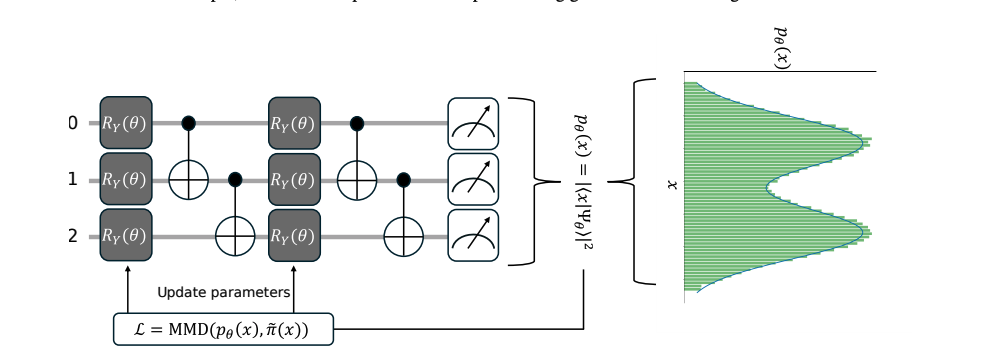
Kolmogorov-Arnold Networks (KANs) represent a distinct approach to neural network architecture, leveraging the Kolmogorov-Arnold representation theorem to achieve function approximation with potentially fewer parameters than traditional MLPs. Unlike MLPs which assign learnable weights to nodes, KANs implement these parameters on the edges, offering an alternative pathway to represent complex relationships. This work details the implementation of both hybrid and fully quantum KAN (QuKAN) architectures utilising a Circuit Born Machine (CBM) approach, demonstrating the feasibility of integrating KAN principles with quantum computation. A Circuit Born Machine is a type of parametrised quantum circuit designed for machine learning tasks, where the circuit parameters are optimised to perform a specific function.
Researchers successfully constructed and trained QuKAN architectures, demonstrating
Researchers successfully constructed and trained QuKAN architectures, demonstrating the feasibility of mapping KAN structures onto quantum hardware and providing a pathway for leveraging quantum parallelism. The hybrid model integrates classical KAN components with quantum subroutines, while the fully quantum version translates the entire residual function architecture into a quantum circuit. Residual functions, in this context, represent the difference between the desired output and the current prediction of the network, allowing for more efficient learning of complex functions.
The study demonstrates the feasibility of constructing and training QuKAN architectures, evaluating performance through benchmark datasets and showcasing the network’s ability to learn and generalise effectively. Furthermore, the research highlights the interpretability of the proposed architecture, a crucial aspect for understanding the decision-making process of complex machine learning models. The use of pre-trained residual functions contributes to this interpretability by providing a known starting point for the learning process, simplifying analysis and validation.
The findings suggest that QuKANs offer a viable alternative to conventional neural networks, particularly in scenarios where model size and interpretability are paramount, providing a pathway for developing more transparent and understandable machine learning models. By combining the strengths of KANs with the potential advantages of quantum computation, this work contributes to the growing field of quantum machine learning and opens avenues for further investigation into the design of efficient and understandable quantum algorithms.
Researchers are currently exploring several avenues for future work, including optimizing the quantum circuit design for improved performance and scalability, and investigating the application of QuKANs to more complex datasets and machine learning tasks. They are also working on developing techniques for visualizing and interpreting the learned representations within the quantum circuits, gaining a deeper understanding of the underlying mechanisms that drive the performance of QuKANs. Furthermore, they plan to explore the potential of combining QuKANs with other quantum machine learning algorithms, creating hybrid models that leverage the strengths of different approaches.
The successful implementation of QuKANs demonstrates the potential
The successful implementation of QuKANs demonstrates the potential of quantum machine learning to address challenging problems in various fields, paving the way for the development of more powerful and efficient machine learning algorithms. By combining the strengths of KANs with the unique capabilities of quantum computation, this work opens up new possibilities for tackling complex data analysis and pattern recognition tasks, driving innovation in areas such as artificial intelligence, data science, and beyond. The research team is committed to continuing their exploration of quantum machine learning, pushing the boundaries of what is possible with this exciting new technology.
🗞 QuKAN: A Quantum Circuit Born Machine approach to Quantum Kolmogorov Arnold Networks
🧠 DOI: https://doi.org/10.48550/arXiv.2506.22340


