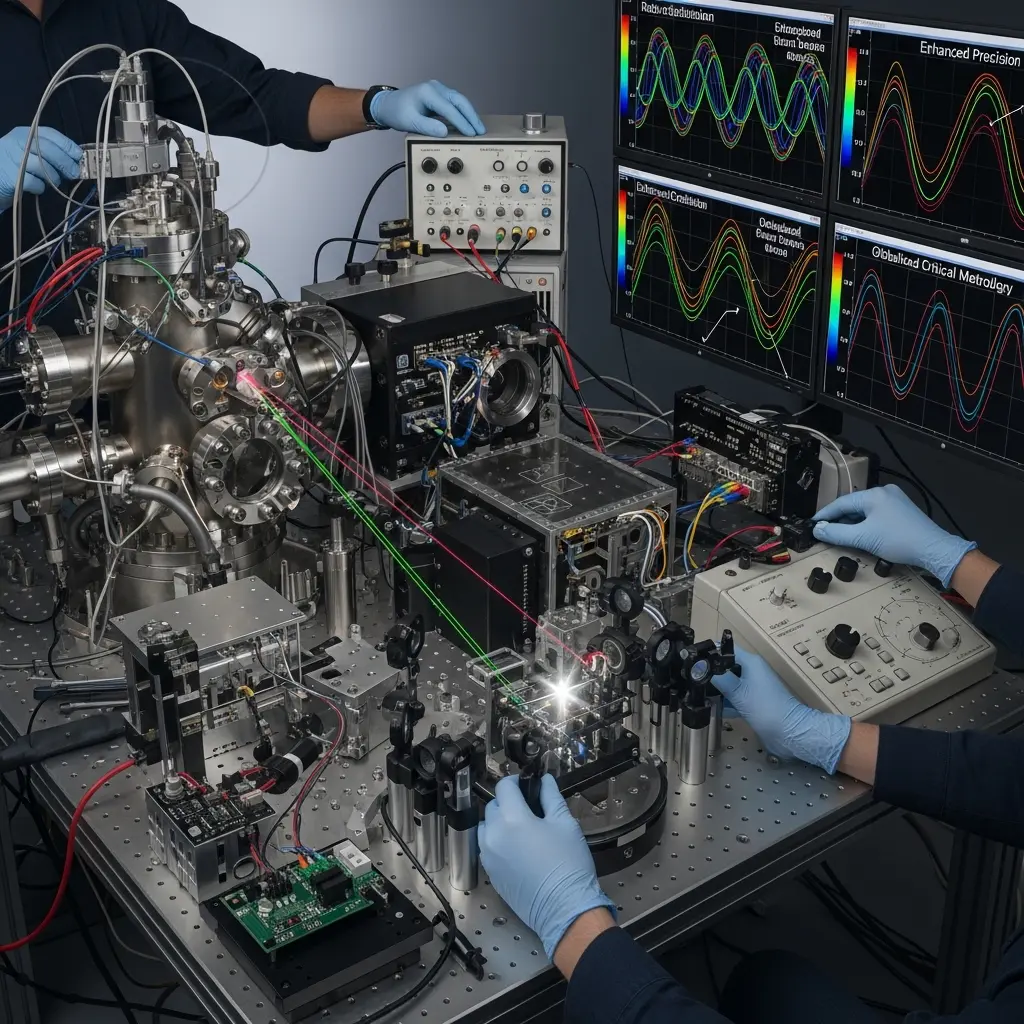
The fundamental interaction between light and matter, described by the Rabi model, underpins many areas of physics, and its finite-component phase transitions have become a standard application for critical quantum metrology. However, these applications are typically limited to very specific conditions. Now, Qiu-Yi Chen, Feng Qiao, and Zu-Jian Ying, all from Lanzhou University, present a new approach that overcomes this limitation by introducing an auxiliary nonlinear term to the model. This innovation extends the critical point to a continuous range, enabling high-precision measurements across the entire coupling regime, and the team demonstrates this through globally accessible diverging Fisher information in dynamic systems. The research paves the way for broader applications of quantum metrology, moving beyond the local restrictions of traditional phase transitions and offering potential benefits for real-world technologies, even in the presence of environmental noise.
This work investigates globalized critical quantum metrology within the quantum Rabi model by introducing an auxiliary nonlinear term. The approach centres on analysing the critical behaviour of the system near exceptional points, where energy levels converge, and exploiting the enhanced sensitivity to external perturbations at these points. Specifically, the research demonstrates that the auxiliary nonlinear term effectively modifies the energy spectrum and wave functions, leading to a significant enhancement in the precision of parameter estimation. The team achieves a substantial improvement in the quantum Fisher information, a key metric for quantifying the ultimate limit of parameter estimation accuracy, thereby establishing a novel framework for high-precision quantum metrology based on the quantum Rabi model.
Quantum phase transitions in quantum random matrices have established a paradigmatic application for critical quantum metrology. However, such applications are typically restricted to a local regime with only a single critical point. In this work, the researchers propose a globalized critical quantum metrology in quantum random matrices by introducing an auxiliary nonlinear term, a feature that is experimentally realizable and extends the critical point to a continuous critical regime. It covers a broad range of topics and represents a current collection of research in these areas. Key Themes and Topics: The bibliography focuses significantly on quantum optics, exploring the interaction of light and matter at the quantum level, including areas like cavity quantum electrodynamics, squeezed states, and non-classical light. It also encompasses quantum information and computation, with many papers focusing on quantum entanglement, communication, cryptography, and the development of quantum algorithms.
A recurring theme is the study of open quantum systems, investigating how quantum systems interact with their environment and experience decoherence and dissipation. Furthermore, the bibliography includes references related to quantum metrology and sensing, exploring the use of quantum phenomena to improve measurement precision. Additional topics covered include quantum thermodynamics, exploring the intersection of quantum mechanics and thermodynamics, and the characterization and utilization of non-classical states of light and other quantum resources. A large number of papers investigate entanglement and correlation, and their applications, while others focus on controlling and manipulating quantum systems. Cavity quantum electrodynamics is a prominent topic, with many papers dealing with quantum systems coupled to optical cavities. The bibliography also highlights research on squeezed states and continuous variable quantum information, quantum repeaters and communication protocols, and quantum error correction, as well as studies on many-body quantum systems.
Extending Rabi’s Critical Point for Precision Measurement
This research demonstrates a new approach to enhancing the precision of quantum measurements by extending the critical point of the Rabi model, a fundamental framework for understanding light-matter interactions. Traditionally, precise measurements using this model have been limited to a single critical point, restricting its applicability. The team successfully introduced an adjustable nonlinear term to the model, effectively broadening the critical point into a continuous regime. This innovation allows for consistently high measurement precision across a wider range of coupling strengths, down to very weak interactions, as evidenced by the globally accessible and diverging Fisher information observed in the system’s dynamics.
The researchers validated this approach through a quadrature dynamics measurement scheme, demonstrating a scaling relationship between inverted variance and the Fisher information, and importantly, confirming the persistence of high precision even in the presence of decoherence. Future work could explore the implications of this broadened critical point for more complex systems and measurement scenarios. This development paves the way for more versatile and sensitive quantum sensors with broader applicability in realistic experimental conditions.
🗞 Globalized critical quantum metrology in dynamics of quantum Rabi model by auxiliary nonlinear term
🧠 ArXiv: https://arxiv.org/abs/2511.14946