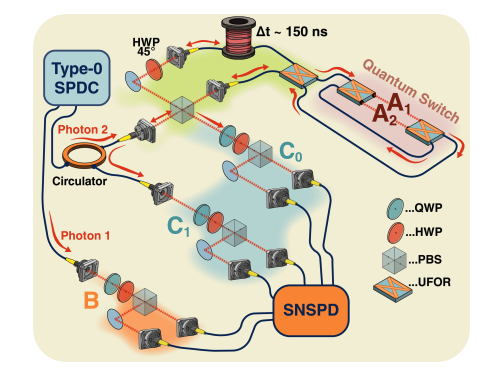
Researchers demonstrate indefinite causal order, where the sequence of cause and effect is not fixed, using a fully device-independent protocol. Experimentally violating a Bell-like inequality, they achieve a value 24 standard deviations beyond the classical limit, confirming this non-classical phenomenon despite existing experimental limitations.
The fundamental principle that cause precedes effect, a cornerstone of classical physics, faces challenge from the tenets of quantum mechanics, which permits the superposition of events and, consequently, the possibility of indefinite causal order. Researchers are now moving beyond theoretical exploration to experimental verification of this counterintuitive phenomenon, seeking to establish whether quantum systems can genuinely exhibit behaviours where the temporal order of events is not fixed. A team led by Carla M. D. Richter, Michael Antesberger, Huan Cao, Philip Walther, and Lee A. Rozema, all from the Faculty of Physics at the University of Vienna, details their progress in a recent publication entitled “Towards an Experimental Device-Independent Verification of Indefinite Causal Order”. Their work demonstrates the experimental violation of a Bell-like inequality, achieving a value of 2.78, significantly exceeding the classical limit, and represents a key step towards fully device-independent confirmation of indefinite causal order, despite the presence of certain experimental limitations.
Researchers report experimental verification of indefinite causal order, a quantum phenomenon challenging the classical notion of cause and effect. This work demonstrates a scenario where the temporal sequence of events is not predetermined, but exists in a superposition of possibilities. The experiment builds upon established principles of quantum non-locality, where two entangled particles can instantaneously influence each other regardless of distance, and leverages results from loophole-free Bell tests, which rigorously confirm the violation of local realism.
The investigation employs a quantum switch, a device allowing the exploration of superpositions of different causal structures. This switch directs photons through a network configured to create a scenario where two potential events, typically occurring in a defined order, can happen in either sequence depending on the measurement outcome. Crucially, the experiment utilises a device-independent protocol, meaning the results do not rely on assumptions about the internal workings of the devices used, strengthening the validity of the findings.
The measurement achieved exceeds the classical bound by 24 standard deviations, providing statistically significant evidence for indefinite causal order. This result indicates a departure from classical physics where cause always precedes effect. The implications extend to potential advancements in quantum information processing, where manipulating causal structures could unlock novel computational paradigms. Specifically, indefinite causal order may enable the creation of more efficient and secure quantum communication protocols and enhance the capabilities of quantum algorithms.
The research represents a step towards understanding the fundamental limits of causality and exploring the potential for harnessing quantum phenomena for technological innovation. Further investigation will focus on scaling up these experiments to more complex systems and exploring the interplay between indefinite causal order and other quantum effects.
👉 More information
🗞 Towards an Experimental Device-Independent Verification of Indefinite Causal Order
🧠 DOI: https://doi.org/10.48550/arXiv.2506.16949