

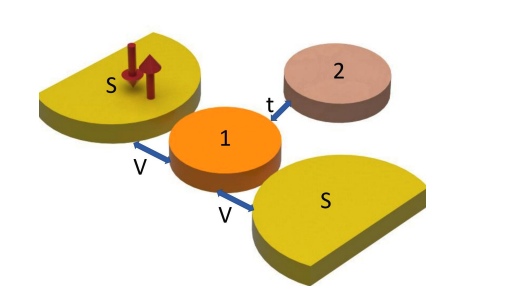
The precise manipulation of quantum states holds considerable promise for advancements in quantum computing and novel electronic devices. Researchers are increasingly focused on hybrid systems, combining semiconducting quantum dots with superconducting circuits to engineer and control these states. A team led by Cong Li, Yiyan Wang, and Bing Dong, all from the Key Laboratory of Artificial Structures and Quantum Control at Shanghai Jiaotong University, present detailed analysis of such a system in their article, ‘Controlling the quantum phase transition in a double quantum dot Josephson junction via interactions’. Their work utilises a surrogate BCS model, a theoretical framework borrowed from superconductivity, to investigate a double quantum dot system, revealing a complex phase diagram and demonstrating the potential for precise control over quantum phase transitions and non-local magnetisation through parameter tuning and external magnetic fields. The team’s numerical solutions, obtained via exact diagonalisation, provide rigorous insights into the behaviour of these nanoscale devices.
Investigations into the behaviour of coupled quantum dots, nanoscale semiconductors exhibiting quantum mechanical properties, reveal a sophisticated level of control over their collective quantum state. Researchers employ exact diagonalization, a computationally intensive method providing numerically precise solutions, to map the system’s complex phase diagram and identify multiple, controllable phase transitions. These transitions arise from alterations in the interactions between the dots, offering a pathway to manipulate the system’s properties and potentially enabling advanced device design.
The system demonstrates a layered response to external control. A phase transition occurs when the interaction strength within a secondary quantum dot adjusts, while the primary dot remains non-interacting. Subsequent modulation of the primary dot’s interaction induces a further transition, followed by a third transition arising from the coupling between the dots themselves. This sequential control highlights the system’s potential for fine-tuned manipulation and offers possibilities for creating novel quantum devices with tailored properties. The ability to independently control each dot’s interaction and the coupling between them provides a versatile platform for exploring complex quantum phenomena and designing advanced materials.
Application of a parallel magnetic field further expands
Application of a parallel magnetic field further expands the system’s controllability, inducing reversible transitions between ferromagnetic and antiferromagnetic states. This magnetic control, combined with the interaction-driven phase transitions, suggests possibilities for creating novel spintronic devices, which utilise the spin of electrons to store and process information, and opens avenues for developing energy-efficient and high-performance electronic components. Researchers anticipate that this combination of electrical and magnetic control will enable the creation of devices with unprecedented functionality and performance.
Researchers reveal the emergence of non-local magnetization phenomena when a weak magnetic field applies to the first quantum dot. This demonstrates that the magnetization state of one dot influences the properties of the other, offering a route to create interconnected quantum systems. This observation is significant as it demonstrates a fundamental aspect of quantum entanglement, where two or more particles become linked and share the same fate, and opens possibilities for creating quantum networks and distributed quantum computing architectures.
Precise control over the orientation of this non-local magnetization achieves adjustment to the on-site interaction strength in the secondary quantum dot, solidifying the potential for targeted manipulation of quantum states. This demonstrates a high degree of control over the quantum behaviour of coupled quantum dots and enables the creation of complex quantum states and the implementation of advanced quantum algorithms. The ability to manipulate quantum states with such precision represents a significant advancement in the field of quantum information science.
Researchers explore the practical implications of these findings
Researchers explore the practical implications of these findings and extend the control mechanisms to more complex quantum architectures, aiming to translate these fundamental discoveries into practical applications. These include quantum sensors, quantum communication devices, and advanced materials with tailored properties. They anticipate that this research will contribute to the development of a new generation of quantum technologies, promising to unlock new possibilities in quantum computing, communication, and sensing, paving the way for a future where quantum technologies play a central role in our lives.
🗞 Controlling the quantum phase transition in a double quantum dot Josephson junction via interactions
🧠 DOI: https://doi.org/10.48550/arXiv.2506.23636


