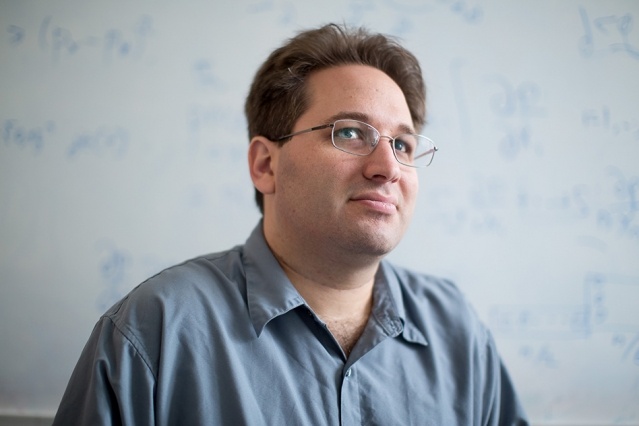
Scott Aaronson is a legend amongst the Quantum Computing luminaries. Known for his no-bulls**t approach to talking about Quantum Computing, Scott is one of the brightest minds actively researching the field and his focus is often on the question as to whether Quantum Computing can actually give a computational speed-up. That is not to say the Scott is sceptical – he simply wants to put Quantum Computing on a firm footing.
Scott writes an amazingly frank blog about Quantum computing and intellectually he pulls no punches. The blog covers the latest developments on Quantum Computing. So it comes as no surprise that he has written a book on Quantum Computing. A rather quirky title might sound off-putting, but Scott Joel Aaronson is a theoretical computer scientist and David J. Bruton Jr. Centennial Professor of Computer Science at the University of Texas at Austin – that means he delves into the complex maths to understand whether Quantum algorithms can actually do anything useful, beyond produce well behaved random numbers! Scott is a prodigiously gifted writer and he writes a lot! His blog posts are exceptionally well constructed and well thought out (we only wish we had more time to read them).
Back to the Book – which is really about some of the fundamental questions in Quantum Computing and mathematics. Its easier to state what it is not, and that is a book about practical applications (if you want one to be applied – check out Jack Hidary or Robert Suitor).
Despite being a challenging book, there is not much required to pick up and read – simply dedication and motivation. Most topics and chapters are easily readable as Scott introduces the background required. Sure it requires some basic maths such as matrices, and some basic concepts but not much else is required apart from the patience to read it. The books covers so many topics (Time Travel, Paleo-complexity, Randomness, Free Will…) you’ll end up learning so much from this book – especially the deep thinking approach from Scott.


In summary
- PRO. Great philosophical and mathematical introduction to some of the difficult concepts and fundamental issues in Quantum Computing.
- PRO. You’ll learn a lot about complexity and the fundamentals of what QC might achieve or not achieve.
- PRO. Well written, interesting and insightful.
- CON. Not an easy read – requires dedication and concepts maybe complex to grasp for beginners.
- CON. Not a practical guide. You might understand the why, but you may not understand how to implement any quantum circuits.
If you want to understand why Quantum Computing might work and why certain algorithms might lead to a speed up that could lead accelerate certain computations, then this is a great book to cement your complexity understanding. It’s the answer to “why”, where-as many books are the answer to “how”.