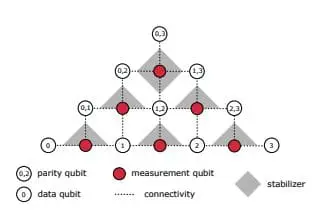
Scientists at Parity Quantum Computing GmbH and the University of Innsbruck have developed a fault-tolerant universal quantum computing architecture. The architecture uses a combination of noise-biased qubits and the parity architecture, which allows for the suppression of errors and can be adjusted to algorithmic requirements on-the-fly. This approach enables codes with less physical qubit overhead compared to the repetition code while requiring only weight-3 and weight-4 stabilizers and nearest neighbor 2D square-lattice connectivity. The team believes this could bring fault-tolerant quantum computation into reach for near-term application.
Quantum Computing: The Parity Code and Noise-Biased Qubits
Quantum computing, a field that aims to develop computers capable of solving real-world problems that are classically intractable, faces a significant challenge: quantum bits, or qubits, are inherently affected by noise. This noise limits the complexity of the quantum algorithms that can be performed. To overcome this, the concepts of fault-tolerance in quantum computation are indispensable. In fault-tolerant quantum computation, the quantum state is redundantly encoded in an error-correction code, and fault-tolerant quantum operations are performed on the encoded quantum state.
The Parity Code: An Efficient Approach to Fault-Tolerant Quantum Computing
The parity code, in combination with noise-biased qubits, offers a promising approach to fault-tolerant quantum computation. The parity code allows for error-correction of one type of error (e.g., bit flips) and code deformation on a platform with only nearest-neighbor interaction on a 2D grid. It also exhibits a high encoding rate compared to the repetition code.
The parity code can be understood as a particular variant of Low-Density Parity-Check (LDPC) code, which extends beyond pure error-correcting capabilities, bringing in powerful and flexible tools for logical gates and compact encodings.
Logical Operations and the Parity Code
Logical operations can be defined within the parity code. The logical Pauli-Z operator can be defined as the product of operators on a set of physical qubits whose parity combines to the desired logical index. The logical Pauli-X operator can be obtained from the product of physical Pauli-X operators on all qubits whose index contains the logical qubit. In other words, all qubits which contain information about the logical qubit, either as a data qubit or as a parity qubit, are flipped.
Implementing Logical Gates with the Parity Code
The parity code allows for the implementation of logical gates on a two-dimensional chip layout using the concepts of code deformation. An efficient and parallelizable implementation of the controlled-Z-gate is introduced alongside a set of universal logical gates. The parity code thus allows for parallelization beyond the capabilities of known error-correction codes of similar type.
The Parity Code: A Promising Candidate for Early Realizations of Fully Fault-Tolerant Quantum Algorithms
The parity code, in combination with noise-biased qubits, is a promising candidate for early realizations of fully fault-tolerant quantum algorithms of practical use. The parity code has a higher encoding rate (for a certain code distance), and the qubit overhead compared to the repetition code is reduced by a factor of approximately 2 in the limit of large numbers of logical qubits.
However, a more thorough comparison of the error-correcting capabilities is needed, as good error correction depends on many aspects beyond the code distance and the encoding rate. Future research could investigate decoding strategies for syndrome measurements in more detail.
External Link: Click Here For More