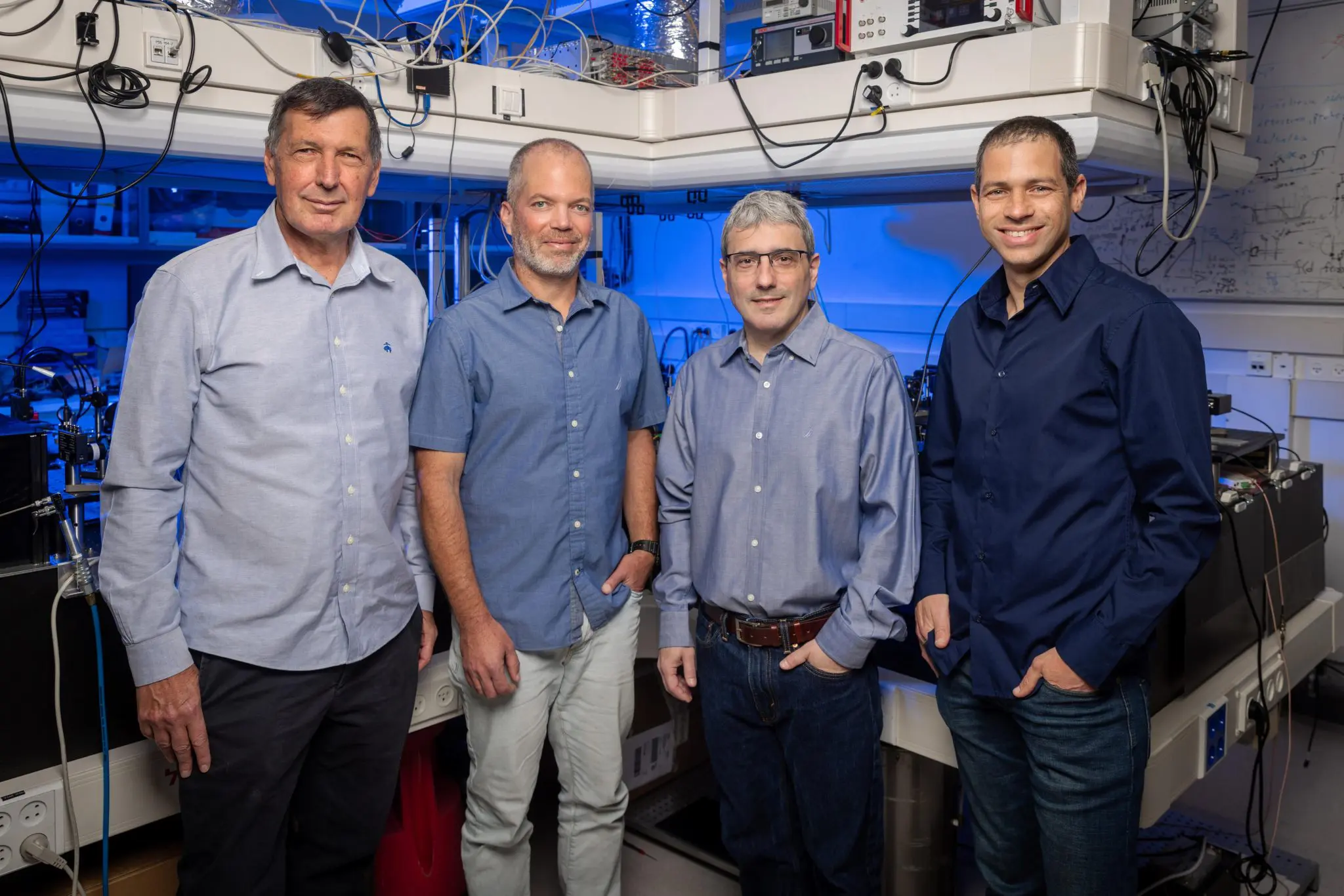
Intel Capital has invested in Q-Factor, a quantum computing company aiming to build a million-qubit computer using neutral atom technology. Founded by physicists from the Weizmann Institute and the Technion, Israel Institute of Technology, Q-Factor secured $24 million in seed funding led by NFX and TPY Capital, alongside grants from the Israel Innovation Authority. The company intends to overcome limitations hindering current quantum computers, which remain too small to provide practical commercial value; Q-Factor’s approach focuses on scaling beyond the few thousand qubits currently achievable. “The quantum computing industry needs a substantial change, not just incremental improvements,” said Prof. Ofer Firstenberg, Q-Factor’s co-founder and chief scientist, asserting that incremental improvements will not bridge the gap to useful computation.
Neutral Atom Architecture Targets Million-Qubit Scalability
Q-Factor has secured $24 million in seed funding to pursue an ambitious goal: building a quantum computer capable of exceeding one million qubits. Unlike superconducting or trapped ion approaches, neutral atoms offer inherent advantages in coherence and control, utilizing light-based manipulation rather than relying on extreme cooling or intricate wiring. Despite these benefits, existing neutral atom platforms struggle to scale beyond a few thousand qubits, a critical barrier to achieving practical quantum computation. The founders of Q-Factor identified specific architectural bottlenecks preventing substantial increases in qubit count, leading them to develop a novel approach designed for continuous scalability. This is not simply about incremental improvements to existing designs; the team believes a fundamental shift is necessary to realize the full potential of quantum computing.
Ofer Firstenberg, co-founder and chief scientist of Q-Factor, explained, “Current systems are too small to deliver on the promise of quantum computing, and incremental improvements alone aren’t going to close that gap. We’ve developed an architecture designed for continuous scalability, a trajectory that can take neutral atom systems from thousands of qubits to millions and beyond.” The company’s foundation rests on decades of research in ultracold atoms, Rydberg physics, and atom transport, spearheaded by a team of accomplished scientists. Prof. Nir Davidson, former dean of physics at the Weizmann Institute, and Prof. Yoav Sagi of the Technion, alongside Dr. Guy Raz, a seasoned technical leader, contribute a unique blend of scientific expertise and commercial acumen.
Investors recognize this strength; Gigi Levy-Weiss, partner at NFX, noted that it is rare to find a team with this combination of scientific authority and commercial instinct, while Dekel Persi, partner at TPY Capital, highlighted Q-Factor’s “distinct architectural advantage” within the emerging field of scalable quantum computing. Lisa Cohen, Investment Director at Intel Capital, added, “Q-Factor’s founding team combines scientific depth with a clear understanding of what it will take to build a commercially viable quantum computer.”
$24M Seed Funding Backs Weizmann-Technion Quantum Team
While neutral atoms offer advantages like long coherence times and precise control via light, existing platforms struggle to expand beyond a few thousand qubits, falling far short of the millions needed for practical applications. The Technion and Weizmann Institute, along with Yeda, the Weizmann Institute’s technology transfer arm, are shareholders, reflecting the origins of this venture in decades of foundational research. The core of Q-Factor’s approach lies in a fundamental architectural redesign intended to bypass the bottlenecks preventing current neutral atom systems from scaling; the founders identified specific limitations that have historically constrained qubit counts, and have developed a path toward exceeding one million qubits. Yoav Sagi of the Technion is an expert in neutral-atom manipulation, and Dr. Guy Raz is a physicist with two decades of experience in deep tech ventures. Four Talpiot graduates with hundreds of published papers in the fields directly underlying this technology, and experience bringing deep science to market, are uniquely positioned to execute one of the most ambitious goals in quantum computing.
TPY has been investing in quantum computing for seven years and has evaluated dozens of companies across modalities and geographies. What the Q-Factor team achieved stood out immediately. Their architectural approach to scale made this a clear must-do for us.
Dekel Persi, partner at TPY Capital
Source: https://www.intel.com