

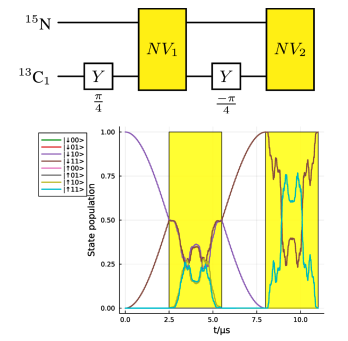
Researchers develop an algorithm utilising algebraic circuit decomposition to optimise control gates for quantum processors with star-shaped topologies. Numerical simulations demonstrate successful implementation of these circuits on a nitrogen-vacancy centre in diamond, coupled with surrounding nuclear spins, paving the way for advanced quantum computation.
The development of scalable quantum processors necessitates innovative approaches to circuit design and implementation, particularly as systems move beyond theoretical models and towards practical realisation. Researchers are increasingly focused on translating abstract quantum algorithms into physical operations achievable on specific hardware architectures. A team at Forschungszentrum Jülich, comprising Yaqing X. Wang, Tommaso Calarco, Felix Motzoi, and Matthias M. Müller, addresses this challenge in their work, “Circuit Design for a Star-shaped Spin-Qubit Processor via Algebraic Decomposition and Optimal Control”. They present a novel algorithm utilising algebraic circuit decomposition, tailored for optimal-control gates on processors with star-shaped topologies, and demonstrate its potential application to a nitrogen-vacancy centre in diamond coupled with surrounding nuclear spins. This approach offers a pathway towards more efficient and practical implementation of quantum computations on emerging hardware.
Quantum circuit decomposition optimises the application of quantum gates for specific physical systems, delivering a functional algorithm that enables tailored implementation of optimal-control gates. This research addresses the practical challenge of translating abstract quantum circuits into device-specific gate implementations, particularly for systems exhibiting star-shaped topologies, and represents a step towards practical quantum computation by bridging the gap between theoretical algorithms and physical realisation. Researchers validate the algorithm through numerical simulations utilising a nitrogen-vacancy (NV) centre in diamond, coupled with surrounding nuclear spins, establishing a robust testbed due to the NV centre’s well-established properties as a qubit and the potential for scalable quantum control via its interaction with nuclear spins.
This study highlights the importance of circuit decomposition
This study highlights the importance of circuit decomposition in translating theoretical quantum algorithms into physical implementations, optimising circuits for a given hardware topology to minimise computational resources and enhance the fidelity of quantum operations. Circuit decomposition systematically breaks down complex quantum circuits into simpler, implementable components. The use of optimal-control gates further refines the precision and efficiency of qubit manipulation, paving the way for more complex quantum computations and advancing the development of scalable quantum technologies.
Results indicate the efficacy of the proposed approach in optimising gate application, potentially reducing circuit complexity and improving fidelity, effectively mapping abstract quantum operations onto the physical constraints of the NV centre system. This optimisation proves crucial for mitigating the effects of decoherence, the loss of quantum information due to interaction with the environment, and achieving reliable quantum computation, prompting further investigation into extending the algorithm’s applicability to more complex quantum circuits and diverse quantum platforms.
Future work explores methods for automating the circuit decomposition process and incorporating error mitigation techniques, expanding the scope to include multi-qubit operations and exploring alternative qubit technologies. A critical area for future development involves the experimental validation of the simulated results, implementing the algorithm on a physical NV centre system and comparing the observed performance with the theoretical predictions, confirming its practical viability and providing valuable insights into the limitations and challenges associated with implementing complex quantum algorithms on real-world devices.
The research also highlights the importance of considering
The research also highlights the importance of considering the specific topology of the quantum system when designing control algorithms, with the star-shaped topology of the NV centre system presenting unique opportunities and challenges for quantum control. Future work investigates the applicability of this algorithm to other quantum topologies and explores methods for adapting it to different system architectures.
The proposed algorithm employs algebraic circuit decomposition, systematically breaking down complex circuits into simpler, implementable components, proving particularly well-suited for platforms exhibiting star-shaped topologies where a central qubit interacts with surrounding nuclear spins. The algorithm’s efficacy demonstrates through numerical simulations focused on a nitrogen-vacancy (NV) centre in diamond, a promising platform for quantum information processing, successfully implementing optimal-control gates, finely tuned pulses that manipulate qubit states within the network, showcasing the algorithm’s ability to tailor quantum circuits to the specific characteristics of the hardware.
🗞 Circuit Design for a Star-shaped Spin-Qubit Processor via Algebraic Decomposition and Optimal Control
🧠 DOI: https://doi.org/10.48550/arXiv.2506.16900


