

The fundamental limits of computational complexity and the relationship between proof verification and computational power continue to be central questions in theoretical computer science. Recent research explores the structural properties of proof systems, specifically examining how restrictions on these systems impact their capabilities and the broader implications for the polynomial hierarchy, a classification of computational problems based on their computational complexity. This work, presented by Kartik Anand, Kabgyun Jeong, and Junseo Lee, investigates these boundaries through a rigorous analysis of probabilistically checkable proofs (PCPs), a method for verifying computations, and their connection to the polynomial hierarchy. Their findings demonstrate how constraints on proof systems, particularly consistency across interaction rounds, influence computational collapse, offering new insights into the interplay between proof complexity and computational power, as detailed in their article, “Collapses in quantum-classical probabilistically checkable proofs and the quantum polynomial hierarchy”.
Researchers currently investigate the architecture of computational proof systems, identifying simplifications within their inherent complexity and advancing theoretical computer science. This work extends established classical results, such as the Karp-Lipton theorem, to polynomial hierarchies that incorporate proofs and demonstrates the preservation of uniqueness for classical probabilistically checkable proof systems (PCPs). A PCP is a method of verifying the correctness of a computational result by checking a proof with a small error probability, even if the verifier only examines a small portion of the proof.
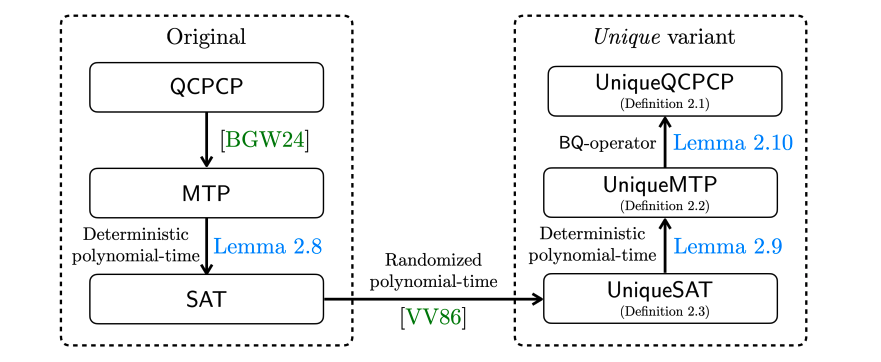
A central focus involves establishing ‘collapse’ results within complexity hierarchies, revealing fundamental connections between the structure of proof systems and their computational power. Researchers prove that restricting classical PCP systems to uniqueness – ensuring a single, correct solution – does not diminish their computational power, mirroring a known result for standard PCPs and reinforcing confidence in their robustness. This discovery indicates that maintaining solution uniqueness does not compromise the verification capabilities of proof systems, offering valuable insights into their design and implementation. Furthermore, a non-uniform analogue of the Karp-Lipton theorem, which concerns the conditions under which a complexity class collapses to a lower one, presents a compelling extension, demonstrating that a collapse occurs if a specific condition is met, and expanding the classical theorem to complexity classes incorporating ‘advice’ – precomputed information that assists computation.
The introduction of a consistent variant of the
The introduction of a consistent variant of the polynomial hierarchy, denoted as Σk, with constraints maintained across interaction rounds while utilising product-state proofs, represents a significant contribution. Product-state proofs are a specific type of proof used in interactive proof systems. Researchers demonstrate an unconditional collapse of this consistent hierarchy, meaning that problems solvable within Σk are also solvable within a lower level of the hierarchy, challenging conventional understandings of complexity. This contrasts with prior work on standard polynomial hierarchies, highlighting that consistency, rather than other factors, drives the collapse, offering a new perspective on computational limits.
Researchers actively explore the implications of these findings for quantum computation, extending classical results to the quantum realm and shedding light on the structural boundaries of complexity theory. By investigating the relationships between different complexity classes, both classical and quantum, the work clarifies the fundamental limits of computation and the interplay between different types of constraints in proof systems. The findings suggest that consistency plays a crucial role in determining the computational power of proof systems, both in classical and quantum settings, offering a pathway to optimize computational processes. This work contributes to a deeper understanding of the limits of quantum computation and the potential for developing new quantum algorithms.
Future research will focus on exploring the practical implications of these findings, developing new algorithms based on these principles, and investigating the potential for applying these techniques to real-world problems. Researchers will also investigate the limitations of these techniques and explore alternative approaches to achieving similar results. The ultimate goal is to develop more efficient and reliable computational systems that can solve complex problems and improve our understanding of the world.
👉 More information🗞Collapses in quantum-classical probabilistically checkable proofs
🗞 Collapses in quantum-classical probabilistically checkable proofs and the quantum polynomial hierarchy
🧠 DOI: https://doi.org/10.48550/arXiv.2506.19792


