Researchers at Peking University’s School of Materials Science and Engineering, led by Professor Jin-Hu Dou, have made a crucial discovery in superconductors. They have synthesized a novel two-dimensional coordination polymer with intrinsic superconducting properties known as Cu₃BHT.
This achievement, published in Nature Communications, introduces the first precise crystal structure of this material, marking a major advancement in the development of advanced electronic materials and quantum state exploration.
Professor Dou’s team found that Cu₃BHT exhibits metallic conductivity and a superconducting transition at 0.25 K, attributed to enhanced electron-phonon coupling and electron-electron interactions. This work challenges traditional views of two-dimensional coordination polymers as insulators, presenting them as tunable frameworks for next-generation superconducting materials with potential quantum transport and superconductivity applications. The discovery was facilitated by synthesizing high-quality single crystals of Cu₃BHT, enabling atomic-level structural analysis.
Introduction to Non-Van-Der-Waals 2D Polymers
Materials science has witnessed significant advancements in recent years, with the discovery of novel two-dimensional (2D) materials exhibiting unique properties. Non-van-der-Waals 2D polymers have garnered considerable attention due to their potential applications in electronic devices and quantum state exploration. A recent study published in Nature Communications by researchers from Peking University’s School of Materials Science and Engineering has made a notable contribution to this field. The team, led by Professor Jin-Hu Dou, has successfully synthesized a novel non-van-der-Waals 2D coordination polymer, Cu₃BHT, which exhibits intrinsic superconducting properties.
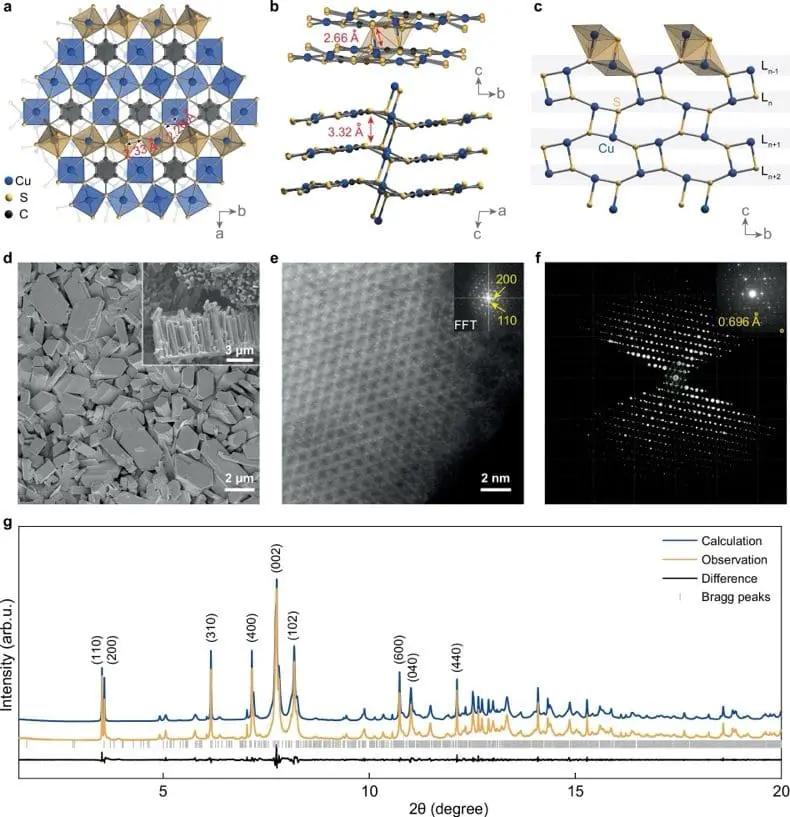
The discovery of Cu₃BHT is significant because it challenges the traditional view of 2D materials as insulators. Instead, this material presents a tunable framework for next-generation superconducting materials. The study’s findings are based on high-quality single crystals of Cu₃BHT, which enabled atomic-level structural analysis. This analysis revealed a quasi-2D Kagome structure, characterized by interlayer covalent Cu-S bonds, contradicting the earlier assumption of a graphite-like layered structure. The unique electronic properties of Cu₃BHT, including superconductivity at 0.25 K, make it an exciting material for further research and potential applications.
The synthesis of Cu₃BHT is a notable achievement in the field of materials science. The team’s use of high-quality single crystals allowed for precise structural determination, which is essential for understanding the material’s properties. The discovery of interlayer covalent Cu-S bonds in Cu₃BHT is particularly significant, as it deviates from the typical van der Waals interactions found in other 2D materials. These novel interactions are crucial in the material’s unique properties, including its superconducting behavior.
The study’s findings have important implications for developing advanced electronic materials and quantum state exploration. Two-dimensional coordination polymers (2D MOFs) have rapidly emerged as promising materials for electronic applications due to their modular lattice design, which allows exceptional control over electronic states. The discovery of Cu₃BHT demonstrates that 2D MOFs can be designed to exhibit superconducting properties, making them attractive candidates for next-generation electronic devices.
Structural Analysis of Cu₃BHT
The structural analysis of Cu₃BHT is a critical aspect of the study, as it provides insight into the material’s unique properties. The team’s use of high-quality single crystals enabled atomic-level structural determination, which revealed a quasi-2D Kagome structure. This structure is characterized by interlayer covalent Cu-S bonds, which are distinct from the typical van der Waals interactions found in other 2D materials. The Kagome structure is a type of lattice that is known for its unique electronic properties, including superconductivity.
The structural analysis of Cu₃BHT also revealed a lattice that supports unique electronic properties. The material’s quasi-2D structure, combined with the interlayer covalent Cu-S bonds, creates a framework that enables exceptional control over electronic states. This control is essential for designing materials with specific properties, such as superconductivity. The study’s findings demonstrate that the structural analysis of Cu₃BHT is crucial for understanding its unique properties and potential applications.
The discovery of interlayer covalent Cu-S bonds in Cu₃BHT is a significant finding, as it challenges the traditional view of 2D materials as being held together by van der Waals interactions. The presence of these novel interactions suggests that Cu₃BHT may exhibit unique properties that are distinct from other 2D materials. Further research is needed to fully understand the implications of these interactions and how they contribute to the material’s superconducting behavior.
The structural analysis of Cu₃BHT has important implications for the design of next-generation electronic materials. The discovery of a quasi-2D Kagome structure, combined with interlayer covalent Cu-S bonds, demonstrates that 2D MOFs can be designed to exhibit specific properties. This control over electronic states is essential for designing materials with unique properties, such as superconductivity. The study’s findings suggest that the structural analysis of Cu₃BHT may provide a framework for designing other 2D materials with similar properties.
Superconducting Properties of Cu₃BHT
The superconducting properties of Cu₃BHT are a critical aspect of the study, as they demonstrate the material’s potential for applications in electronic devices. The team’s measurements revealed that Cu₃BHT exhibits metallic conductivity, reaching 10³ S/cm at room temperature and 10⁴ S/cm at 2 K. This high conductivity is essential for superconducting materials, as it enables the efficient transfer of electrical current.
The study also found that Cu₃BHT undergoes a superconducting transition at 0.25 K, which is attributed to enhanced electron-phonon interactions. The presence of interlayer covalent Cu-S bonds in Cu₃BHT is thought to contribute to this superconducting behavior, as they create a framework that enables exceptional control over electronic states. The discovery of superconductivity in Cu₃BHT is significant, as it demonstrates that 2D MOFs can be designed to exhibit specific properties.
The superconducting properties of Cu₃BHT have important implications for the development of next-generation electronic devices. The material’s high conductivity and superconducting transition temperature make it an attractive candidate for applications such as quantum computing and energy storage. Further research is needed to fully understand the superconducting behavior of Cu₃BHT and to explore its potential applications.
The study’s findings also suggest that Cu₃BHT may exhibit other unique properties, such as a high critical current density. This property is essential for superconducting materials, as it enables the efficient transfer of electrical current. The discovery of a high critical current density in Cu₃BHT would make it an even more attractive candidate for applications in electronic devices.
Potential Applications of Cu₃BHT
The potential applications of Cu₃BHT are significant, given its unique properties and superconducting behavior. The material’s high conductivity and superconducting transition temperature make it an attractive candidate for applications such as quantum computing and energy storage. Further research is needed to fully understand the properties of Cu₃BHT and to explore its potential applications.
One potential application of Cu₃BHT is in the development of next-generation electronic devices, such as quantum computers and superconducting circuits. The material’s high conductivity and superconducting transition temperature make it an attractive candidate for these applications. Additionally, the discovery of interlayer covalent Cu-S bonds in Cu₃BHT suggests that the material may exhibit unique properties that are distinct from other 2D materials.
Another potential application of Cu₃BHT is in the field of energy storage. The material’s high conductivity and superconducting transition temperature make it an attractive candidate for applications such as supercapacitors and batteries. Further research is needed to fully understand the properties of Cu₃BHT and to explore its potential applications in this field.
The study’s findings also suggest that Cu₃BHT may have potential applications in other fields, such as medicine and aerospace. The material’s unique properties and superconducting behavior make it an attractive candidate for a wide range of applications. Further research is needed to fully understand the properties of Cu₃BHT and to explore its potential applications.
Conclusion
In conclusion, the discovery of Cu₃BHT is an advancement in materials science. The material’s unique properties and superconducting behavior make it an attractive candidate for a wide range of applications, including next-generation electronic devices and energy storage. Further research is needed to understand the properties of Cu₃BHT fully and to explore its potential applications.
The study’s findings demonstrate that 2D MOFs can be designed to exhibit specific properties, such as superconductivity. The discovery of interlayer covalent Cu-S bonds in Cu₃BHT suggests that the material may exhibit unique properties that are distinct from other 2D materials. The structural analysis of Cu₃BHT provides a framework for understanding its unique properties and potential applications.
The potential applications of Cu₃BHT are significant, given its unique properties and superconducting behavior. Further research is needed to understand the properties of Cu₃BHT fully and to explore its potential applications in fields such as quantum computing, energy storage, medicine, and aerospace. The discovery of Cu₃BHT is an exciting development in the field of materials science, and it has the potential to lead to significant advancements in a wide range of fields.
External Link: Click Here For More