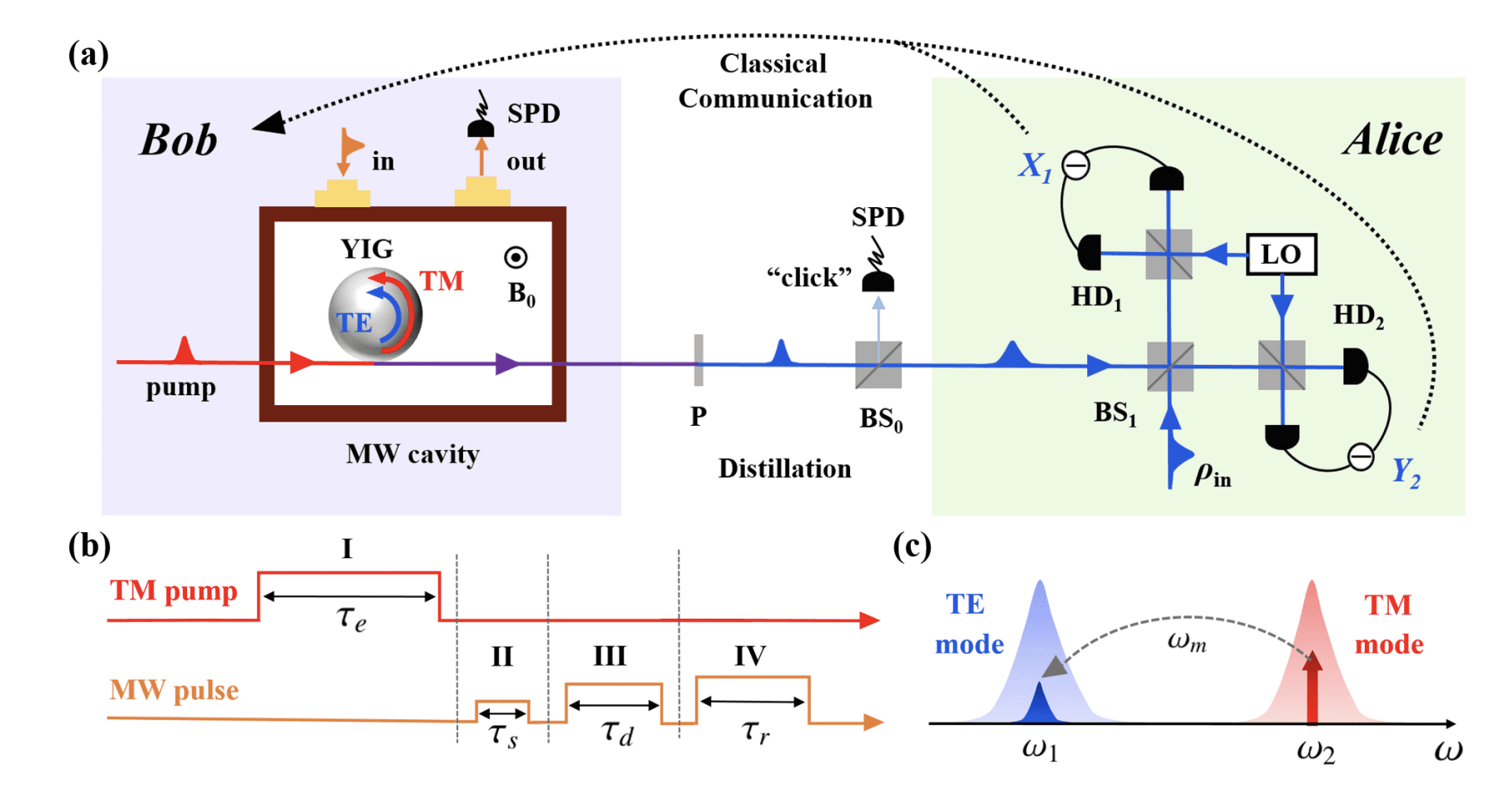
The challenge of transmitting quantum information over long distances drives research into innovative approaches to quantum communication, and a team led by Zi-Xu Lu, Xuan Zuo, and Zhi-Yuan Fan at Zhejiang University are pioneering a new method using magnons , wave-like excitations in magnetic materials. Their work demonstrates a continuous-variable quantum teleportation protocol that transfers quantum states to a remote magnon, effectively using light to carry information within a future magnonic network. To address limitations in current experimental setups, the researchers enhance the entanglement between light and magnons through non-Gaussian distillation, significantly improving the fidelity of the teleportation process. This breakthrough not only paves the way for building practical magnonic repeaters and networks, but also offers a novel technique for creating a variety of complex magnonic states using photon-to-magnon teleportation.
Continuous Variable Quantum Teleportation Advances
Quantum teleportation transfers an unknown quantum state to a distant location without physically moving the carrier of that information, and it is a vital component for future quantum technologies such as quantum repeaters and distributed quantum computing. Originally demonstrated using discrete quantum properties, theories suggest it can also be achieved with continuous variables, which represent quantum information using infinite-dimensional systems. Recent research explores the potential of hybrid systems combining light and magnons, wave-like excitations in magnetic materials, for quantum communication, focusing on improving the quality of entanglement, which directly impacts the fidelity, or accuracy, of the teleportation process.
Hybrid Polaritons and Magnon Control
Cavity optomagnonics is a rapidly developing field that combines cavity quantum electrodynamics with magnonics, the study of spin waves, allowing researchers to create hybrid light-matter quasiparticles called polaritons and offering new ways to control and manipulate quantum information. Current research focuses on overcoming challenges such as signal loss and optimizing system design to maximize the interaction between light and magnons, while also exploring the use of orbital angular momentum of light to manipulate magnons and integrate them with other quantum systems, like superconducting qubits. This work aims to develop new platforms for quantum computing, secure quantum communication networks, and highly sensitive sensors, bridging the gap between quantum optics, spintronics, and quantum information science.
👉 More information
🗞 Optomagnonic continuous-variable quantum teleportation enhanced by non-Gaussian distillation
🧠 DOI: https://doi.org/10.48550/arXiv.2507.12065