Opentrons is partnering with NVIDIA to supercharge its network of over 10,000 laboratory robots with artificial intelligence. The collaboration integrates NVIDIA Isaac and NVIDIA Cosmos platforms, aiming to bridge the gap between AI prediction and real-world biological experimentation—a critical bottleneck in fields like drug discovery. By standardizing experimental execution and generating valuable training data, Opentrons hopes to create AI systems that learn directly from “wet-lab” results. “We see a future where physical AI unlocks autonomous experimental execution throughout laboratory environments,” said James Atwood, CEO of Opentrons. This advancement promises to dramatically accelerate scientific breakthroughs, potentially compressing discovery timelines from years to weeks.
NVIDIA Isaac & Cosmos Enable AI Training for Lab Robotics
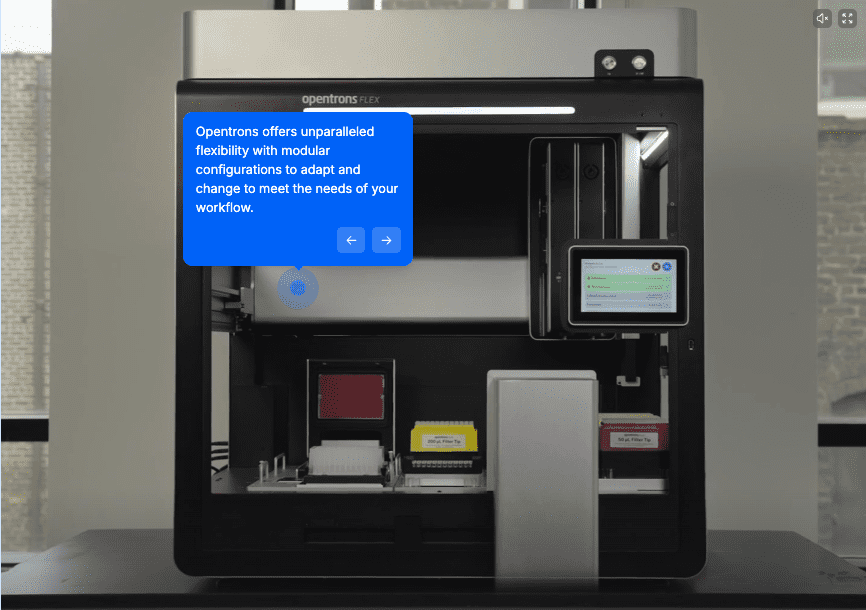
Opentrons Labworks is integrating NVIDIA Isaac and NVIDIA Cosmos platforms to generate training data for physical AI models specifically designed for laboratory settings, marking a significant step toward fully autonomous scientific experimentation. The company leverages a substantial network of over 10,000 deployed robotic systems—present in every top-20 U.S. research university and 14 of the top 15 global biopharma companies—to provide real-world data crucial for AI development. This initiative addresses a critical bottleneck in drug discovery, where experimental execution has lagged behind computational prediction.
The system functions by allowing AI to propose hypotheses and experiments, with Opentrons robots executing them and feeding the results back into the AI for refinement. Stacie Calad-Thomson, North American Business Development Lead for Healthcare and Life Sciences at NVIDIA, stated, “Connecting computational models with experimental validation is essential to accelerating AI-driven drug discovery.” Opentrons and NVIDIA will showcase this partnership at the SLAS International Conference and Exhibition, February 9–11, 2026, in Boston.
Opentrons’ 10,000-Robot Network Standardizes Experimental Execution
Opentrons Labworks Inc. The company reports systems are currently operating within every top-20 U.S. Until recently, AI in drug discovery primarily focused on prediction, but experimental execution has become a limiting factor, according to Opentrons. The system facilitates a closed-loop process where AI proposes experiments, robots execute them, and results refine future iterations.
BioNeMo & Closed-Loop Systems Accelerate Drug Discovery Timelines
Opentrons Labworks Inc. This partnership aims to close the loop between digital design and experimental validation, utilizing BioNeMo as the foundation for training AI models and Opentrons’ systems for standardized physical execution. “AI models and agents propose a hypothesis and experimental plan; our systems execute that experiment,” said James Atwood, CEO of Opentrons.
AI models and agents propose a hypothesis and experimental plan; our systems execute that experiment.
James Atwood, CEO of Opentrons