

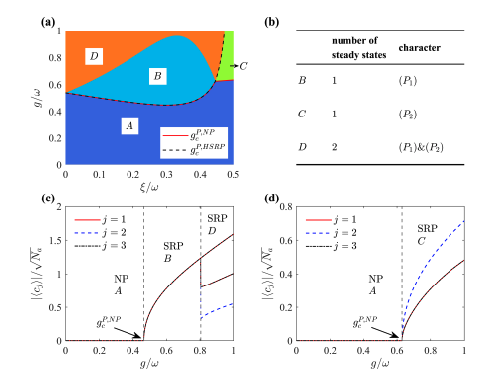
The behaviour of many-body systems undergoing collective behaviour, such as lasers or superfluids, often relies on interactions between individual components and their environment, leading to fascinating, non-equilibrium states of matter. Peng-Fei Wei from Northeast Normal University, Yilun Xu and Fengxiao Sun from Peking University, and their colleagues, now demonstrate that the edges of these systems play a surprisingly critical role in determining these states. Their research focuses on the dissipative Dicke lattice model, a system mimicking light-matter interactions, and reveals that imposing open boundaries, as opposed to infinite or periodic ones, gives rise to a diverse range of superradiant phases exhibiting broken symmetry. This discovery highlights the crucial influence of boundary effects on the stationary phases of these dissipative lattice models, offering exciting new avenues for exploring these phenomena in emerging experimental platforms like optics and circuit quantum electrodynamics.
The superradiant phase transition in the Dicke lattice model, a cornerstone of nonequilibrium quantum many-body physics, is profoundly influenced by the presence of boundaries. While much research focuses on infinite systems, real-world experiments are invariably limited in size, introducing edges that can dramatically alter behaviour. This work addresses this crucial gap in understanding by exploring how boundaries impact the superradiant transition in finite-sized Dicke lattices, providing insights vital for designing and interpreting experiments in this field.
Dicke Model Quantum Simulation and Phase Transitions
This research delves into the realm of quantum many-body physics and quantum simulation, focusing on systems described by the Dicke model and its variations. The Dicke model explains how collections of atoms interact with light, and researchers aim to simulate these quantum phenomena using physical platforms with the ultimate goal of building controllable quantum systems capable of solving complex problems. The study extends the basic Dicke model to include arrangements of multiple interacting units, cyclic arrangements, frustrated systems where interactions compete, and systems that interact with their environment. A major strength of this work lies in its consideration of practical implementation.
Researchers are actively exploring how to build these systems using superconducting circuits, Rydberg atoms, and nitrogen-vacancy centres in diamond. Superconducting circuits, utilizing qubits and resonators, offer a leading platform for quantum computing and simulation, while Rydberg atoms, with their strong interactions, are ideal for simulating many-body physics. Nitrogen-vacancy centres, with their long coherence times, present another promising avenue for quantum simulation. Successful implementation of these simulations could pave the way for new quantum technologies, including quantum sensors and quantum information processors.
Open Boundaries Drive Complex Superradiance
Researchers have discovered a surprising sensitivity in the Dicke lattice model to the conditions imposed at its edges. This system exhibits a transition to a superradiant phase where it collectively emits light, and understanding this transition is crucial for advancements in quantum technologies. The team found that defining the lattice boundaries as either open or periodic dramatically alters the behaviour of this superradiant phase. Specifically, when the lattice boundaries are open, meaning light cannot loop around, a much more complex range of superradiant phases emerges than with periodic boundaries.
A single, uniform superradiant phase is observed in a periodic lattice. Still, open boundaries give rise to a “zoo” of different superradiant phases, each with a unique arrangement of light emission and broken symmetry. This indicates that the edges of the system play a critical role in determining the overall quantum state. The strength of interaction needed to initiate the superradiant phase is also affected by the boundary conditions, requiring a different level of interaction between atoms and photons with open boundaries compared to periodic ones. Furthermore, open boundaries significantly shift the range of conditions ensuring the system’s stability. These findings demonstrate that boundary effects are not merely a technical detail but a fundamental aspect of these dissipative quantum systems, with important implications for the design and control of future quantum devices. The ability to engineer specific superradiant phases through boundary control could unlock new possibilities for quantum information processing and light-matter interactions.
Open Boundaries Drive Symmetry Breaking
This research investigates the superradiant phase transition within the Dicke lattice model, a system crucial to understanding non-equilibrium physics. The study reveals a strong sensitivity to boundary conditions, demonstrating that open boundaries dramatically alter the system’s behaviour compared to infinite lattices. Specifically, the researchers find that open boundaries suppress the formation of a fully homogeneous superradiant phase and instead give rise to a variety of superradiant phases exhibiting broken symmetry. This highlights the crucial influence of boundaries on the stationary phases observed in these light-matter interacting systems, and is particularly relevant for current and near-future experiments, which are naturally limited in size and where boundary effects can be exploited to explore different phases. The authors suggest that extending this research to higher-dimensional geometries represents a promising avenue for future work, potentially illuminating boundary-induced effects on quantum phase transitions in both natural and engineered quantum materials.
🗞 Boundary-induced Phases in the Dissipative Dicke Lattice Model
🧠 ArXiv: https://arxiv.org/abs/2508.10296


