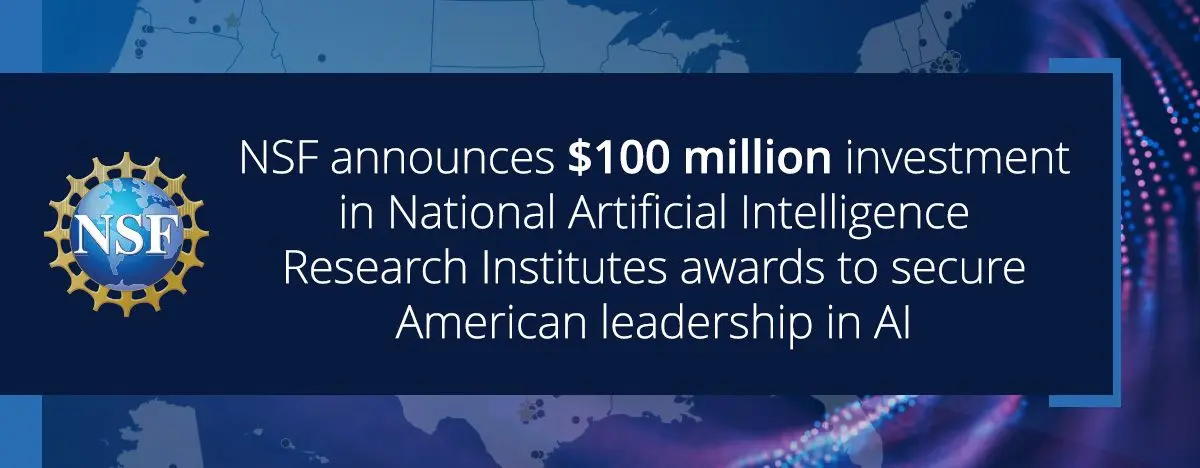
The National Science Foundation (NSF), in partnership with Capital One and Intel, announced a $100 million investment on July 29, 2025, to support five National Artificial Intelligence Research Institutes and a central community hub. This public-private investment aims to maintain and enhance America’s global AI leadership by driving breakthroughs in critical areas including mental health, materials discovery, STEM education, human-AI collaboration, and drug development. The initiative aligns with the White House AI Action Plan and represents a strategic effort to translate cutting-edge AI research into practical solutions that improve lives across various sectors.
The five institutes receiving funding each bring unique interdisciplinary approaches to AI research. Cornell University’s NSF AI-MI focuses on accelerating the discovery of next-generation materials for energy and quantum technologies. The University of Texas at Austin’s NSF IFML, building on five years of foundational work, will advance generative AI technologies including applications in protein engineering and clinical imaging. The University of Colorado Boulder’s NSF iSAT transforms STEM education through AI-enhanced group learning tools. The University of Illinois Urbana-Champaign’s NSF MMLI develops AI for rapid molecule discovery in medicine and clean energy. Brown University’s NSF ARIA works on creating safer, more adaptive AI assistants. Additionally, UC Davis leads NSF AIVO, which serves as a central hub connecting all AI Institutes.
A key component of this investment is building national infrastructure for AI education and workforce development. The institutes will train the next generation of researchers and practitioners while expanding AI literacy across all communities, supporting Executive Order 14277 on “Advancing Artificial Intelligence Education for American Youth.” For example, NSF iSAT has already reached over 6,000 middle-school students and educators with AI tools and curricula, and plans to develop a semester-long AI literacy curriculum to address the urgent need for an AI-ready workforce.
This investment represents a comprehensive approach to maintaining U.S. competitiveness in AI by fostering open innovation and ensuring AI serves the public good. By connecting academic research with industry partnerships and community engagement, the institutes aim to move beyond headline-grabbing chatbots to address real-world challenges in healthcare, manufacturing, agriculture, and financial security. The network of institutes, coordinated through the AIVO hub, creates a collaborative ecosystem designed to accelerate the translation of research breakthroughs into scalable solutions that benefit society for decades to come.
More information
External Link: Click Here For More