
New Quantum Algorithm from Microsoft and ETH-Zurich addresses Climate Change

The development by researchers at Microsoft and ETH-Zurich has the potential to impact global climate change by finding efficient catalysts for carbon fixation which reduces CO2 by turning into products which are more useful (such as methanol).

The team have development a new compression algorithm which offers a speed-up over existing methods. The experiments with Ruthenium catalyst configuration can offer almost a 19 time speedup over traditional computations.

In our research, we precisely achieve this runtime reduction by developing a new, efficient quantum algorithm. Our algorithm exploits the improved compression properties of the double-factorized form, and it also manages to perform the simulation with significantly larger step sizes compared to prior state of the art that exploits the un-factorized or single-factorized forms of the Hamiltonian

The illustrate the rapid progress in quantum algorithm development, the new algorithm is roughly 10,000 times faster than just three years ago.

Chemistry as one of the first Quantum Use Cases

We have written extensively how sectors such as drug and chemical development are being actively explored as potential candidates for innovation. Companies such as Merck are also actively exploring quantum computing to assist in developing drugs.

Building on the research, tools for chemistry are integrated into the Microsoft Quantum Development Kit (QDK) for the language Q# which are open for researchers to explore. There are other alternative languages out there and platforms such that as Qiskit and Cirq.
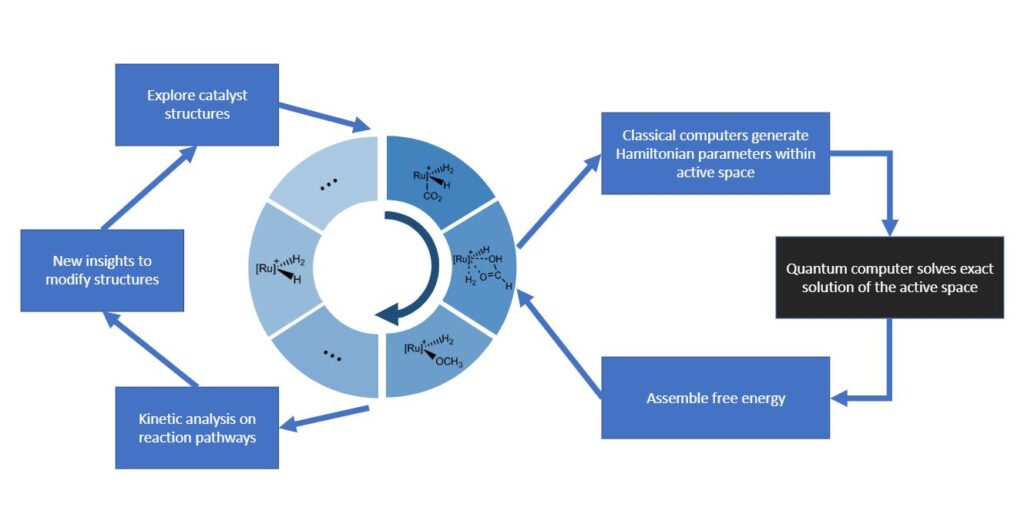
The Catalysis Quantum Workflow.

You can read more about the published paper here.

The Quantum Mechanic

The Quantum Mechanic

The Quantum Mechanic is the journalist who covers quantum computing like a master mechanic diagnosing engine trouble - methodical, skeptical, and completely unimpressed by shiny marketing materials. They're the writer who asks the questions everyone else is afraid to ask: "But does it actually work?" and "What happens when it breaks?" While other tech journalists get distracted by funding announcements and breakthrough claims, the Quantum Mechanic is the one digging into the technical specs, talking to the engineers who actually build these things, and figuring out what's really happening under the hood of all these quantum computing companies. They write with the practical wisdom of someone who knows that impressive demos and real-world reliability are two very different things. The Quantum Mechanic approaches every quantum computing story with a mechanic's mindset: show me the diagnostics, explain the failure modes, and don't tell me it's revolutionary until I see it running consistently for more than a week. They're your guide to the nuts-and-bolts reality of quantum computing - because someone needs to ask whether the emperor's quantum computer is actually wearing any clothes.

Latest Posts by The Quantum Mechanic:

Sopra Steria Expands into European Space Agency & EUMETSAT Projects

Sopra Steria Expands into European Space Agency & EUMETSAT Projects

December 18, 2025
New concept for energy transfer between gravitational waves and light

New concept for energy transfer between gravitational waves and light

December 16, 2025
Horizon Quantum Unveils Beryllium at Q2B Silicon Valley Conference

Horizon Quantum Unveils Beryllium at Q2B Silicon Valley Conference

December 9, 2025

Leave a Reply

Your email address will not be published. Required fields are marked *