Researchers from the AWS Center for Quantum Computing, Stanford University, and the University of Chicago have proposed a new method for designing a two-qubit gate between fluxonium qubits. The approach, which uses a linear resonator to couple two fluxoniums, aims to reduce error, increase speed, and simplify control. The team’s analysis suggests that this method could reduce incoherent error rates by a factor of 10, potentially leading to more efficient and reliable quantum computing systems. The new approach also offers potential for increased connectivity between fluxonium qubits in large circuits, a requirement for quantum error correction.
What is the New Approach to Designing Two-Qubit Gates Between Fluxonium Qubits?
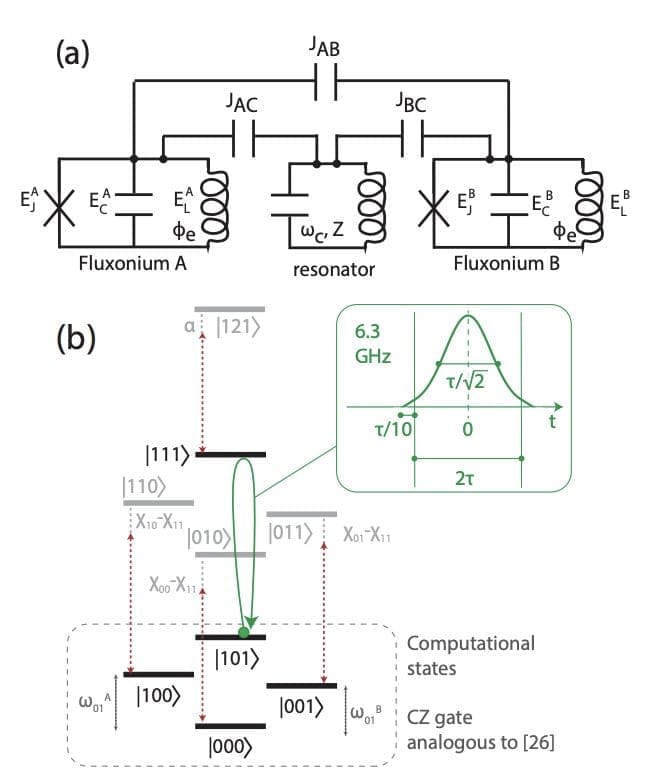
The research team from the AWS Center for Quantum Computing, Stanford University, and the University of Chicago has proposed a new approach to designing a two-qubit gate between fluxonium qubits. This approach aims to minimize error, speed, and control simplicity. The proposed architecture consists of two fluxoniums coupled via a linear resonator. The use of a linear coupler introduces the possibility of material optimization for suppressing its loss, enables efficient driving of state-selective transitions through its large charge zero point fluctuation, reduces sensitivity to junction aging, and partially mitigates coherent coupling to two-level systems.
The researchers performed analytic and numeric analyses of the circuit Hamiltonian and gate dynamics. They tuned circuit parameters to destructively interfere sources of coherent error, revealing an efficient fourth-order scaling of coherent error with gate duration. For component properties from the literature, they predict an open-system average CZ quantum gate infidelity of 1.86104 in 70ns.
How Does This Approach Differ from Current Practices?
The fluxonium circuit, consisting of a small Josephson junction with shunt inductance as well as capacitance, has recently reemerged as a long-lived qubit with the potential for entangling gate fidelities surpassing the current state of the art transmon fidelities. However, further work is required to develop gate and control architectures that are optimal for large-scale devices consisting of many fluxonium qubits with a high degree of connectivity.
Fluxonium exhibits qualitatively different matrix elements, spectra, and robustness to noise compared to the transmon. This precludes a simple translation of best practices for transmon gates to fluxonium. Instead, first-principles studies are required to understand the opportunities and risks of new fluxonium-based gate schemes.
What is the Proposed Gate Architecture?
The proposed gate architecture is a pair of fluxonium qubits connected through a coupler formed by a simple linear resonator. This approach incorporates many best practices that give it strong practical advantages, especially when one considers scaling to multi-qubit circuits.
The researchers model a microwave-activated CZ gate achieved via a control scheme similar to that used in the recent work of Ding et al., which entangled two fluxonium qubits through selective microwave excitations of a transmon qubit coupler using two linear charge drives, one on each fluxonium qubit. In this work, they use a single drive tone optimized only over its frequency and amplitude to drive a resonator coupler from its ground state to first excited state and back, selective on the qubits being in the computational 11-state and yielding a state-selecting phase shift of π.
How Does This Approach Facilitate Increased Connectivity?
The resonator-as-coupler approach could facilitate increased connectivity between fluxonium qubits in a large circuit. This is both required for quantum error correction and an open problem. Maintaining the fluxonium’s small self-capacitance for a typical EC1 GHz becomes challenging as the connectivity increases because of capacitive loading and extra parasitic capacitances to the ground plane in a practical design.
For integration in a realistic circuit capable of implementing a surface code, a high impedance coupler may be chosen to connect nearby fluxoniums with minimal coupling capacitance. In particular, for ultra-high impedance resonators with impedance Z > 1 kΩ, loading efficiency would be improved compared to a transmon coupler.
What are the Predicted Performance Advantages?
The researchers predict performance advantages from their choice of a coupler that does not contain Josephson junctions. The resonator quality factor can be increased by fabricating it out of high-quality materials such as tantalum, suppressing coupler-induced gate errors. Their analysis suggests that in a realistic device, incoherent error rates can be reduced by a factor of 10. This research opens up new possibilities for the design and optimization of two-qubit gates between fluxonium qubits, potentially leading to more efficient and reliable quantum computing systems.
Publication details: “Designing high-fidelity two-qubit gates between fluxonium qubits”
Publication Date: 2024-03-11
Authors: Emma L. Rosenfeld, Connor T. Hann, David I. Schuster, Matthew H. Matheny, et al.
Source: arXiv (Cornell University)
DOI: https://doi.org/10.48550/arxiv.2403.07242