

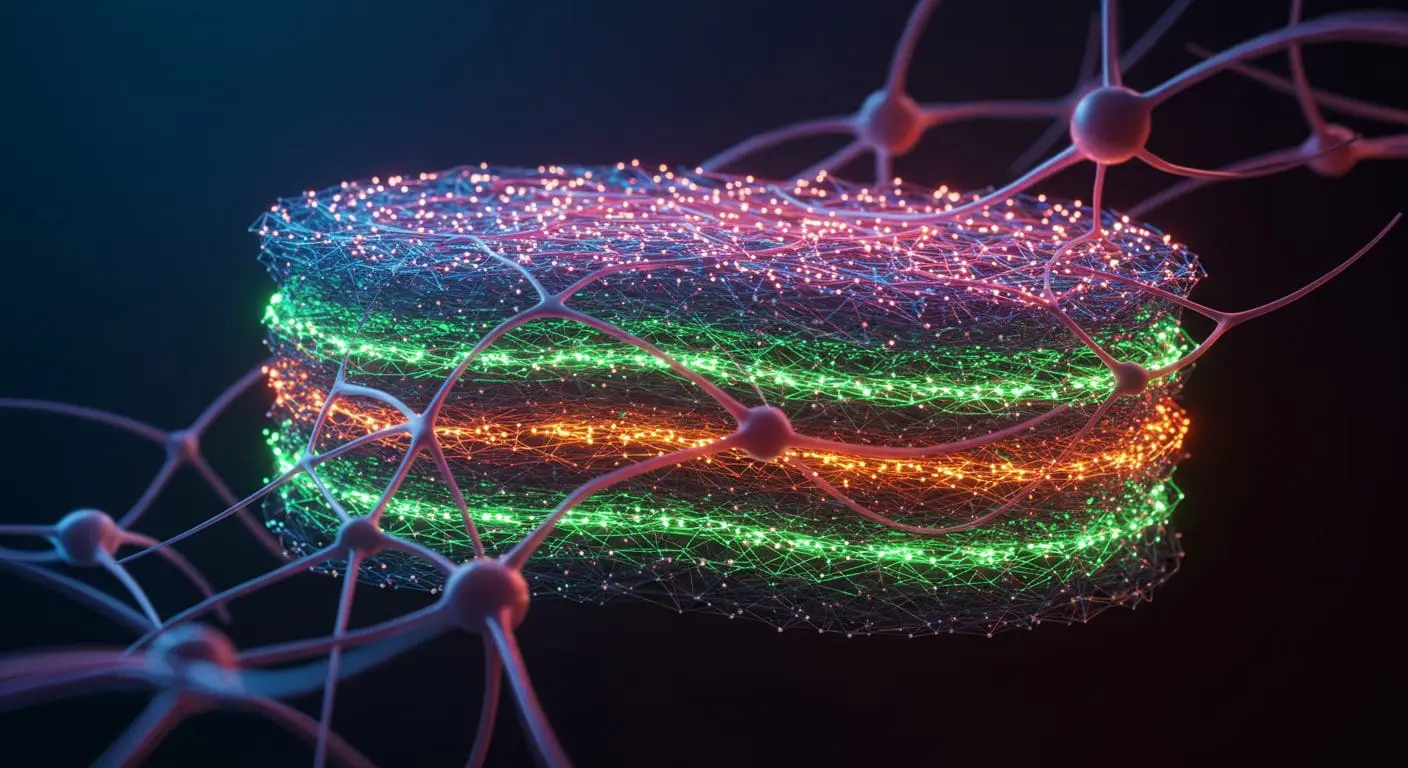
On April 14, 2025, Kamran Majid published Neural Network Emulation of the Classical Limit in Quantum Systems via Learned Observable Mappings, exploring how neural networks can model the transition from quantum to classical behavior in harmonic oscillators as Planck’s constant approaches zero.
The study investigates the quantum-to-classical transition using a neural network approach to model the harmonic oscillator’s behavior as Planck’s constant approaches zero. The network was trained to predict the time evolution of position expectation values from initial conditions across varying hbar regimes, offering insights into the emergence of classical mechanics. This work highlights machine learning’s potential as a tool for exploring foundational questions in quantum-classical dynamics.
Researchers employed artificial neural networks—machine learning models inspired by the human brain—to analyze data from quantum simulations. These simulations modeled systems transitioning from quantum to classical behavior, enabling researchers to observe how properties like coherence and entanglement evolve during this process. Neural networks excel at identifying complex patterns in large datasets, making them an ideal tool for uncovering subtle relationships that govern the quantum-classical transition.
By training neural networks on data from these simulations, researchers identified patterns that revealed how quantum systems lose their quantum characteristics and begin to exhibit classical behavior. This approach provided insights into the mechanisms underlying the transition, offering a novel perspective on this enduring scientific question.
The study yielded several significant insights into the nature of the quantum-classical transition:
- Decay of Quantum Properties: The research demonstrated that certain quantum properties, such as entanglement, decay in predictable ways as systems approach classical behavior. This suggests the existence of universal principles governing the transition across diverse physical systems.
- Gradual Transition: Contrary to the common perception of a sharp divide between quantum and classical realms, the study revealed that the transition occurs gradually. Intermediate states exhibit a mix of quantum and classical characteristics, highlighting the complexity of the process.
- Role of Machine Learning: The research underscored the potential of machine learning as a powerful tool for exploring fundamental questions in physics. Neural networks proved particularly effective at uncovering insights hidden within complex datasets, demonstrating their value in advancing our understanding of quantum systems.
This research represents a significant advancement in understanding the quantum-classical transition, offering new perspectives on how quantum systems give rise to classical behavior. By combining machine learning with quantum mechanics, researchers demonstrated the power of interdisciplinary approaches in addressing profound scientific questions.
As quantum technologies continue to evolve, understanding the mechanisms behind the quantum-classical transition will become increasingly important. The findings of this study not only deepen our theoretical understanding but also have practical implications for the development of quantum computers and other emerging technologies. By bridging the gap between the quantum and classical worlds, this work paves the way for future discoveries and innovations in both physics and technology.
👉 More information
🗞 Neural Network Emulation of the Classical Limit in Quantum Systems via Learned Observable Mappings
🧠 DOI: https://doi.org/10.48550/arXiv.2504.10781


