The creation of robust and reliable entanglement sources represents a critical challenge in the development of quantum technologies, and researchers are now demonstrating a new approach using ultracold atoms. Chen Li, RuGway Wu, and Jörg Schmiedmayer from the Vienna Center for Quantum Science and Technology at TU Wien, detail a method for generating entangled pairs of neutral atoms through the controlled breaking apart of diatomic molecules. This technique produces intrinsically linked atoms exhibiting correlations in multiple properties, paving the way for the creation of complex quantum states and scalable networks. Importantly, the protocol leverages existing technologies in atom manipulation and detection, offering a directly implementable pathway towards deterministic entanglement sources for fundamental tests of quantum mechanics and the construction of powerful, scalable neutral-atom processors.
Deterministic Entanglement via Matter-Wave Integrated Optics
Scientists engineered a novel method for generating entangled pairs of ultracold neutral atoms by precisely controlling the dissociation of diatomic Feshbach molecules. This process inherently produces correlations in spin, position-momentum, and path, enabling the deterministic preparation of entangled pairs and multiqubit states through hyperentangled encoding. The study pioneered an architecture where each atom of the entangled pair is prepared within a matter waveguide, allowing for scalability to hundreds of parallel entanglement sources connected via a matter-wave optical network. This network incorporates beam splitters, phase shifters, interferometers, tunnel junctions, and local detectors, creating a platform for complex quantum operations.
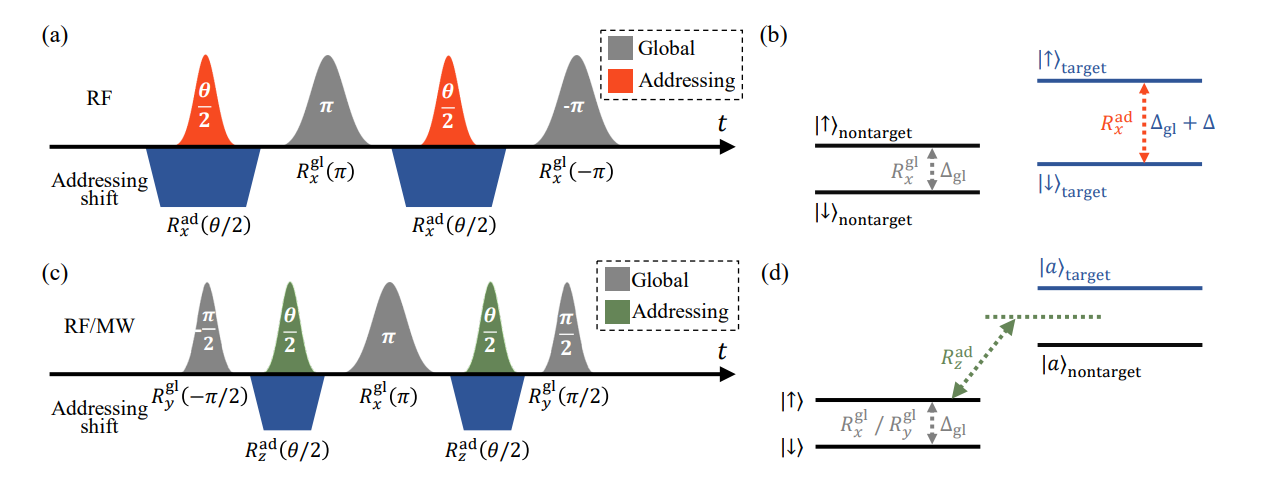
They employed radio frequency pulses to transfer atoms between spin states, effectively quenching the interatomic interaction and projecting the molecule into an unbound scattering channel. Alternatively, they utilized magnetic-field sweeps to adiabatically convert bound dimers into free atoms, allowing precise control over the relative momentum distribution. The dissociation process yields a maximally entangled spin singlet state, and once released from microtraps, the atoms propagate with correlated momenta, allowing for individual addressing and manipulation. The researchers further developed techniques for single-qubit operations on the spin states of the atoms, applying global operations to the entire ensemble and addressed operations to specific subsets using tightly focused laser beams.
These beams induced local AC Stark shifts, enabling selective and coherent manipulation of individual qubits without disturbing the rest of the system. Two schemes were implemented for an addressed Rx(θ) gate, utilizing combinations of addressed half-rotations and global spin-echo rotations, or coupling the qubit state to an auxiliary state with an addressing laser. These methods provide precise control over the quantum states of the atoms, paving the way for complex quantum computations and tests of fundamental physics.
Hyperentangled Atoms Generated Deterministically
Scientists have achieved a deterministic method for generating entangled pairs of ultracold neutral atoms through the controlled dissociation of diatomic molecules, opening new avenues for quantum technologies. The research demonstrates the creation of entanglement not only in the atoms’ spins, but also in their positions, momenta, and paths, a phenomenon termed hyperentanglement. This work builds upon established techniques in atom manipulation, including precise optical control and high-fidelity detection, making immediate implementation with current technology feasible. Experiments reveal that the spin entanglement violates the Clauser-Horne-Shimony-Holt (CHSH) inequality, a key indicator of quantum nonlocality, with a predicted Bell violation of approximately 2.
45, significantly exceeding the classical limit of 2. The team also confirmed continuous-variable entanglement in the atoms’ positions and momenta, demonstrating that the product of their conditional uncertainties falls below the Heisenberg limit. Furthermore, the research successfully generated path entanglement by splitting a single waveguide into two, creating spatially separated paths for the dissociated atoms, establishing a maximally entangled state. Verification of this entanglement involves a two-atom interferometer, where joint detection probabilities exhibit high-visibility fringes. These results demonstrate a powerful platform for probing fundamental quantum mechanics with massive particles and pave the way for scalable neutral-atom processors and advanced atomtronics circuits.
Deterministic Hyperentanglement of Ultracold Neutral Atoms
This research demonstrates a deterministic method for generating entangled pairs of ultracold neutral atoms by carefully controlling the dissociation of Feshbach molecules. The process naturally creates strong correlations between the atoms’ spin, position, momentum, and path, allowing for the creation of entangled pairs of massive particles and complex multi-qubit states, termed hyperentangled encoding. This approach offers a significant advancement as it deterministically produces entanglement, unlike probabilistic methods, and is directly implementable using existing neutral-atom technologies. The team’s protocol is designed to be scalable, potentially enabling the creation of hundreds of entanglement sources within an array connected to a matter-wave optical network.
This architecture integrates seamlessly with existing atomtronics circuits and chip-based matter-wave optics, paving the way for new devices and networks based on entangled neutral atoms. The researchers highlight the potential for this technology to advance fundamental tests of quantum mechanics and to build scalable quantum processors. Future work will focus on embedding these deterministic entanglement sources into integrated atomtronic architectures, potentially creating compact matter-wave circuits that parallel photonic networks but leverage the unique properties of massive particles, such as tunable interactions and long coherence times.
🗞 A Source of Deterministic Entanglement for Matter-Wave Networks
🧠 ArXiv: https://arxiv.org/abs/2509.22096