
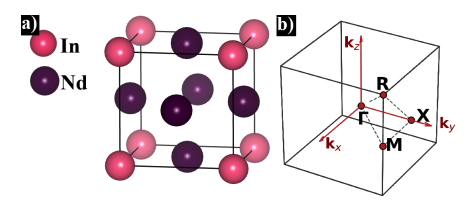
The search for materials exhibiting both superconductivity and unusual electronic properties continues to drive materials science, promising breakthroughs in fundamental physics and future technologies. Arafat Rahman, Alamgir Kabir, and Tareq Mahmud, all from the University of Dhaka, now predict that cubic neodymium indium (NdIn) possesses a remarkable combination of these characteristics. Their calculations reveal that NdIn exhibits strong-coupling superconductivity, potentially reaching temperatures of 14 Kelvin at atmospheric pressure and increasing further under pressure, alongside properties of a Weyl semimetal. This unique coexistence, arising from pronounced electronic interactions within the material, positions NdIn as a promising candidate for advanced applications in transport phenomena and beyond.
Ongoing research into quantum technologies concentrates on identifying materials with the potential to exhibit novel quantum phenomena, and this work predicts that cubic Nd3In exhibits exceptional promise, combining strong-coupling superconductivity with distinctive topological features. First-principles calculations demonstrate that robust electron-phonon coupling drives superconductivity in Nd3In, resulting in an electron-phonon coupling constant of λ = 1, a value indicating a strong-coupling regime where quantum effects are significant. These calculations predict a superconducting transition temperature of approximately 14 K at ambient pressure, rising to 18 K under 15 GPa of pressure, suggesting a pathway to enhance superconducting performance through external manipulation. The significance of this prediction lies in the potential for Nd3In to become a viable material for applications requiring superconductivity at relatively accessible temperatures and pressures, bridging the gap between theoretical possibilities and practical implementation.
Pressure Effects on Nd3In Superconductivity and Structure
This research investigates the superconducting potential of Nd3In and explores the electronic and phonon properties of both Nd3In and In3Nd, aiming to understand how pressure influences the superconducting transition temperature and the underlying mechanisms responsible for superconductivity. The study employs Density Functional Theory (DFT) calculations, a quantum mechanical modelling method used to describe the electronic structure of materials, and Eliashberg theory, a framework for calculating superconducting properties based on electron-phonon interactions, to model these properties. Detailed analysis of phonon behaviour, which describes the vibrational modes of the crystal lattice, complements these calculations, providing a comprehensive understanding of the material’s behaviour. DFT calculations accurately predict ground state properties, while Eliashberg theory accounts for the many-body effects crucial for superconductivity.
A significant finding is that increasing pressure enhances the superconducting transition temperature in Nd3In, suggesting that pressure strengthens the electron-phonon coupling, the fundamental mechanism driving superconductivity in this material. This enhancement arises from the compression of the crystal lattice, which alters the electronic band structure and increases the density of states at the Fermi level, thereby promoting stronger interactions between electrons and phonons. Supporting evidence reveals changes in phonon behaviour and the superconducting gap distribution as pressure increases, confirming the strengthening of electron-phonon coupling. The superconducting gap represents the energy required to break a Cooper pair, the fundamental charge carriers in a superconductor, and its magnitude is directly related to the transition temperature.
Calculations show phonon dispersion relations, which map the frequency of phonon vibrations as a function of wavevector, and the strength of coupling between electrons and phonons, emphasizing the crucial role of electron-phonon coupling in achieving superconductivity. Softer phonon modes, particularly at lower frequencies, correlate with stronger electron-phonon coupling and higher superconducting transition temperatures, as these modes are more easily excited by electrons. This correlation highlights the importance of lattice vibrations in mediating the attractive interaction between electrons that leads to Cooper pair formation. The analysis extends to calculating the Eliashberg spectral function, which provides a detailed picture of the electron-phonon interaction and its contribution to superconductivity.
The research reveals that the superconducting gap distribution on the Fermi surface is anisotropic, varying depending on direction, a characteristic commonly observed in unconventional superconductors. This anisotropy suggests that the superconducting state is not simply described by a single energy gap, but rather by a more complex distribution of gaps, potentially leading to unique properties and behaviours. Understanding this anisotropy is crucial for developing a complete theoretical description of the superconducting state and predicting its response to external stimuli. The observed anisotropy may also be linked to the material’s crystal structure and the specific arrangement of atoms within the lattice.
Analysis of the electronic structure demonstrates that In3Nd is a semimetal with a low density of electronic states at the Fermi level, and the presence of Fermi arcs supports its classification as a Dirac or Weyl semimetal. Semimetals exhibit properties intermediate between metals and insulators, possessing a small but finite energy gap. Dirac and Weyl semimetals are characterised by linear band crossings in their electronic structure, leading to unique topological properties and potentially hosting exotic quasiparticles. Fermi arcs are surface states that connect these band crossings, providing experimental signatures of the material’s topological nature.
Including spin-orbit coupling in the calculations opens band gaps in In3Nd, indicating its role in the material’s electronic structure and influencing its topological properties. Spin-orbit coupling arises from the interaction between an electron’s spin and its orbital motion, leading to modifications in the electronic band structure and the emergence of topological states. This effect is particularly pronounced in materials containing heavy elements, such as indium and neodymium. The induced band gaps can significantly alter the material’s electronic and optical properties.
Calculations of phonon dispersion, atom-projected phonon density of states, and the Eliashberg spectral function for In3Nd reveal electron-phonon coupling, suggesting potential applications beyond superconductivity. While In3Nd does not exhibit superconductivity in these calculations, the presence of electron-phonon coupling indicates that lattice vibrations can influence its electronic properties. This interaction could be exploited in applications such as thermoelectric devices, where lattice vibrations play a crucial role in heat transport, or in manipulating the material’s optical properties. The atom-projected phonon density of states reveals which atoms contribute most strongly to the lattice vibrations.
The research suggests that Nd3In is a promising material for superconductivity, and applying pressure is an effective strategy to enhance its superconducting properties. The increased transition temperature with pressure likely results from the strengthening of electron-phonon coupling, driven by the compression of the crystal lattice and the resulting changes in the electronic band structure. In3Nd, while not explicitly superconducting, is a semimetal with interesting electronic properties and exhibits electron-phonon coupling, potentially opening avenues for other applications in areas such as thermoelectrics or optoelectronics. Further research is needed to explore the potential of both materials fully and to optimise their properties for specific applications.
👉 More information
🗞 Reviving the Search for Indium-Based Superconductors: Theoretical Prediction of Semimetallic Superconductivity in Cubic Nd In
🧠 DOI: https://doi.org/10.48550/arXiv.2507.11123