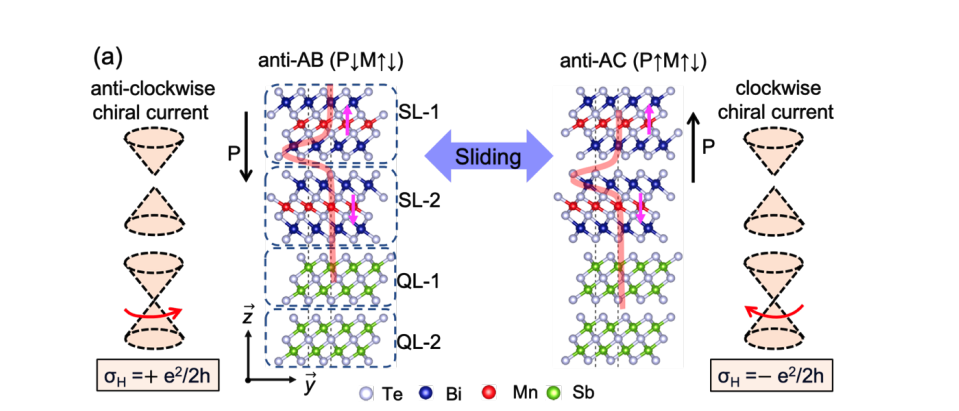
Researchers demonstrate electrically switchable topological transport in a multiferroic heterostructure, combining antiferromagnetism and ferroelectricity. A manganese bismuth telluride bilayer, coupled with antimony telluride, exhibits a half-quantized anomalous Hall effect, with Hall conductivity reversibly controlled by manipulating the antiferromagnetic configuration via interlayer sliding.
The pursuit of materials exhibiting both ferroelectric and topological properties represents a significant area of condensed matter physics, with potential applications in novel electronic devices. Combining these characteristics with antiferromagnetism offers further possibilities for controlling electronic behaviour. Muzaffar, Bai, and colleagues report the observation of a switchable half-quantized Hall effect, a phenomenon where Hall conductivity occurs at precisely half-integer values, in a specifically designed multiferroic heterostructure. Their research, detailed in the article ‘Ferroelectrically Switchable Half-Quantized Hall Effect’, demonstrates how manipulating the electric polarisation within the material allows for reversible control of topological transport, offering a promising avenue for future device development. The team, comprised of researchers from the University of Science and Technology of China and the University of Hong Kong, achieved this control by integrating an antiferromagnetic manganese bismuth telluride bilayer with a film of antimony telluride.
Symmetry Reduction in Materials Yields Novel Quantum and Electrical Behaviours
Condensed matter physics is increasingly focusing on materials that exhibit emergent quantum phenomena arising from symmetry breaking, with the quantum anomalous Hall effect (QAHE) and ferroelectricity representing prominent examples. The QAHE, characterised by quantized Hall conductance, emerges when time-reversal symmetry is broken, while ferroelectricity arises from the breaking of inversion symmetry, resulting in spontaneous electric polarization. Recent research explores combining these phenomena, particularly within topological insulators, materials possessing conducting surface states protected by topology and offering potential for low-dissipation electronics, as controlling these surface states unlocks avenues for novel device functionalities.
Materials like manganese bismuth telluride (MnBi₂Te₄) have garnered attention as intrinsic magnetic topological insulators exhibiting antiferromagnetic behaviour, where the magnetic ordering dictates the emergence of the QAHE with specific layer configurations leading to quantized Hall conductance. Investigations into MnBi₂Te₄ reveal asymmetric Hall responses in even-layered structures, suggesting symmetry breaking via mechanisms beyond simple magnetisation can induce the QAHE, challenging the established link between magnetisation and the anomalous Hall effect. External electric fields and intrinsic ferroelectricity, through a process termed layertronic sliding, drive this effect, opening new possibilities for controlling topological transport and expanding the understanding of quantum phenomena in materials science.
The interplay between antiferromagnetism, ferroelectricity, and topological transport forms a central theme in current research, offering a pathway towards creating devices with switchable topological states and enhanced fault tolerance, particularly relevant for developing next-generation quantum devices requiring robust and controllable quantum states. This research centres on the creation and investigation of a novel multiferroic heterostructure, combining antiferromagnetic and ferroelectric properties to manipulate topological transport, demonstrating the potential for a half-quantized anomalous Hall (HQAH) effect with a switchable Hall conductivity of $\frac{e^2}{h}$. The study establishes that the antiferromagnetic MnBi₄Te₄ bilayer induces a band gap in the top surface states of the Sb₂Te₃ film via a proximity effect, while maintaining gapless bottom surface states, thereby sustaining an HQAH conductivity dependent on the antiferromagnetic configuration.
The research detailed relies heavily on a sophisticated interplay of computational and materials science techniques, establishing a firm theoretical foundation before experimental validation. Density functional theory (DFT), a cornerstone of modern materials modelling, is employed, with researchers utilising parameterizations developed by Perdew et al. to refine calculations and account for complex electron interactions. Calculations extend beyond standard DFT with the inclusion of dispersion corrections, such as the DFT-D method introduced by Grimme et al., to accurately model van der Waals interactions vital when investigating layered two-dimensional materials and heterostructures. Software packages like WannierTools and TB2J facilitate the analysis of electronic band structures and topological properties, enabling a deeper understanding of electron behaviour within these materials, with WannierTools allowing researchers to project electronic states onto Wannier functions, simplifying complex band structures and revealing the underlying physics.
A significant methodological innovation lies in the combination of these computational techniques with a specific focus on van der Waals heterostructures, formed by stacking different two-dimensional materials, offering a unique platform for manipulating electronic properties. The research leverages the ability to precisely control the stacking order and interlayer interactions within these heterostructures, allowing for the engineering of novel quantum phenomena, exemplified by the investigation of MnBi₂Te₄, an antiferromagnetic topological insulator, where researchers meticulously model the electronic structure, paying close attention to the influence of Mn-Bi site mixing and thickness-dependent properties. This detailed modelling informs the design of the heterostructure, where MnBi₂Te₄ is coupled with Sb₂Te₃, creating a system where antiferromagnetism, ferroelectricity, and topological transport can coexist.
The theoretical framework extends to understanding the interplay between these different phenomena, exploring how the antiferromagnetic order in MnBi₂Te₄ can induce a gap in the surface states of Sb₂Te₃ through a proximity effect, creating conditions for the observation of the half-quantized anomalous Hall effect. Furthermore, the team investigates how the ferroelectric polarization of Sb₂Te₃ can be manipulated to switch the direction of the Hall conductivity, offering a pathway for controlling topological transport with an electric field.
Crucially, the research demonstrates that interlayer sliding within the MnBi₄Te₄ bilayer reverses its electric polarization, breaking parity-time reversal symmetry and simultaneously inverting the HQAH conductivity, providing a powerful method for controlling topological transport in antiferromagnetic materials using ferroelectricity. The research builds upon a foundation of work concerning topological insulators, antiferromagnetism, and the quantum anomalous Hall effect, as evidenced by citations of foundational papers by Zhang et al. (2009) and Shen (2017), integrating these concepts and demonstrating a novel approach to controlling topological transport through the manipulation of ferroelectric polarisation in an antiferromagnetic system. This integration represents a significant step towards developing advanced devices based on the principles of topological quantum matter.
The bibliography reveals a strong emphasis on MnBi₄Te₄ as a key material, reflecting its central role in enabling the observed effects, with references to computational tools like WannierTools and DFT methods, including Perdew’s functional and Grimme’s dispersion corrections, highlighting the importance of theoretical modelling in understanding and predicting material behaviour. Furthermore, the inclusion of references to van der Waals heterostructures and 2D materials indicates an interest in leveraging these systems to create and study novel materials with tailored properties, establishing a firm theoretical foundation before experimental validation. The emphasis on both computational precision and materials design underscores the research’s ambition to not only understand fundamental physics but also to create materials with tailored properties for future device applications, opening up exciting possibilities for developing next-generation electronic devices with enhanced functionality and performance.
👉 More information
🗞 Ferroelectrically Switchable Half-Quantized Hall Effect
🧠 DOI: https://doi.org/10.48550/arXiv.2507.03985