

The behaviour of electrons emitted from molecules when exposed to light reveals surprising insights into molecular structure and symmetry, as demonstrated by research led by Christian S. Kern from the University of Graz, Xiaosheng Yang from Forschungszentrum Jülich, and Peter Puschnig, also from the University of Graz. Their team investigates a phenomenon called circular dichroism in the angular distribution of photoelectrons, where the direction electrons are emitted depends on the ‘handedness’ of the light used to liberate them. Surprisingly, they observe this effect even in molecules lacking inherent chirality, such as tetracene and pentacene, which are commonly used in organic electronics. By combining experiments with advanced theoretical modelling, the researchers demonstrate that this circular dichroism originates not from the molecule itself, but from the behaviour of the emitted electron after it leaves the molecule, fundamentally changing our understanding of how light and matter interact at the nanoscale.
Achiral Molecules Exhibit Circular Dichroism in Electrons
Circular dichroism, typically associated with chiral materials, describes the differential absorption of circularly polarized light. This effect arises from the interplay between electric and magnetic properties within a substance and is widely used to investigate molecular structure and environment. Surprisingly, circular dichroism can also be observed in achiral materials, presenting a puzzle for scientists. Recent research focuses on circular dichroism in the angular distribution of emitted electrons, known as CDAD, which emerges when measuring the angles at which electrons are ejected from a material.
The observation of CDAD in achiral molecules challenges conventional understanding, suggesting that factors beyond a molecule’s inherent chirality are at play. Researchers have investigated this phenomenon in organic molecules called acenes, specifically tetracene and pentacene, deposited as ordered layers on metal surfaces. These molecules, while achiral themselves, exhibit CDAD, indicating that the behavior of electrons after emission, the final state, plays a crucial role in generating this effect. This is significant because it suggests that CDAD isn’t solely determined by the initial state of the molecule, but is also influenced by the properties of the ejected electrons.
The team’s work demonstrates that the symmetry of the molecule’s initial electronic state, specifically its highest occupied molecular orbital (HOMO), influences the CDAD signal. While tetracene and pentacene have similar electron distributions in their HOMOs, they possess different symmetries. By comparing experimental measurements of CDAD with detailed theoretical simulations, the researchers show that the final state of the emitted electron, its energy and momentum, is critical in determining the observed CDAD pattern. This understanding moves beyond simply identifying the presence of CDAD and begins to explain how it arises in these systems.
This research expands the potential applications of CDAD beyond the study of chiral materials. By demonstrating that CDAD can be generated in achiral systems through the properties of the final electron state, scientists can now use this technique to probe the electronic structure and symmetry of a wider range of materials. Furthermore, connecting the CDAD signal to the symmetry of the initial molecular orbital opens the door to experimentally determining the full quantum mechanical wave function of these molecules, offering a powerful new tool for materials characterization and design.
CDAD Reveals Molecular Orbital Asymmetries
Researchers investigated how light interacts with molecules to reveal details about their electronic structure, focusing on organic molecules deposited on a metallic surface. The core of their methodology lies in a technique called circular dichroism in the angular distribution (CDAD), which observes how the distribution of emitted electrons changes depending on the “handedness” of circularly polarized light. This approach was chosen because CDAD is sensitive to both the initial and final states of the photoemission process, potentially revealing subtle asymmetries in molecular orbitals. To explore this phenomenon, the team carefully deposited molecules onto a copper surface, ensuring they aligned in a single orientation.
This controlled arrangement was crucial for obtaining clear and interpretable CDAD patterns. They then illuminated the sample with circularly polarized light and measured the angles at which electrons were emitted, creating detailed maps of the electron distribution. This experimental setup allowed them to directly observe the influence of light’s handedness on the emitted electrons. A key innovation in their approach was the use of time-dependent density functional theory (TDDFT) to simulate the photoemission process. This computational technique models how electrons behave when exposed to light, providing a theoretical framework for interpreting the experimental results.
By simulating the emission of electrons from both the molecules and the underlying copper surface, researchers could compare their predictions with the experimental data. This comparison allowed them to disentangle the contributions from the initial state of the molecule and the final state of the emitted electron. Furthermore, the team developed a specialized method within TDDFT, called the t-SURFF method, to accurately model the propagation of photoelectrons. This technique simulates the interaction of emitted electrons with both the molecule and the surrounding environment, providing a realistic representation of the photoemission process. By incorporating these advanced computational techniques, the researchers were able to gain a deeper understanding of the underlying physics governing the CDAD effect and extract detailed information about the molecular orbitals. This combination of precise experiment and sophisticated theory represents a powerful approach to probing the electronic structure of materials.
Circular Dichroism Reveals Emission State Details
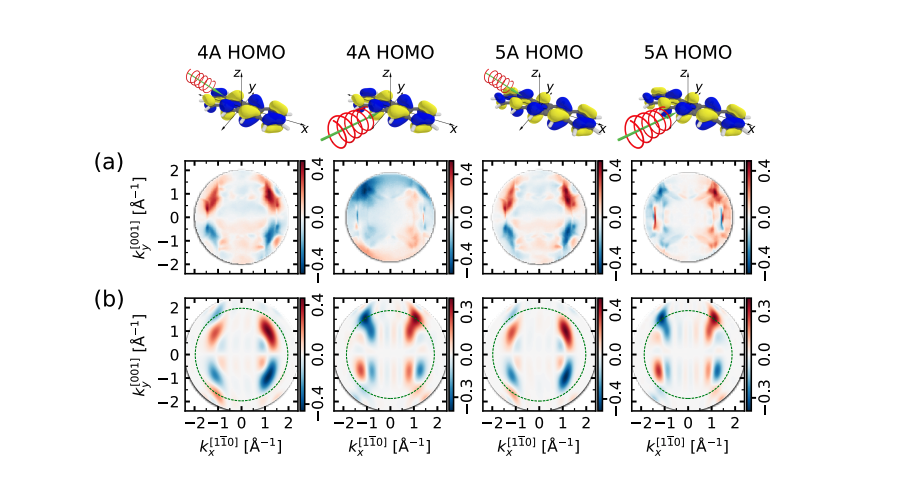
Researchers have discovered a surprising link between the polarization of light and the way electrons are emitted from organic molecules, revealing details about the final state of the photoemission process. This effect, known as circular dichroism in the angular distribution (CDAD), causes the distribution of emitted electrons to change depending on whether the light used to stimulate emission is circularly polarized clockwise or counterclockwise. The team investigated two similar molecules, tetracene and pentacene, and found that even though their initial electronic structures differ, they exhibit remarkably similar CDAD patterns. This finding challenges previous explanations that attributed CDAD solely to the initial state of the molecules, specifically the symmetry of their orbitals.
Instead, the research points to the final state of the emitted electron as the primary source of the effect. By simulating the photoemission process using advanced computational methods, the researchers demonstrated that the observed CDAD patterns originate from how electrons scatter after being ejected from the molecules. These simulations accurately reproduce the experimental results, even predicting subtle features not clearly visible in the experiments due to limitations in detector range. Importantly, the symmetry of the CDAD pattern directly correlates with the direction of the incoming light’s polarization.
When light is polarized parallel to the long axis of the molecule, the CDAD pattern exhibits one symmetry; when polarized perpendicularly, the symmetry changes. This suggests that the interaction between the light and the emitted electron is a key factor in determining the observed effect. The ability to extract information about the final state of photoemission, and even subtle contributions from different electron orbital shapes, opens new avenues for understanding electron behavior in materials and could lead to advancements in fields like spectroscopy and materials science. The research demonstrates a sensitive method for probing the final state of photoemission, offering insights beyond what is typically accessible through conventional techniques.
Photoemission Reveals Final State Chirality Origin
The research demonstrates that circular dichroism in the angular distribution (CDAD), a dependence of emitted electron angles on the handedness of light, arises from the final state of photoelectrons, even in molecules lacking inherent chirality. By comparing experimental data from tetracene and pentacene molecules deposited on a copper surface with theoretical simulations, the team reveals that the CDAD signal originates not from the molecules’ initial electronic structure, but from how electrons scatter as they leave the material. Specifically, the observed patterns are traced back to contributions from different angular momentum functions within the final state description of photoemission. The study successfully reproduces experimental CDAD momentum maps using time-dependent density functional theory, allowing researchers to decompose the signal into partial wave contributions.
The findings challenge previous interpretations suggesting a link between CDAD patterns and molecular orbital symmetry, as no such dependence was confirmed in this work. Further investigation is needed to fully understand the complex interplay of factors influencing the CDAD effect. Future research could focus on exploring the sensitivity of the CDAD signal to subtle changes in the final state, potentially offering a new method for characterizing electronic states in materials.
🗞 Circular dichroism in the photoelectron angular distribution of achiral molecules
🧠 DOI: https://doi.org/10.48550/arXiv.2507.12113


