The fundamental challenge of maintaining coherence, the quantum state enabling superposition and entanglement, limits progress in many areas of physics and chemistry. C. J. Muller investigates this issue in molecular mechanically controlled break junctions, systems exhibiting surprisingly long coherence times at room temperature. By carefully controlling the duration of current measurements within these junctions, the research demonstrates a direct link between measurement time and the loss of quantum behaviour, transitioning from observable interference patterns to classical responses. This achievement establishes measurement duration as a powerful tool for actively probing and manipulating decoherence in molecular systems, offering new avenues for understanding and potentially extending quantum effects in complex materials.
Measurement Time Controls Quantum Coherence Transition
This research details experimental observations of a molecular mechanically controllable break junction (MCB) in a partially wet phase, creating what the authors term an enclosed open quantum system. The core finding is that by manipulating the measurement time relative to the system’s decoherence time, they can observe a transition between coherent and decoherent behavior. The system allows bidirectional information flow between the molecule and its environment, unlike typical open quantum systems where information flows primarily outwards. The authors estimate the decoherence time of this system to be between 1 and 20 milliseconds at room temperature.
Researchers discovered that the measurement time acts as a control mechanism, influencing the observed quantum effects. Two distinct effects coexist within the system: one appears with longer integration times, manifesting as interleaved sinusoidal curves, and the other relates to continuous strain on the bridging molecule, resulting in a spiky pattern in current-voltage measurements. When measurements are taken very quickly, the system averages out the quantum states, losing the coherent information, but slower measurements preserve the quantum characteristics. Remarkably, the system demonstrates robustness, recovering from minor disruptions, suggesting a self-correcting mechanism.
The authors propose that a measurement disturbs the equilibrium between the molecule and its environment, triggering an exchange of information. This unique system offers a novel platform for studying decoherence and quantum measurement, providing control over the system’s behavior. Further research will investigate the observed patterns and the interplay between measurement frequency and information diffusion, potentially revealing the role of Heisenberg’s principle and the environment in influencing device behavior.
Tuning Measurement Time to Control Molecular Coherence
This study investigates how the duration of current measurements influences coherence within molecular mechanically controlled break junctions, operating within a partially wet tetrahydrofuran environment. Researchers engineered a system enabling precise control over decoherence times at room temperature, typically ranging from 1 to 20 milliseconds. The core of the work involves tuning the integration time of current measurements during current-voltage characterization, relative to the established decoherence time, to observe a transition from interference patterns to classical behavior. A key aspect of the method involves defining a measurement by the integration time, calculating current by integrating charge flow, and employing a delay time for data storage.
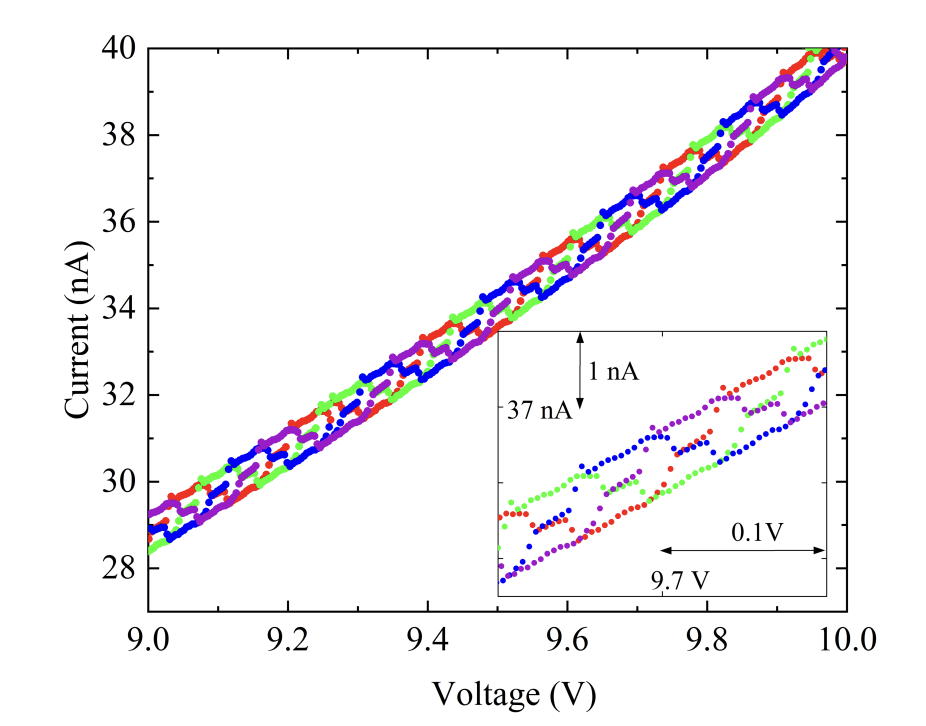
Measurements demonstrate the sensitivity of measurement time, with scans lasting 45 seconds for 20 millisecond integration times and just 5 seconds for 640 microsecond integration times. Researchers characterized the system by measuring the noise bandwidth, finding it to be 15 picoamperes for 20 milliseconds and 50 picoamperes for 640 microseconds. Data primarily utilizes fast measurements with 640 microsecond integration times, except for comparative analysis where integration time is toggled between 640 microseconds and 20 milliseconds. The team systematically varied the integration time and analyzed the resulting current-voltage curves, observing structured bands of data points indicative of quantum coherence at shorter integration times, and a transition to single averaged responses at longer times. This detailed analysis of measurement time and resulting data patterns demonstrates a novel method for probing decoherence dynamics in molecular junctions.
Measurement Duration Controls Quantum Coherence in Junctions
Scientists have demonstrated a novel method for probing quantum behavior in molecular mechanically controlled break junctions, revealing a direct link between measurement duration and coherence. The research focuses on enclosed open quantum systems, where a bridging molecule between two electrodes is studied within a carefully controlled tetrahydrofuran environment. Experiments reveal that the duration of current measurement, specifically the integration time, critically influences the observed quantum characteristics of the junction. Using integration times of 640 microseconds, scientists observed structured bands of data points in current-voltage characteristics, indicative of quantum interference.
Conversely, slower measurements with 20 millisecond integration times resulted in a single, averaged response, signifying a loss of coherence. The team meticulously recorded voltage-dependent current fluctuations, revealing that the noise bandwidth is 15 picoamperes for 20 millisecond scans and 50 picoamperes for 640 microsecond scans. Further analysis of data from a benzene dithiol junction and a tetrahydrofuran-only junction demonstrates a recurring pattern in the data. Specifically, the team observed that data points tend to favor positions at the extremes and middle of a band, with groups of four points creating distinct data lines.
This pattern is consistently observed across multiple current-voltage curves, with the amplitude of the data band typically around 1 nanoampere. Detailed analysis of grouped data reveals phase-shifted similarity between different color groups, further confirming the systematic nature of the observed behavior. These findings establish a critical relationship between measurement time and coherence, offering new insights into decoherence dynamics in molecular junctions.
Molecular Junctions Exhibit Extended Quantum Coherence
This research demonstrates that molecular mechanically controlled break junctions, operating in a partially wet environment, exhibit behaviour characteristic of enclosed open quantum systems, displaying unusually long decoherence times, ranging from one to twenty milliseconds at room temperature. By carefully adjusting the duration of current measurements, scientists can actively observe the transition from coherent quantum effects, evidenced by interference patterns in the data, to classical behaviour represented by averaged responses. This control establishes measurement duration as a key parameter for investigating decoherence dynamics within these molecular junctions, offering new insights into how quantum systems interact with their environment. Future work will focus on exploring a wider range of measurement frequencies to better characterise the system’s response and address fundamental questions about the exceptionally long decoherence times observed. The findings suggest that the influence of environmental factors, and potentially Heisenberg uncertainty, on device behaviour may have been underestimated in previous studies, opening new avenues for research in quantum mechanics and molecular electronics.
🗞 Measuring the measurement problem: controlling decoherence with measurement duration in molecular MCB junctions
🧠 ArXiv: https://arxiv.org/abs/2510.01945