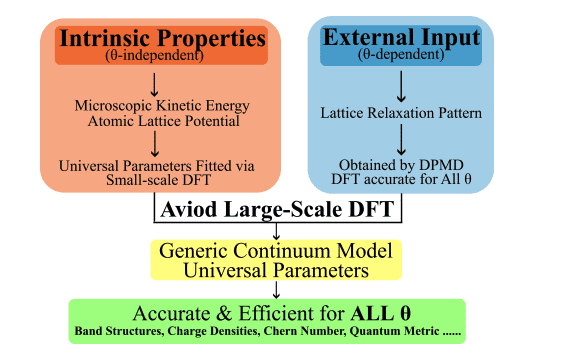
Moiré superlattice systems present a fascinating opportunity to explore new states of matter, and researchers are increasingly focused on understanding their complex behaviour. Bo Xie, Jianqi Huang from the Liaoning Academy of Materials, and Jianpeng Liu from ShanghaiTech University, have developed a new approach to modelling these systems, overcoming a significant challenge in accurately representing their properties across different twist angles. The team establishes a powerful formalism for constructing generic continuum models applicable to any moiré superlattice, ensuring that fundamental electronic properties remain consistent regardless of the twist angle. This achievement allows for more precise theoretical studies of low-energy electronic behaviour and provides a robust framework for predicting the properties of these materials, ultimately advancing our understanding of correlated and topological phenomena in moiré superlattices.
Moiré Superlattices, Lattice Relaxation and Interlayer Coupling
Researchers have developed a comprehensive theoretical framework for describing moiré superlattice systems, which arise when two-dimensional materials are twisted relative to each other. This new method accurately captures the complex interplay between the arrangement of atoms in the twisted structure and the resulting electronic properties, incorporating the effects of lattice deformation and interlayer interactions. The model predicts the formation of flat electronic bands near the material’s Fermi level, a crucial condition for observing correlated electronic states, and accurately predicts how the moiré pattern changes with twist angle and lattice constant. This work represents a significant advancement in the theoretical understanding of moiré superlattices and facilitates the prediction of novel quantum phenomena within these materials.
Machine Learning Force Field and DFT Validation
This work details the computational methods used to accurately simulate twisted bilayer MoTe₂. A machine learning force field, trained using data from over four thousand configurations, accelerates simulations while maintaining accuracy. The model utilizes a sophisticated descriptor representing the local atomic environment, and rigorous testing demonstrates low errors in predicting energy, force, and stress. First-principles calculations, performed using advanced techniques to account for van der Waals interactions, generated the training data and verified the simulation results, ensuring the accuracy, reliability, and reproducibility of the research findings while significantly reducing computational costs.
Universal Model Predicts Moiré Superlattice Properties
Scientists have created a new theoretical framework for constructing continuum models of moiré superlattices, addressing limitations in existing approaches and enabling accurate predictions across a range of twist angles. The team’s key insight lies in separating the intrinsic electronic properties of the materials from the extrinsic lattice relaxation patterns that change with angle and influence electron behaviour, allowing for the creation of a universal model using a single set of parameters. Applying this framework to twisted bilayer MoTe₂, the team obtained a parameter set that precisely reproduces first-principles results, including electronic band structures, charge density distributions, and Chern numbers, at multiple twist angles, and successfully extrapolates to smaller angles. This breakthrough lays a foundation for future theoretical studies of low-energy electronic properties in a wide range of moiré superlattice systems.
Universal Continuum Model for Twisted Layered Materials
This research presents a new formalism for constructing accurate continuum models of moiré superlattices. Scientists developed a method that distinguishes between the intrinsic electronic properties of these materials and the external effects of lattice relaxation caused by twisting, creating a universal model applicable to various twist angles using a single set of parameters. Successfully applied to twisted bilayer MoTe₂, the model accurately reproduces first-principles calculations of electronic band structures, charge distributions, and topological properties, establishing a foundation for future theoretical investigations of their low-energy electronic properties.
👉 More information
🗞 Generic continuum model formalism for moiré superlattice systems
🧠 ArXiv: https://arxiv.org/abs/2509.11747