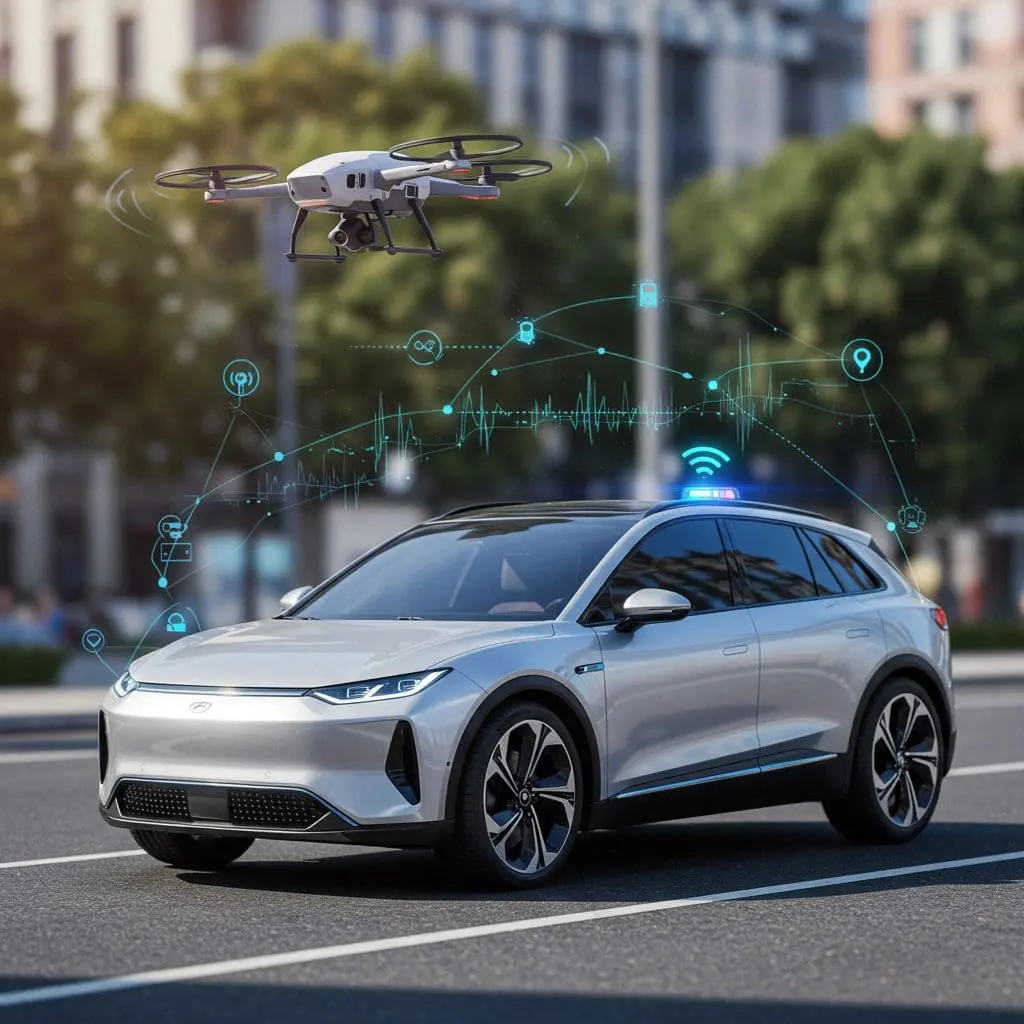
A mobile quantum key distribution system was demonstrated across drone-to-drone, drone-to-vehicle, and vehicle-to-vehicle links. The compact, modular devices achieved secure key rates of 1.6 to 20 kbps, validated by physics models accounting for platform-specific device imperfections. Future upgrades will incorporate diverse photonic sources.
The demand for secure communication continues to escalate, prompting investigation into quantum key distribution (QKD) as a potential solution. Unlike classical cryptography, QKD relies on the laws of quantum mechanics to guarantee secure communication, as any attempt to intercept the key will inevitably disturb the quantum states carrying it, alerting the legitimate parties. Researchers are now extending QKD beyond static, fibre-optic networks to encompass mobile platforms. A collaborative team, comprising Andrew Conrad, Roderick Cochran, Daniel Sanchez-Rosales, Samantha Isaac, Timur Javida, Tahereh Rezaei, A.J. Schroeder, Grzegorz Golba, Akash Guthab, Brian Wilensa, Kyle Herndon, Alex Hill, Joseph Chapman, Ian Call, Joseph Szabo, Aodhan Corrigand, Lars Kamind, Norbert Lütkenhaus, Daniel J. Gauthier, and Paul G. Kwiat, detail their work in ‘Drone- and Vehicle-Based Quantum Key Distribution’. They present a compact, adaptable QKD system deployed across various moving platforms – drones and vehicles – achieving secure key rates of 1.6 to 20 kbps, and incorporating refined physical models to account for the challenges inherent in mobile operation.
Mobile Quantum Key Distribution Achieved Between Moving Platforms
Researchers have successfully demonstrated quantum key distribution (QKD) between mobile platforms, establishing secure communication links between drones and vehicles. This development represents a progression towards practical, mobile quantum communication networks. QKD leverages the principles of quantum mechanics to encode and transmit information, guaranteeing security rooted in the fundamental laws of physics and offering a robust alternative to traditional cryptographic methods which rely on computational complexity.
The demonstrated system achieves key rates ranging from 1.6 to 20 kilobits per second. This validates the feasibility of mobile QKD networks and opens doors for secure communication in dynamic environments. The system employs free-space QKD, transmitting photons through the air to establish a secure key. Crucially, maintaining alignment between transmitter and receiver requires precise pointing, acquisition, and tracking (PAT) systems. These systems utilise beacon lasers to actively compensate for the relative motion of the platforms, ensuring a stable optical link despite movement. Advanced physical models account for non-ideal device behaviours, enhancing the accuracy of security assessments in mobile scenarios.
The system prioritises modularity, reduced size, weight, and power consumption, enabling deployment on diverse moving platforms. Successful communication has been demonstrated in drone-to-drone, drone-to-vehicle, and vehicle-to-vehicle configurations. Detailed modelling of channel parameters, including loss and background noise, optimises system performance and enhances key generation rates. Safety concerns have been addressed by ensuring the laser beacons remain eye-safe for surrounding personnel and traffic.
Researchers implemented decoy state methods, a security protocol that mitigates potential eavesdropping attacks by verifying the integrity of the quantum signals. Rigorous testing achieved secure key rates ranging from 1.6 to 20 kilobits per second in the finite-key regime – a security analysis accounting for a limited number of key exchanges. Quantum bit error rate (QBER) is carefully monitored and minimised to maintain the integrity of the quantum channel.
Advanced physical models of the QKD system incorporate non-ideal behaviours inherent in mobile platforms, such as vibrations and atmospheric turbulence. Validation against experimental data collected during flight tests confirms the predictive accuracy of these models.
Potential applications for this technology include secure military communications, critical infrastructure protection, and secure data transmission for financial institutions. Future work will focus on increasing key rates, extending communication distances, and integrating QKD with other security technologies, such as post-quantum cryptography, to create a comprehensive security solution. Collaboration with industry partners will accelerate the development and deployment of mobile QKD systems.
This research represents a significant step towards realising the full potential of quantum communications, paving the way for a future where secure communication is guaranteed by the laws of physics and offering a robust defence against evolving cyber threats.
👉 More information
🗞 Drone- and Vehicle-Based Quantum Key Distribution
🧠 DOI: https://doi.org/10.48550/arXiv.2505.17587