
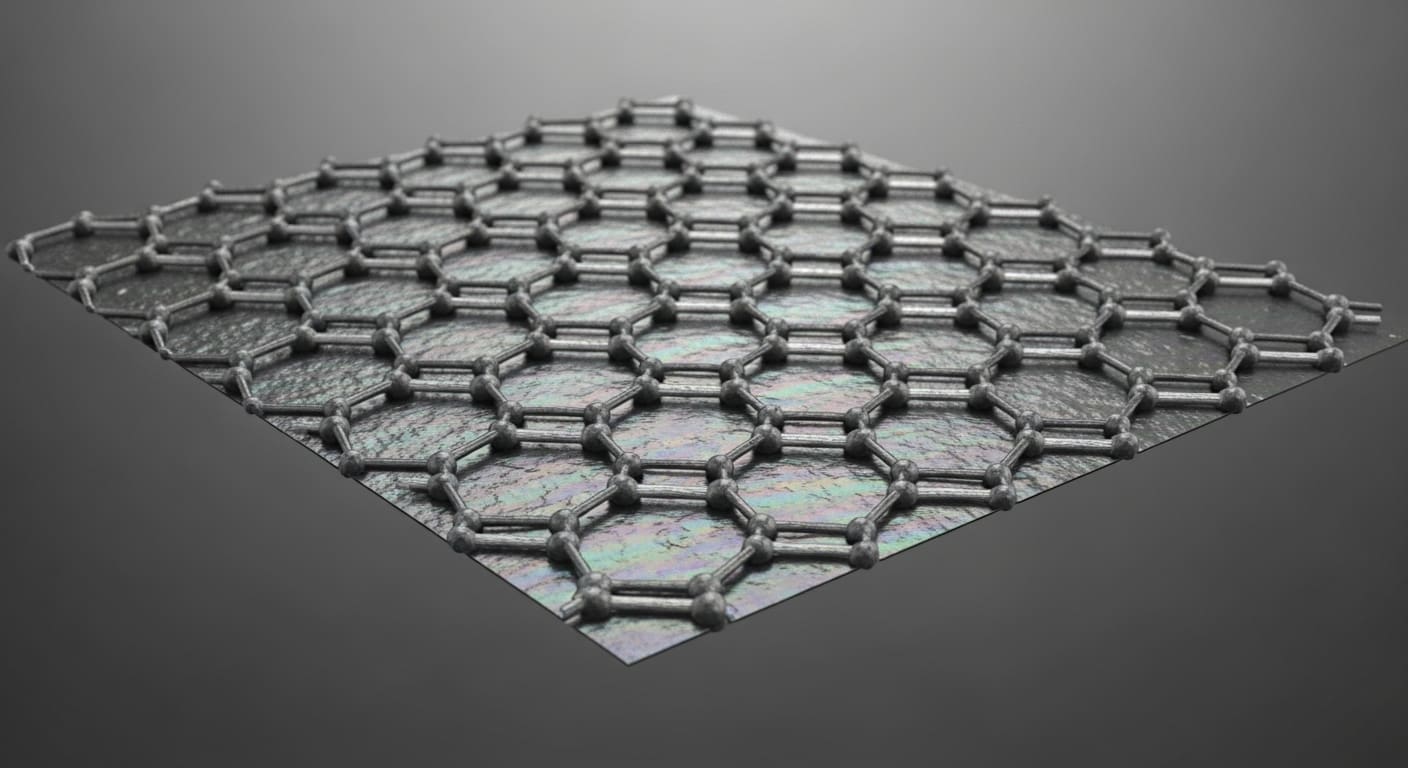
MIT physicists Shuwen Sun and Jeong Min Park have demonstrated compelling evidence of unconventional superconductivity in magic-angle twisted trilayer graphene (MATTG). Published November 6, 2025, their work at MIT’s Research Laboratory of Electronics details a novel tunneling spectroscopy platform used to probe the material’s superconducting gap. The team’s experiments represent the first conclusive observation that MATTG exhibits a non-traditional superconducting order, characterized by a gap deviating from the predictions of conventional Bardeen-Cooper-Schrieffer (BCS) theory. This finding establishes MATTG as a promising candidate for realizing higher-temperature superconductivity and advancing the field of condensed matter physics.
MIT Physicists Confirm Unconventional Superconductivity in Graphene
MIT physicists have definitively confirmed unconventional superconductivity in “magic-angle” twisted trilayer graphene (MATTG). Published in Science, the research details a novel experimental platform used to measure MATTG’s “superconducting gap” – a key property indicating how a material achieves superconductivity. Crucially, the observed gap differs significantly from conventional superconductors, confirming a unique, unconventional mechanism is at play. This finding moves the field closer to discovering materials exhibiting superconductivity at higher, more practical temperatures.
The team’s breakthrough hinged on a new method allowing real-time observation of the superconducting gap as it emerges in 2D materials. By “tunneling” electrons between layers of MATTG, researchers directly probed its superconducting state. This contrasts with previous indirect evidence, offering the most direct confirmation yet of unconventional behavior. Understanding this mechanism is vital, as unconventional superconductivity is a potential pathway towards room-temperature superconductors with revolutionary technological applications.
This research builds on the 2018 discovery of “magic-angle” graphene and the emerging field of “twistronics.” By precisely stacking and twisting graphene layers, researchers are engineering materials with exotic electronic properties. While initial observations hinted at unconventional superconductivity, this latest study provides concrete evidence, opening avenues for exploring other twisted 2D materials. The ultimate goal remains designing superconductors capable of lossless energy transfer at ambient temperatures, a “Holy Grail” for the field.
Measuring the Superconducting Gap in MATTG
MIT physicists have definitively measured the superconducting gap in magic-angle twisted trilayer graphene (MATTG), providing strong evidence for unconventional superconductivity. Unlike traditional superconductors, MATTG’s gap—a key property indicating resilience to temperature—exhibits a distinct signature. This measurement, published in Science, moves beyond indirect observations, confirming a fundamentally different mechanism driving superconductivity in this material. Understanding this mechanism is crucial for the pursuit of higher-temperature superconductors with real-world applications.
The team developed a novel experimental platform to directly “watch” the superconducting gap emerge in MATTG. This involved tunneling electrons between layers and carefully measuring the material’s response. The observed gap isn’t the simple, predictable shape seen in conventional superconductors, indicating that Cooper pairs – the carriers of superconductivity – are forming in a non-traditional way. This detailed measurement provides a crucial fingerprint for future comparisons with other potential unconventional superconductors.
This breakthrough in characterizing MATTG’s superconducting gap is significant because it advances the field of “twistronics”—the study of exotic properties arising from stacking and twisting 2D materials. Identifying and understanding unconventional superconductivity is a vital step toward designing materials that superconduct at room temperature. Researchers believe insights from MATTG could unlock the pathway to zero-resistance power grids and practical quantum computing systems.
The Emergence of Twistronics and Magic-Angle Graphene
The field of “twistronics” has exploded since 2018, stemming from the theoretical prediction that stacking graphene layers at a precise “magic angle” – approximately 1.1 degrees – would unlock exotic electronic properties. Researchers at MIT, led by Pablo Jarillo-Herrero, first experimentally created magic-angle graphene and observed unusual behaviors. This sparked investigation into multi-layered structures, including twisted tri-layer graphene (MATTG), aiming to harness unconventional superconductivity – a phenomenon promising higher-temperature superconductivity beyond traditional materials.
Recent MIT research provides the most direct evidence yet that MATTG exhibits unconventional superconductivity. Utilizing a novel experimental platform, the team measured MATTG’s “superconducting gap” – a critical property indicating the resilience of the superconducting state. Their findings demonstrate a distinctly different gap structure compared to conventional superconductors, confirming a unique, unconventional mechanism driving superconductivity within the twisted graphene layers. This gap measurement is crucial for understanding how superconductivity arises in this material.
This breakthrough is significant because conventional superconductors require extremely low temperatures to function, limiting their practical applications. Unconventional superconductors, like MATTG, offer the potential for higher-temperature operation—a “holy grail” for technologies like lossless power grids and practical quantum computing. By meticulously characterizing MATTG’s superconducting gap, researchers are not only validating a new material, but also gaining critical insights that could guide the design of future room-temperature superconductors.
How Superconductivity Enables Energy Efficiency
Superconductivity offers a pathway to drastically improved energy efficiency by eliminating electrical resistance. In conventional superconductors, electrons flow without losing energy, powering technologies like MRI machines. However, these require extremely low temperatures. Recent research at MIT focuses on “unconventional” superconductors – materials like magic-angle twisted trilayer graphene (MATTG) – that may achieve superconductivity at higher, more practical temperatures. This breakthrough could revolutionize power transmission, eliminating energy loss in electricity grids and enabling more efficient technologies.
The MIT team confirmed unconventional superconductivity in MATTG by directly measuring its “superconducting gap” – a key property indicating how robust the superconducting state is. Unlike typical superconductors, MATTG exhibits a significantly different gap structure, suggesting a unique, and potentially more versatile, superconductivity mechanism. This discovery, published in Science, provides the strongest evidence yet that MATTG’s behavior deviates from conventional superconductivity, offering a promising route toward room-temperature applications.
Researchers developed a new experimental platform to “watch” superconductivity emerge in 2D materials in real-time, allowing precise measurement of MATTG’s gap. This platform will be used to explore other 2D materials, accelerating the search for candidates with even more favorable superconducting properties. Understanding unconventional superconductors like MATTG is crucial—unlocking room-temperature superconductivity remains the “Holy Grail” of the field, promising transformative advancements in energy and computing.
Understanding Cooper Pairs and Superconducting States
Superconductivity—the frictionless flow of electricity—promises revolutionary technologies, but conventional superconductors require extremely low temperatures. Scientists are now intensely studying “unconventional” superconductors like magic-angle twisted trilayer graphene (MATTG). Recent MIT research provides the most direct evidence yet that MATTG exhibits this unconventional behavior. Crucially, the team measured MATTG’s superconducting gap – a key property indicating how robust superconductivity is – and found it distinctly different from typical superconductors, suggesting a novel mechanism at play.
The MIT team developed a new experimental platform to directly “watch” the superconducting gap emerge in 2D materials like MATTG. This allowed them to confirm the unusual nature of the material’s superconductivity. Specifically, the measured gap’s characteristics don’t align with traditional superconductivity models, strengthening the case for an unconventional pairing mechanism involving “Cooper pairs” – electrons joining forces to move without resistance. This discovery provides a crucial step towards understanding how to achieve superconductivity at higher temperatures.
MATTG’s structure—three layers of graphene stacked at a precise “magic angle”—is key to its unique properties. This field, known as “twistronics,” explores how precisely twisting 2D materials can unlock exotic electronic behaviors. By probing MATTG’s superconducting gap, researchers hope to not only understand this material better, but also unlock design principles for future room-temperature superconductors—a “Holy Grail” in materials science with the potential to transform energy transmission and computing.
Future Implications for Room-Temperature Superconductors
Recent MIT research confirms unconventional superconductivity in magic-angle twisted trilayer graphene (MATTG). Utilizing a novel experimental platform, physicists directly measured MATTG’s “superconducting gap” – a key property indicating how superconductivity arises. Unlike conventional superconductors, MATTG exhibits a distinctly different gap profile, suggesting an entirely new mechanism is at play. This is crucial because identifying these unconventional mechanisms is a vital step towards designing materials capable of superconductivity at practical, room temperatures.
The team’s breakthrough centers on precisely “watching” the emergence of superconductivity in 2D materials. This real-time observation, enabled by their new platform, allowed for definitive measurement of the superconducting gap in MATTG. Prior evidence hinted at unconventional behavior, but this provides the strongest confirmation yet. Understanding the properties of these unconventional materials – like MATTG – is expected to accelerate the search for higher-temperature superconductors, bypassing the need for costly and complex cooling systems.
This research builds on the field of “twistronics,” sparked by the creation of magic-angle graphene in 2018. By stacking and twisting atomically thin layers, researchers are engineering materials with unexpected electronic properties. The ability to control these properties, coupled with the new insights into unconventional superconductivity, offers a promising pathway toward revolutionary technologies. The “Holy Grail” remains a room-temperature superconductor, and work like this significantly narrows the search.