

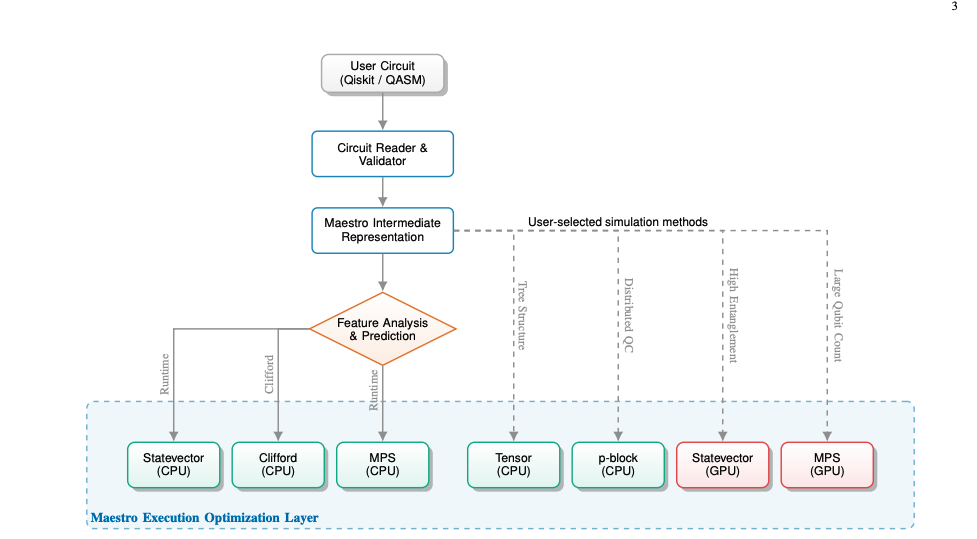
Oriol Bertomeu, Hamzah Ghayas, Adrian Roman, and Stephen DiAdamo have introduced Maestro, a unified interface designed to advance quantum circuit simulation by integrating multiple simulation paradigms – including state vector, MPS, tensor network, stabilizer, GPU-accelerated, and p-block methods – under a single API. This platform incorporates a predictive runtime model that automatically selects the optimal simulator based on circuit structure and available hardware, applying backend-specific optimizations such as multiprocessing and GPU execution. Benchmarks demonstrate Maestro outperforms individual simulators in both single-circuit and large batched settings, offering a scalable solution for quantum algorithm research and emerging distributed quantum computing architectures.
Maestro: Unified Interface for Quantum Circuit Simulation
Maestro is a unified interface designed for quantum circuit simulation, addressing the challenges posed by the increasing diversity of simulation methods and software tools. It integrates multiple paradigms—including state vector, MPS, tensor network, stabilizer, GPU-accelerated, and p-block methods—under a single API. This consolidation aims to reduce the barrier to selecting the most suitable backend for a given quantum circuit, streamlining the simulation process for researchers.
A key feature of Maestro is its predictive runtime model. This model automatically selects the optimal simulator based on the structure of the circuit being simulated and the available hardware resources. Furthermore, Maestro applies backend-specific optimizations like multiprocessing, GPU execution, and improved sampling techniques. Benchmarks demonstrate that Maestro outperforms individual simulators in both single-circuit and large batched settings, particularly in high-performance computing environments.
Developed by Oriol Bertomeu, Hamzah Ghayas, Adrian Roman, and Stephen DiAdamo, Maestro provides a scalable and extensible platform. It supports quantum algorithm research, hybrid quantum-classical workflows, and the development of emerging distributed quantum computing architectures. The work was submitted to arXiv on December 3, 2025, with identifier arXiv:2512.04216 [quant-ph].
Predictive Runtime Model and Optimization Techniques
Maestro introduces a predictive runtime model designed to optimize quantum circuit simulation. This model automatically selects the most suitable simulator – from options including state vector, MPS, tensor network, and GPU-accelerated methods – based on both the circuit’s structure and the available hardware. The goal is to bypass the challenge of selecting the best backend from a diverse set of simulation tools, improving efficiency in quantum algorithm development and validation given limitations in current quantum hardware.
The system further enhances performance through backend-specific optimizations. These include techniques like multiprocessing, GPU execution, and improved sampling methods, applied after the optimal simulator is chosen by the predictive model. Maestro integrates multiple simulation paradigms under a single API, creating a unified interface for researchers. Benchmarks demonstrate that Maestro outperforms individual simulators, especially in high-performance computing environments, across both single circuits and large batched settings.
Maestro provides a scalable and extensible platform for several areas of quantum computing research. It supports hybrid quantum-classical workflows and emerging distributed quantum computing architectures. The system’s design enables improvements in quantum algorithm research by streamlining the simulation process, and overcoming limitations of existing hardware through optimized software selection and execution.
Scalability for Quantum Research and Computing
Maestro is a unified interface designed to address challenges in quantum circuit simulation, a critical step in developing and validating quantum algorithms given current hardware limitations. It integrates multiple simulation paradigms—including state vector, MPS, tensor network, stabilizer, GPU-accelerated, and p-block methods—under a single API. This consolidation aims to lower the barrier to selecting the most suitable simulation backend for a given quantum circuit, streamlining the research process.
The system incorporates a predictive runtime model that automatically chooses the optimal simulator based on circuit structure and available hardware. Maestro also applies backend-specific optimizations like multiprocessing, GPU execution, and improved sampling techniques. Benchmarks demonstrate performance gains in both single-circuit and large batched settings, particularly within high-performance computing environments, suggesting its efficiency and scalability.
Maestro provides a scalable and extensible platform applicable to several areas of quantum computing research. These include quantum algorithm research, hybrid quantum-classical workflows, and the development of emerging distributed quantum computing architectures. The unified interface and automated optimization features position Maestro as a tool to help advance the field, despite limitations in current quantum hardware scale and quality.
Maestro provides a scalable, extensible platform for quantum algorithm research, hybrid quantum-classical workflows, and emerging distributed quantum computing architectures.
Source: https://arxiv.org/abs/2512.04216


