

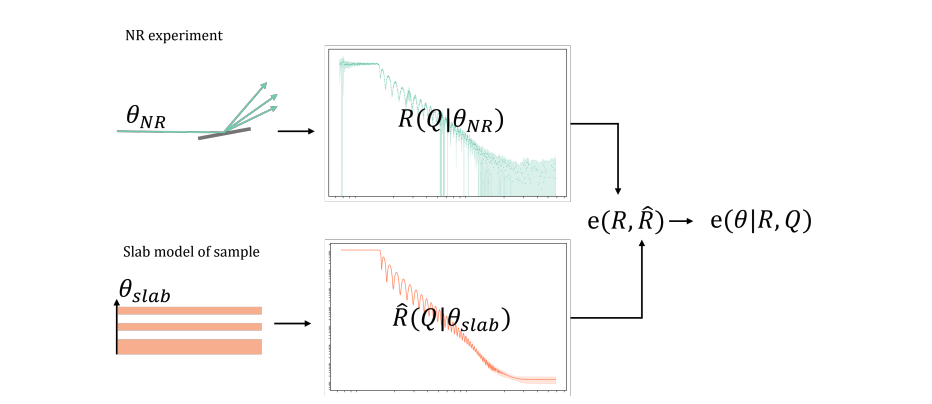
Neutron reflectometry offers a detailed way to investigate the properties of surfaces and interfaces, but extracting meaningful data from experiments often requires solving complex mathematical problems, particularly when analysing layered materials like those found in batteries or organic electronics. Max Champneys, Andrew Parnell, and Philipp Gutfreund, along with Maximilian Skoda, J. Patrick Fairclough, and Timothy Rogers, present a new method that streamlines this process by directly optimising the analysis of neutron reflectivity data using gradient descent. This technique leverages automatic differentiation to calculate precise gradients, allowing researchers to apply advanced optimisation tools previously unavailable in neutron reflectometry, and significantly improving both speed and accuracy. The team demonstrates the power of this approach with successful analyses of both simple oxide films and the complex layered structures found in organic light-emitting diodes, and they have also released an open-source software library to enable wider adoption of this gradient-based method.
Variational Inference for Neutron Reflectometry Analysis
This research details a new approach to analyzing neutron reflectometry data, focusing on efficiently determining the structural properties of thin films and interfaces. Analyzing neutron reflectometry data to extract structural information is computationally challenging, especially for complex multilayer systems. Traditional methods can be slow and require significant computational resources. This team proposes using variational inference (VI), employing gradient descent optimization, to efficiently approximate the distribution of model parameters, offering a faster alternative to Markov Chain Monte Carlo (MCMC) methods.
They utilize a Gaussian distribution as a simplified representation, streamlining the optimization process. The VI approach was benchmarked against Hamiltonian Monte Carlo (HMC) to assess its accuracy and efficiency. The team used a slab model to represent the layered structure of the sample, analyzing datasets from crystalline quartz, organic LED devices, and a lipid bilayer. Results demonstrate that VI is significantly faster than HMC, allowing for quicker analysis of complex datasets and providing accurate parameter estimates with good fits to the experimental data. However, VI tends to underestimate the variance of the distribution, a known limitation due to the optimization process.
The team achieved comparable results on the lipid bilayer benchmark, demonstrating the viability of the VI approach. This research offers a valuable trade-off between computational speed and accuracy. The authors emphasize the importance of carefully considering the limitations of VI in terms of uncertainty quantification. The proposed method can be applied to a wide range of neutron reflectometry data analysis problems, including materials science, biology, and nanotechnology.
Automatic Differentiation Streamlines Neutron Reflectometry Analysis
Scientists have developed a novel approach to analyzing neutron reflectometry data, overcoming limitations inherent in traditional methods that struggle with complex multilayer structures. Neutron reflectometry is a powerful technique for probing surfaces and interfaces, but extracting meaningful information typically requires solving complex inverse problems. This team harnessed the power of automatic differentiation to directly optimize the forward calculation of reflectivity, enabling rapid and accurate data analysis. The breakthrough centers on calculating exact gradients of the error function, allowing researchers to employ modern optimization and inference techniques.
Demonstrating the efficacy of this approach, the team successfully analyzed data from a thick oxide quartz film, achieving a low χ2 error, indicating the new method effectively identifies optimal parameters for accurate material characterization. Furthermore, the researchers showcased robust co-fitting performance with organic light-emitting diode multilayer devices, highlighting the technique’s ability to handle complex systems. To facilitate wider adoption, they have released an open-source software library, refjax, built on the JAX ecosystem, providing fast computation of reflectivity and gradients. This library allows researchers to freely apply a variety of optimization routines and benefit from features like just-in-time compilation, parallelism, and GPU acceleration.
Efficient Nanoscale Interface Analysis via Gradient Descent
This research introduces a new method for analysing data from neutron reflectometry, a technique used to examine surfaces and interfaces at the nanoscale. Traditionally, interpreting neutron reflectometry data involves solving complex inverse problems, which can be inefficient, particularly for multilayer materials. The team has developed a system that uses gradient descent on the forward reflection model itself, allowing for faster and more efficient data analysis. This approach leverages automatic differentiation to calculate precise gradients, enabling the application of modern optimisation and machine learning techniques to neutron reflectometry data.
The method was successfully demonstrated on both a simple quartz film and the more complex structure of organic light-emitting diode (OLED) devices, achieving state-of-the-art performance in both cases. Importantly, the researchers have made their software, a library of differentiable reflectometry kernels in Python, openly available, facilitating its adoption by other researchers. While acknowledging the method’s current scope is limited to neutron reflectometry, the authors envision extending this approach to other indirect measurement techniques like small-angle neutron scattering and ellipsometry. Future work will focus on developing more comprehensive forward models for these related techniques.
🗞 Neutron Reflectometry by Gradient Descent
🧠 ArXiv: https://arxiv.org/abs/2509.06924


