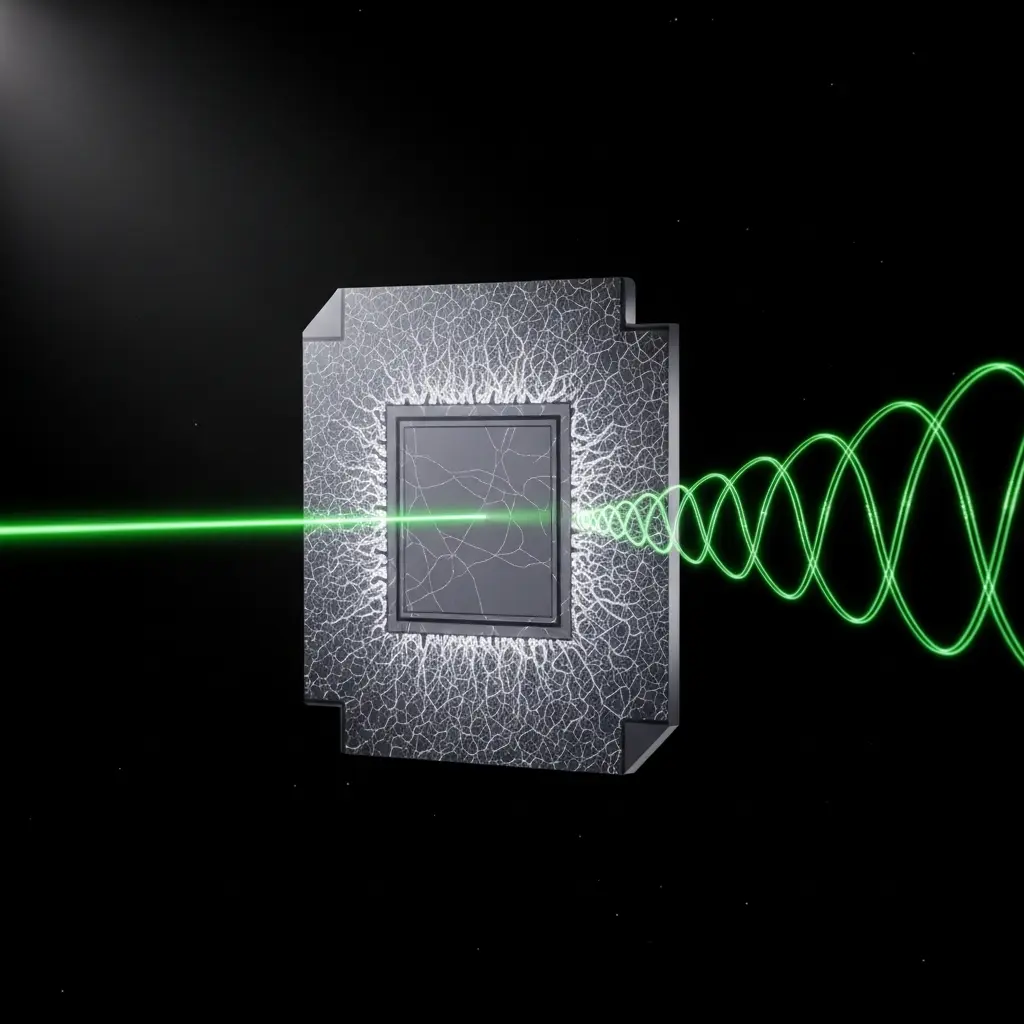
Researchers have developed an integrated photonic circuit capable of both generating and analysing arbitrary polarization states of light, a crucial advancement for technologies ranging from coherent communications to polarimetric sensing. Carson G. Valdez, Anne R. Kroo, Anna J. Miller, Charles Roques-Carmes, and colleagues at Stanford University, alongside David A. B. Miller and David A. B. Olav Solgaard, also from Stanford University, have demonstrated a device fabricated using CMOS-compatible processes that offers reconfigurable control over the full polarization degree of freedom of coherent light on a single chip. This innovation is significant because it moves beyond traditional, destructive polarization measurement techniques, preserving the optical signal for further processing and eliminating the need for bulky external optics, paving the way for more robust and scalable photonic integrated systems.
For decades, manipulating light’s polarisation has demanded bulky, delicate optical setups — now, a single integrated photonic chip performs both the creation and measurement of any polarisation state with unprecedented precision. This compact device promises more stable and flexible optical systems for sensing and information technology, and scientists have long sought methods for precisely controlling and measuring the polarization of light. This device, built using techniques compatible with standard computer chip manufacturing. Offers reconfigurable access to the complete polarization degree of freedom of coherent light on a single platform.
Eliminating bulk optics for polarization analysis
Theoretical Basis for Polarization Analysis
Conventional methods for determining polarization, such as Stokes vector measurement, often rely on directly detecting the light, which destroys the signal and limits further processing. Once separated, a network of Mach-Zehnder Interferometers, tiny optical circuits that split and recombine light beams, manipulates the polarization states with remarkable precision. The implications of this effort extend beyond simply miniaturizing existing polarization control technology.
By integrating both generation and analysis onto a single chip, the need for bulky external optics is eliminated, paving the way for more stable and scalable photonic systems. Researchers demonstrates the ability to generate any polarization state, effectively mapping the entire Poincaré sphere, a geometrical representation of all possible polarization states, within the integrated circuit.
It accurately measures Stokes vectors, a standard way to characterise polarization, directly on the chip. Since the device is fabricated using CMOS-compatible processes, it promises a path toward large-scale, reproducible manufacturing. Unlike many specialised photonic devices that require complex fabrication techniques. By offering a stable, compact, and reprogrammable solution for polarization control, this project unlocks new possibilities for a wide range of photonic applications.
Validating performance of the grating coupler structure
Evaluating Grating Coupler Performance on Silicon
Polarization splitting performance and complex amplitude characteristics of a silicon-on-insulator grating coupler
Once fabricated on a silicon-on-insulator platform, the polarization splitting grating coupler (PSGC) demonstrated an 86.4% mode overlap with a 10.4μm mode field diameter Gaussian field profile at 1.55μm. Simulations, utilising a 3-dimensional finite-difference time-domain method, revealed an insertion loss of -2.9 dB at 1.55μm for the coupler, with a minimum loss of -2.6 dB achieved at 1.535μm, indicating efficient light coupling.
These losses are primarily attributed to substrate effects stemming from the device’s near-perfect vertical symmetry and the 70nm partial etch depth used during fabrication. Meanwhile, the project detailed the complex amplitudes measured at each port of the PSGC for various polarization states. With ports B and D registering zero amplitude.
Observed outcomes across various polarization states
Measured Outcomes for Different Polarization States
Conversely, vertical linear polarization yielded a complex amplitude of 1√2 * e^(jθ) at ports B and D. Demonstrating equal distribution across all four outputs. Right-hand circular polarization resulted in complex amplitudes of 1/2 * e^(jθ) and 1/2 * e^(j(θ-π/2)) at alternating ports. In turn, this device utilizes a symmetric, 70nm partial etch to function both as a polarizing beam splitter and a polarization rotator, and finite-difference time-domain (FDTD) simulations at 1.550μm revealed an insertion loss of -2.9 dB. With approximately half the light directed towards the substrate due to the grating’s vertical symmetry.
Once fabricated, the PSGC couples both horizontally and vertically polarized light into the quasi-TE mode of their respective waveguide ports, effectively characterising the input polarization state through the resulting complex amplitudes. Beyond the PSGC, a two-stage binary tree photonic mesh comprised of Mach-Zehnder Interferometers (MZIs) is central to both polarization analysis and generation.
These MZIs recombine the outputs from the PSGC. Employing self-configuration algorithms to direct the signal to a single output port of the photonic integrated circuit. Meanwhile, the phase shifter settings within the MZIs, needed for interferometric recombination, contain the information required to determine the input polarization state. Their design differs from conventional Stokes parameter measurement techniques by preserving the input optical signal for subsequent processing.
By operating the binary tree to generate specific complex amplitudes at the PSGC ports, the system achieves programmatic control over the launched polarization state. The device was fabricated using CMOS-compatible processes in a commercial foundry, ensuring scalability and reproducibility for system-level integration. Leveraging the horizontal symmetry of a normal-incidence beam.
For analysis, the device relies on a normal-incidence beam with a dominant electric field component out of plane — equally coupling into the fundamental quasi-TE mode at opposing ports and maintaining phase coherence. Similarly, a beam with a dominant electric field along the x-axis is split with zero relative phase between the vertical ports. Owing to the 90° rotational symmetry. By breaking the central-symmetric condition with beam offset, the PSGC’s ports individually respond, enabling detailed polarization state determination.
Integrated photonic circuit advances on-chip polarization control and measurement
Scientists have created a compact photonic circuit capable of both generating and measuring the polarization of light. For years, manipulating light polarization has demanded bulky, discrete optical components, hindering the creation of truly integrated photonic systems. This new device, fabricated using standard CMOS processes, sidesteps that limitation by confining all polarization control and analysis onto a single chip.
The non-destructive nature of the on-chip measurement, preserving the optical signal for further processing, opens possibilities previously unavailable with traditional methods relying on direct detection. The challenge of integrating complex polarization control stems from the difficulty of precisely shaping light’s electromagnetic field within a small space.
Previous attempts often involved trade-offs between size, accuracy, and signal loss — by leveraging self-configuring optics and advanced fabrication techniques, researchers have demonstrated full control over the Poincaré sphere, a representation of all possible polarization states. The implications extend far beyond fundamental optics. However, the groundwork laid by this effort could soon enable a new generation of compact, flexible, and high-performance photonic instruments.
🗞 Integrated Photonic Polarization Synthesizer and Analyzer
🧠 ArXiv: https://arxiv.org/abs/2602.17024