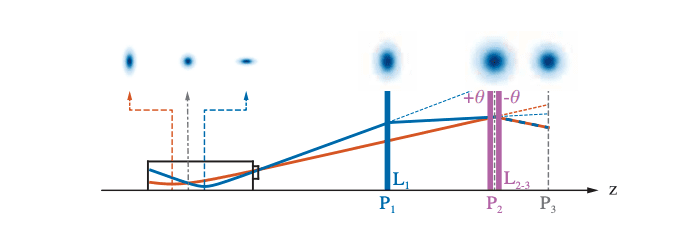
Maintaining precise control over laser beam shape is fundamental to a diverse range of scientific and industrial applications, from high-resolution microscopy and advanced manufacturing to quantum computing and atomic physics. Imperfections in optical systems frequently introduce aberrations, notably astigmatism and ellipticity, which distort the beam’s expected Gaussian profile and degrade performance. Researchers at the University of Waterloo, Soroush Khoubyarian, Anastasiia Mashko, and Alexandre Cooper, detail a novel and comparatively simple method for correcting these distortions in their article, ‘Correcting astigmatism and ellipticity in Gaussian beams using a cylindrical lens pair with tunable focal lengths’. Their approach utilises three cylindrical lenses, strategically arranged to reshape the elliptical beam and overlap its separate beam waists, effectively producing a circular Gaussian beam without the need for precisely matched focal lengths, offering a balance between the flexibility of active correction systems and the simplicity of passive techniques.
Maintaining precise control over laser beam shape presents a continuing challenge across diverse scientific and industrial applications, and researchers continually seek methods to correct aberrations, such as astigmatism and ellipticity, that degrade performance. This study details a novel, compact technique employing three cylindrical lenses to transform astigmatic, elliptical beams into circular Gaussian beams, a configuration essential for optimal performance in many optical systems. A Gaussian beam, characterised by its bell-shaped intensity profile, represents the ideal for many applications due to its minimal diffraction and focused spot size.
The core innovation lies in the use of a biaxial lens pair, positioned within the plane of symmetry and adjusted via relative angular displacement, allowing for precise overlap of the two beam waists characteristic of astigmatic beams, effectively achieving circularisation. Beam waist refers to the point where the beam radius is smallest. Astigmatism causes the beam to focus differently in orthogonal planes, resulting in two distinct beam waists. Theoretical modelling validates the efficacy of this approach, while numerical simulations quantify its resilience to practical imperfections, confirming its reliability.
Experimental demonstration confirms the method’s ability to circularise the output of a standard commercial laser source, representing an advantage over existing active correction methods. Active correction typically involves deformable mirrors or spatial light modulators, which are often bulky, expensive, and can reduce the efficiency with which the laser light propagates, known as diffraction efficiency. The simplicity and compactness of the three-lens system facilitate seamless integration into both laboratory setups and industrial applications, offering a versatile solution for a wide range of optical challenges.
This research builds upon existing work in optical tweezers and atom manipulation, specifically addressing the need for highly controlled laser beams for creating and controlling large arrays of atoms. Optical tweezers use highly focused laser beams to physically trap and manipulate microscopic objects. Precise beam shaping, as demonstrated here, is crucial for achieving uniform trapping potentials and minimising aberrations that can disrupt atom arrays, and this capability opens new avenues for research in quantum physics and materials science. Uniform trapping potentials ensure that atoms are held stably within the array.
Future research will focus on optimising the performance of the three-lens technique and exploring its potential for correcting other types of beam aberrations. Researchers also plan to investigate the use of this technique in more complex optical systems, such as high-power lasers and adaptive optics systems. Adaptive optics systems correct for distortions caused by atmospheric turbulence or imperfections in optical components. The ultimate goal is to develop a versatile and reliable beam shaping technology that can meet the ever-increasing demands of the scientific and industrial communities.
👉 More information
🗞 Correcting astigmatism and ellipticity in Gaussian beams using a cylindrical lens pair with tunable focal lengths
🧠 DOI: https://doi.org/10.48550/arXiv.2506.22308