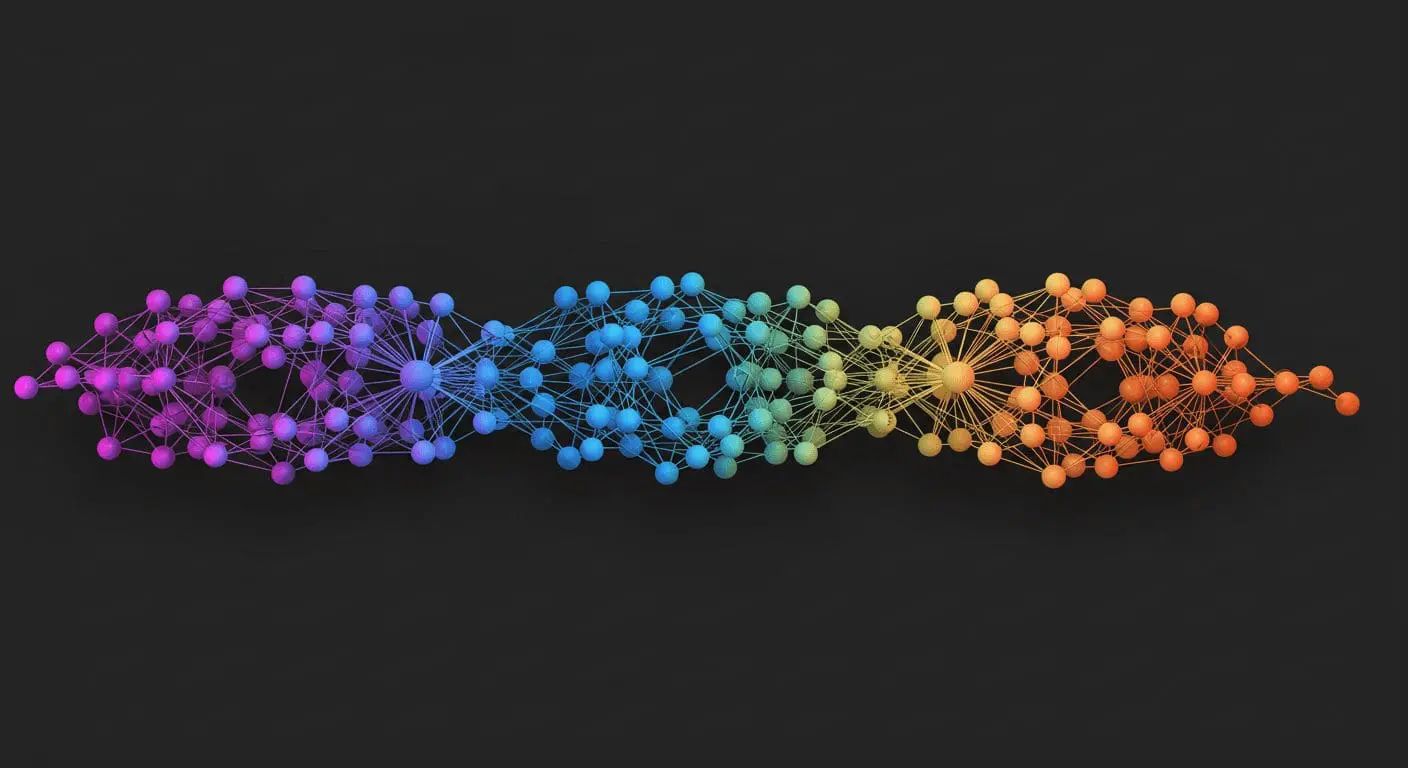
On April 10, 2025, a collaborative research team published Pushing the Accuracy Limit of Foundation Neural Network Models with Quantum Monte Carlo Forces and Path Integrals, detailing an innovative integration of quantum computing techniques with machine learning to enhance chemical simulations. Their work leverages exascale computing resources for precise calculations, enabling advancements in understanding complex biological systems through advanced molecular dynamics modeling.
The research introduces an end-to-end strategy for generating synthetic chemistry datasets using exascale computing resources. A GPU-accelerated protocol produces highly accurate quantum chemistry data, leveraging layers of computational methods from DFT to QMC and s-CI.
These datasets are integrated with a foundation ML model, enabling beyond-DFT accuracy in molecular dynamics simulations. The approach successfully simulates large-scale systems, including a 1 million-atom plant virus under physiological conditions, allowing the study of complex chemical interactions such as bond breaking and proton transfers. This marks the first time such quantities have been handled at this scale, advancing the understanding of biosystem machinery.
In computational chemistry, traditional methods grapple with the curse of dimensionality, where complexity grows exponentially with additional variables, hindering large molecular system studies. Quantum computing emerges as a promising solution, efficiently handling intricate complexities in molecular simulations.
The integration of quantum algorithms with machine learning models presents hybrid quantum-classical approaches, leveraging classical computers and emerging quantum processors for specific tasks. This synergy addresses computational challenges effectively, even as quantum technology evolves.
Enhanced core potentials (ECPs), approximations simplifying electron behavior around nuclei, are refined through correlated calculations enhanced by quantum methods. These improved ECPs offer a more accurate representation of molecular interactions, crucial for precise simulations and understanding real-world dynamics.
The impact on research is significant. Reduced computational costs and increased accuracy enable the exploration of larger molecules without prohibitive resource demands. For instance, predicting reaction mechanisms in catalysis becomes feasible, aiding new materials and pharmaceutical development.
Looking ahead, quantum computing’s transformative potential for computational chemistry enhances efficiency and precision, opening doors to studying complex systems previously beyond reach. This innovation could drive breakthroughs in drug discovery, energy production, and materials science, where understanding molecular behaviour is paramount.
The synergy between quantum computing and classical methods offers a pathway to overcome traditional limitations, promising more efficient and accurate molecular studies that could reshape various scientific fields.
👉 More information
🗞 Pushing the Accuracy Limit of Foundation Neural Network Models with Quantum Monte Carlo Forces and Path Integrals
🧠 DOI: https://doi.org/10.48550/arXiv.2504.07948