

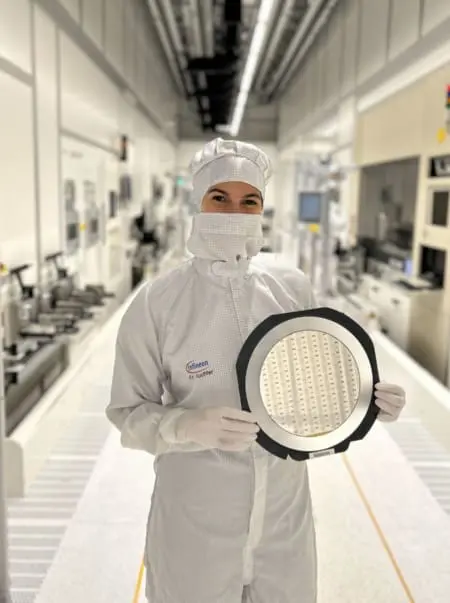
Infineon Technologies AG, a global leader in semiconductor solutions, has partnered with Quantinuum, a pioneer in integrated, full-stack quantum computing, to accelerate the development of powerful ion traps for future generations of quantum computers.
This strategic partnership aims to drive progress in fields such as generative chemistry, material science, and artificial intelligence. Infineon will provide expertise in process development, fabrication, and quantum processing unit (QPU) technology, while Quantinuum brings its cutting-edge ion-trap design expertise and experience with operating high-performance commercial quantum computers.
Richard Kuncic, Senior Vice President and General Manager Power Systems at Infineon Technologies, expressed excitement about the partnership, which combines the companies’ strengths to push the boundaries of quantum computing. Dr. Rajeeb Hazra, President and CEO of Quantinuum, emphasized that this collaboration is key to delivering on their commitment to reach universal fault-tolerance in 2029.
Accelerating Quantum Computing towards Real-World Applications
The partnership between Infineon Technologies AG, a leading semiconductor solutions provider, and Quantinuum, a pioneer in integrated full-stack quantum computing, aims to accelerate the development of powerful ion traps for future generations of quantum computers. This collaboration brings together Infineon’s expertise in process development, fabrication, and quantum processing unit (QPU) technology with Quantinuum’s cutting-edge ion-trap design expertise and experience with operating high-performance commercial quantum computers.
The partnership is expected to drive progress in fields such as generative chemistry, material science, and artificial intelligence. By combining their strengths, the companies aim to develop larger, more powerful machines that can solve meaningful real-life problems. Infineon’s Senior Vice President and General Manager Power Systems, Richard Kuncic, emphasized the importance of this collaboration, stating that it will “push the boundaries of quantum computing” and enable the development of more sophisticated ion traps.
Infineon has been innovating in the field of trapped-ion quantum processing units (QPUs) since 2017, applying its expertise in high-volume processing technologies to develop technologies like integrated photonics and control electronics. These advancements will enable partners to scale the qubit count of their machines. In contrast, Quantinuum’s hardware approach involves trapping charged atoms with electromagnetic fields, which can be manipulated and encoded with information using microwave signals and lasers. This design has distinct advantages over other quantum hardware, including higher fidelities and longer coherence times.
The Quest for Universal Fault-Tolerance
Quantinuum’s mission is to accelerate useful quantum computing, with a roadmap to reach universal fault-tolerance by 2029. The partnership with Infineon is key to delivering on this commitment. Engineers from both companies have been working together for over a year and will intensify their efforts under the current partnership to develop powerful ion traps for Quantinuum’s next-generation quantum computers.
Universal fault-tolerance is a critical milestone in the development of practical quantum computing, as it would enable the creation of robust and reliable quantum systems. Achieving this goal would require significant advancements in ion trap design, materials science, and control electronics. The collaboration between Infineon and Quantinuum is expected to play a crucial role in driving progress towards this ambitious target.
Ion Trap Design and Quantum Computing
Ion traps are a critical component of trapped-ion quantum computers, which currently hold the world records in key performance benchmarks such as 2-qubit gate fidelity, quantum volume, and cross-entropy benchmark fidelity. To deliver even better fidelity at greater scale and achieve commercial advantage, larger and more sophisticated ion traps are needed.
The design of ion traps involves trapping charged atoms with electromagnetic fields, which can be manipulated and encoded with information using microwave signals and lasers. This approach has distinct advantages over other quantum hardware, including higher fidelities and longer coherence times. However, scaling up the size and complexity of ion traps while maintaining their performance is a significant technical challenge.
The Role of Partnerships in Quantum Computing
The partnership between Infineon and Quantinuum highlights the importance of collaborations in driving progress in quantum computing. By combining their strengths and expertise, companies can accelerate the development of new technologies and overcome complex technical challenges.
In the field of quantum computing, partnerships are essential for driving innovation and achieving commercial success. Companies like Infineon and Quantinuum are leading the way in developing powerful quantum computers and advanced software solutions that can drive breakthroughs in materials discovery, cybersecurity, and next-gen quantum AI. As the industry continues to evolve, collaborations between companies, academia, and governments will play a critical role in shaping the future of quantum computing.
External Link: Click Here For More


