

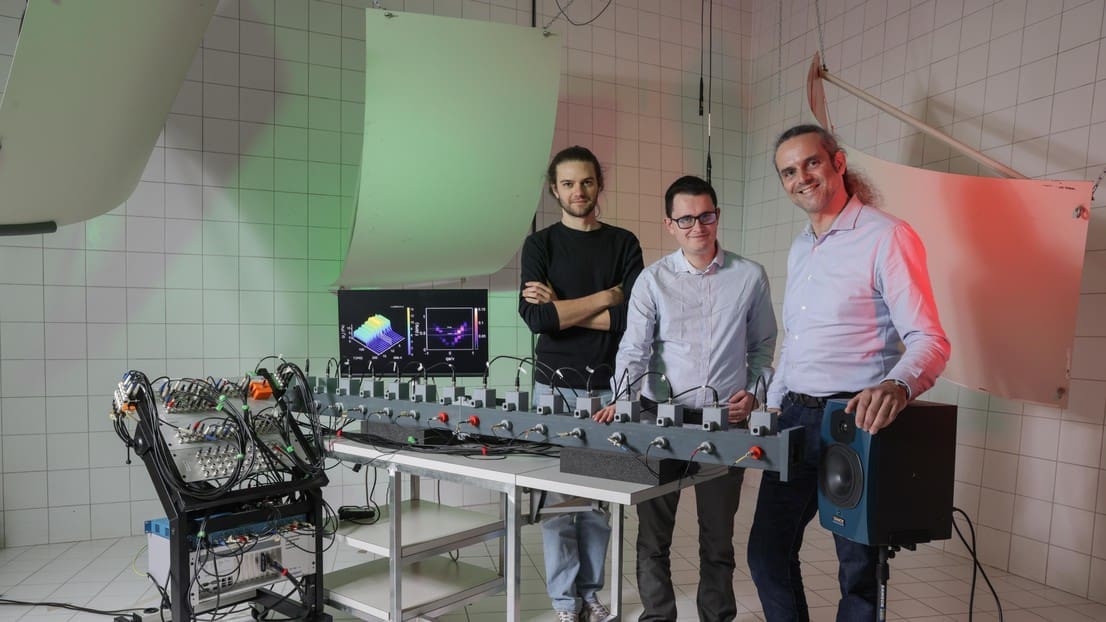
EPFL researchers have developed an acoustic system using metamaterials to study quantum phenomena in condensed matter atoms without perturbation. The team, led by Mathieu Padlewski along with Hervé Lissek and Romain Fleury, aims to create an acoustic analog of a quantum computer. Their system allows direct probing of sound waves, enabling the observation of superposed states akin to Schrödinger’s cat thought experiment. Potential applications include telecommunications and energy harvesting.
Quantum physics faces significant challenges due to the sensitivity of quantum systems when measured. The act of observation often disrupts the system, making it difficult to study phenomena such as superposition states in condensed matter. To address these limitations, researchers at EPFL have developed an innovative acoustic system using metamaterials.
This system consists of small cubes arranged in a line, functioning as “acoustic atoms.” By generating and measuring sound waves through this structure, the researchers can observe quantum phenomena like superposed states without disrupting them. The robustness of sound waves compared to quantum systems enables precise control and measurement, offering a stable environment for studying complex quantum behaviours.
The system’s architecture, resembling biological structures like the cochlea, enables efficient processing of sound frequencies. This biomimetic approach not only enhances our understanding of auditory processes but also opens new avenues for developing medical devices that address hearing impairments such as tinnitus.
Beyond medical applications, the acoustic system presents a promising platform for analog computing inspired by quantum principles. By leveraging sound waves, researchers can explore non-separable states and information processing akin to quantum computers, potentially offering a more robust alternative for handling large datasets. This approach could pave the way for scalable solutions in computational tasks that require parallel processing capabilities.
In essence, the acoustic system at EPFL exemplifies how sound waves can serve as an accessible medium for exploring quantum phenomena, bridging the gap between theoretical concepts and practical applications. This innovation not only advances our comprehension of quantum mechanics but also fosters interdisciplinary advancements in technology and medicine.
Schrödinger’s Cat Inspired by Quantum Principles
The fragility of quantum systems poses challenges for studying phenomena such as superposition states in condensed matter. Traditional approaches often disrupt these delicate states during measurement, complicating efforts to observe and analyze them directly.
To address this limitation, researchers at EPFL have developed an innovative acoustic system using metamaterials. This system consists of small cubes arranged in a line, functioning as “acoustic atoms.” By generating and measuring sound waves through this structure, the researchers can observe quantum phenomena like superposed states without disrupting them.
The robustness of sound waves compared to quantum systems enables precise control and measurement, offering a stable environment for studying complex quantum behaviors. This approach not only advances our understanding of quantum mechanics but also opens new possibilities for technological applications, including analog computing inspired by quantum principles.
The system’s architecture, resembling biological structures like the cochlea, enables efficient processing of sound frequencies. This biomimetic approach enhances our understanding of auditory processes and opens new avenues for developing medical devices that address hearing impairments such as tinnitus.
Beyond medical applications, the acoustic system presents a promising platform for analog computing inspired by quantum principles. By leveraging sound waves, researchers can explore non-separable states and information processing akin to quantum computers, potentially offering a more robust alternative for handling large datasets. This approach could pave the way for scalable solutions in computational tasks that require parallel processing capabilities.
In essence, the acoustic system at EPFL exemplifies how sound waves can serve as an accessible medium for exploring quantum phenomena, bridging the gap between theoretical concepts and practical applications. This innovation not only advances our comprehension of quantum mechanics but also fosters interdisciplinary advancements in technology and medicine.
Towards an Acoustic Analog Computer Inspired by Quantum Principles
The robustness of sound waves compared to quantum systems enables precise control and measurement, offering a stable environment for studying complex quantum behaviors. This approach not only advances our understanding of quantum mechanics but also opens new possibilities for technological applications, including analog computing inspired by quantum principles.
The system’s architecture, resembling biological structures like the cochlea, enables efficient processing of sound frequencies. This biomimetic approach enhances our understanding of auditory processes and opens new avenues for developing medical devices that address hearing impairments such as tinnitus.
Beyond medical applications, the acoustic system presents a promising platform for analog computing inspired by quantum principles. By leveraging sound waves, researchers can explore non-separable states and information processing akin to quantum computers, potentially offering a more robust alternative for handling large datasets. This approach could pave the way for scalable solutions in computational tasks that require parallel processing capabilities.
In essence, the acoustic system at EPFL exemplifies how sound waves can serve as an accessible medium for exploring quantum phenomena, bridging the gap between theoretical concepts and practical applications. This innovation not only advances our comprehension of quantum mechanics but also fosters interdisciplinary advancements in technology and medicine.
More information
External Link: Click Here For More


