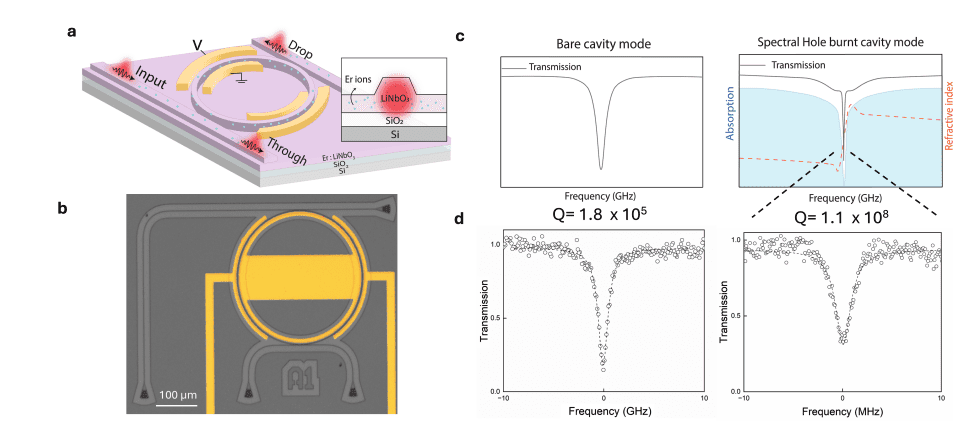
On April 28, 2025, a study titled Ultra High-Q tunable microring resonators enabled by slow light was published, showcasing the development of highly efficient optical resonators using slow light phenomena. The research achieved Q-factors exceeding previous capabilities and demonstrated dynamic control over resonance shapes, offering potential improvements in quantum sensing applications.
The research demonstrates ultra-high quality factors in nanophotonic resonators by implementing spectral hole burning in erbium-doped lithium niobate microring resonators, achieving Q-factors exceeding previous limits. The study reveals dynamically controllable Fano lineshapes through electro-optic tuning and presents a theoretical model explaining experimentally observed linewidths narrower than expected due to reduced erbium dephasing under strong optical drive.
In the realm of quantum sensing, a groundbreaking integration of rare-earth ions into lithium niobate thin films is poised to redefine precision detection. This innovative approach leverages the unique optical properties of rare-earth ions, such as erbium, which offer long-lived excited states ideal for quantum memory applications. When embedded in lithium niobate—a material celebrated for its electro-optic and piezoelectric properties—these ions create a platform that excels in both sensitivity and tunability.
Recent research has highlighted the potential of cavity-enhanced narrowband spectral filters using rare-earth ions doped into thin-film lithium niobate. These systems exploit the sharp spectral lines produced by excited ions, enabling precise control and measurement. This advancement not only enhances quantum sensing precision but also opens doors to applications in telecommunications and metrology.
The integration of rare-earth ions into lithium niobate
The integration of rare-earth ions into lithium niobate thin films is a complex yet rewarding endeavor. Lithium niobate’s crystal structure facilitates efficient light-matter interaction, making it an ideal host for quantum emitters like rare-earth ions. When excited, these ions emit photons at specific wavelengths, creating narrow spectral lines that can be meticulously controlled and measured.
A pivotal advancement in this field is the use of photonic structures supporting Fano resonances. This phenomenon, where interference between different light paths creates sharp spectral features, allows researchers to develop highly sensitive filters capable of detecting minute environmental changes. By exploiting these resonances, the precision of quantum sensing is significantly enhanced, paving the way for new applications in various scientific domains.
The process of integrating rare-earth ions into lithium niobate thin films presents several challenges. Ensuring uniform distribution of ions without introducing defects or impurities is a critical hurdle. Additionally, maintaining the optical quality of the cavity, essential for amplifying and controlling light, is crucial for achieving high sensitivity.
To address these issues, researchers have developed advanced fabrication techniques that meticulously control the doping process. These methods ensure optimal ion distribution while preserving the material’s structural integrity. The result is devices with exceptional performance metrics, including high finesse and low loss rates, marking a significant step forward in quantum sensing technology.
The potential applications of this technology are extensive
The potential applications of this technology are extensive. In quantum communication, these sensors could revolutionize data transmission by enabling secure and efficient detection and manipulation of individual photons. In metrology, they offer the possibility of creating ultra-precise instruments for measuring fundamental constants or environmental parameters.
Looking ahead, researchers aim to further refine these systems, focusing on increasing operational bandwidth and improving stability under real-world conditions. Collaborative efforts between material scientists, physicists, and engineers will be instrumental in transitioning this laboratory success into practical, deployable technologies.
The integration of rare-earth ions into lithium niobate thin films represents a significant advancement in quantum sensing technology. By combining the unique properties of these materials with advanced photonic structures, researchers have created a platform that excels in precision and sensitivity. As this technology continues to evolve, it holds the promise of revolutionising various fields, from telecommunications to metrology, marking a new era in quantum sensing capabilities.
🗞 Ultra High-Q tunable microring resonators enabled by slow light
🧠 DOI: https://doi.org/10.48550/arXiv.2504.19465