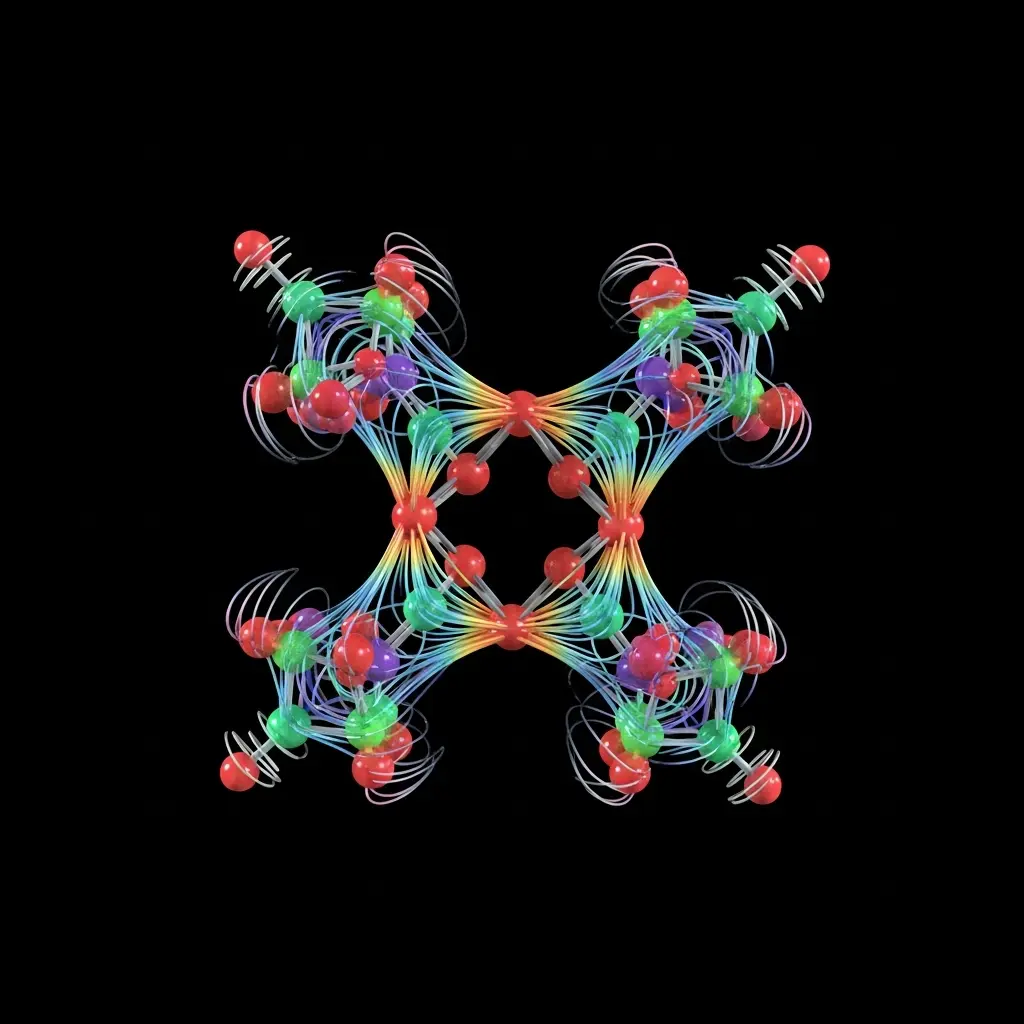
Scientists are increasingly focused on accurately modelling molecular vibrations within complex liquid environments. Ryotaro Hoshino and Yoshitaka Tanimura, both from Kyoto University, alongside their colleagues, present a new computational framework, HEOM-2DVS, which addresses the challenges of simulating these non-Markovian dynamics. Their research significantly advances the field by combining the hierarchical equations of motion (HEOM) with two-dimensional vibrational spectroscopy (2DVS), allowing for rigorous treatment of energy relaxation, dephasing and thermal excitation in molecular liquids, processes crucial for understanding complex chemical and biological phenomena. This implementation provides a powerful tool for both theoretical prediction and interpretation of experimental 2DVS data, particularly when vibrational energies exceed thermal levels.
HEOM-2DVS for molecular liquid vibrational spectra
This breakthrough addresses a long-standing challenge in accurately capturing quantum effects that become significant when vibrational energy exceeds thermal excitation levels, necessitating a rigorous treatment of system-bath entanglement. The study reveals a computational implementation capable of handling non-perturbative and nonlinear interactions, which are essential for describing the behaviour of molecules in complex environments. Researchers employed the HEOM methodology to simulate Open quantum systems, a crucial step in accurately representing the energy transfer and coherence dynamics within molecular liquids. The resulting spectra clarify how these interactions manifest as characteristic changes in spectral features, providing valuable insights into the underlying molecular processes.
This work establishes a robust theoretical foundation for interpreting and fully exploiting the information contained within two-dimensional vibrational spectroscopy (2DVS) data. The HEOM-2DVS program, meticulously written in C++, is provided as supporting material, enabling other researchers to replicate and extend these findings. By moving beyond classical simulations, which struggle to account for quantum coherence, the team has created a tool capable of accurately modelling the ultrafast phenomena governing chemical reactivity. Experiments show that the developed framework accurately captures the quantum nature of vibrational dynamics, particularly for intramolecular modes exhibiting significant quantum effects.
Previous approaches were limited by their inability to model three interacting modes, hindering the accurate description of energy transfer pathways and coherence dynamics. The team’s extension to a three-mode formulation is therefore indispensable for resolving the intricate processes observed in high-resolution 2DVS experiments. By calibrating classical simulations to reproduce molecular dynamics benchmarks and applying quantum HEOM for quantum-level insights, the researchers have demonstrated the power of combining computational methods to reveal the complexities of molecular behaviour. This computational advancement promises to accelerate the interpretation of 2DVS data and facilitate a deeper understanding of the fundamental processes governing molecular behaviour in complex environments. The ability to accurately simulate these dynamics will be crucial for advancing fields such as solution-phase chemistry, biophysics, and materials science.
HEOM-2DVS modelling of vibrational dynamics and entanglement offers
The study pioneered a C++ program, HEOM-2DVS, which is provided as supporting material, enabling detailed analysis of non-perturbative and nonlinear interactions. By combining the MAB model with HEOM, the researchers achieved numerically precise simulations of nonlinear spectra in complex systems, revealing the quantum nature of vibrational dynamics and enabling rigorous quantification of relaxation, dephasing mechanisms governing spectral broadening.
Water vibrational dynamics via HEOM-2DVS simulations reveal key
Results demonstrate that intramolecular motions, particularly the OH stretching vibration of water, contribute significantly to reactivity and exhibit ultrafast phenomena including energy and phase relaxation. The HEOM-2DVS program, written in C++, was created to address the limitations of classical molecular dynamics simulations, which struggle to incorporate essential quantum mechanical phenomena like zero-point energy and quantum thermal fluctuations. Data shows that traditional methods, such as path-integral Centroid MD, face computational challenges when applied to 2DVS. The work builds upon previous multidimensional spectral analyses using the multimode anharmonic Brownian model and Hierarchical Fokker, Planck equations, extending these approaches to a three-mode formulation. Measurements confirm that the implementation accurately simulates linear absorption spectra and 2D correlation IR spectra, validating its ability to capture complex vibrational dynamics. The breakthrough delivers a robust theoretical framework for interpreting and fully exploiting 2DVS data, enabling more precise simulations of nonlinear spectra in complex systems and furthering understanding of quantum phenomena in condensed phases.
HEOM-2DVS clarifies 2D spectra line shapes through quantum
Analysis of the simulated 2D signals clarifies the physical origins of spectral line shapes, offering insights difficult to obtain from traditional molecular dynamics simulations. While the current code represents intramolecular vibrations as three-level systems, limiting its descriptive power compared to other methods, it offers a complementary approach to existing computational techniques. Acknowledging limitations in descriptive power relative to some existing methods, the authors highlight the code’s efficiency for specific applications. Future work will focus on integrating machine learning algorithms to construct more accurate models directly from molecular dynamics trajectories. This will enable detailed analysis of the 2D spectra of water and its isotopes, potentially revealing distinct physical processes underlying their infrared spectra. The developed numerical integration codes are also provided as supplementary material, facilitating further research in this area.
👉 More information
🗞 HEOM-Based Numerical Framework for Quantum Simulation of Two-Dimensional Vibrational Spectra in Molecular Liquids (HEOM-2DVS)
🧠 ArXiv: https://arxiv.org/abs/2601.20550