

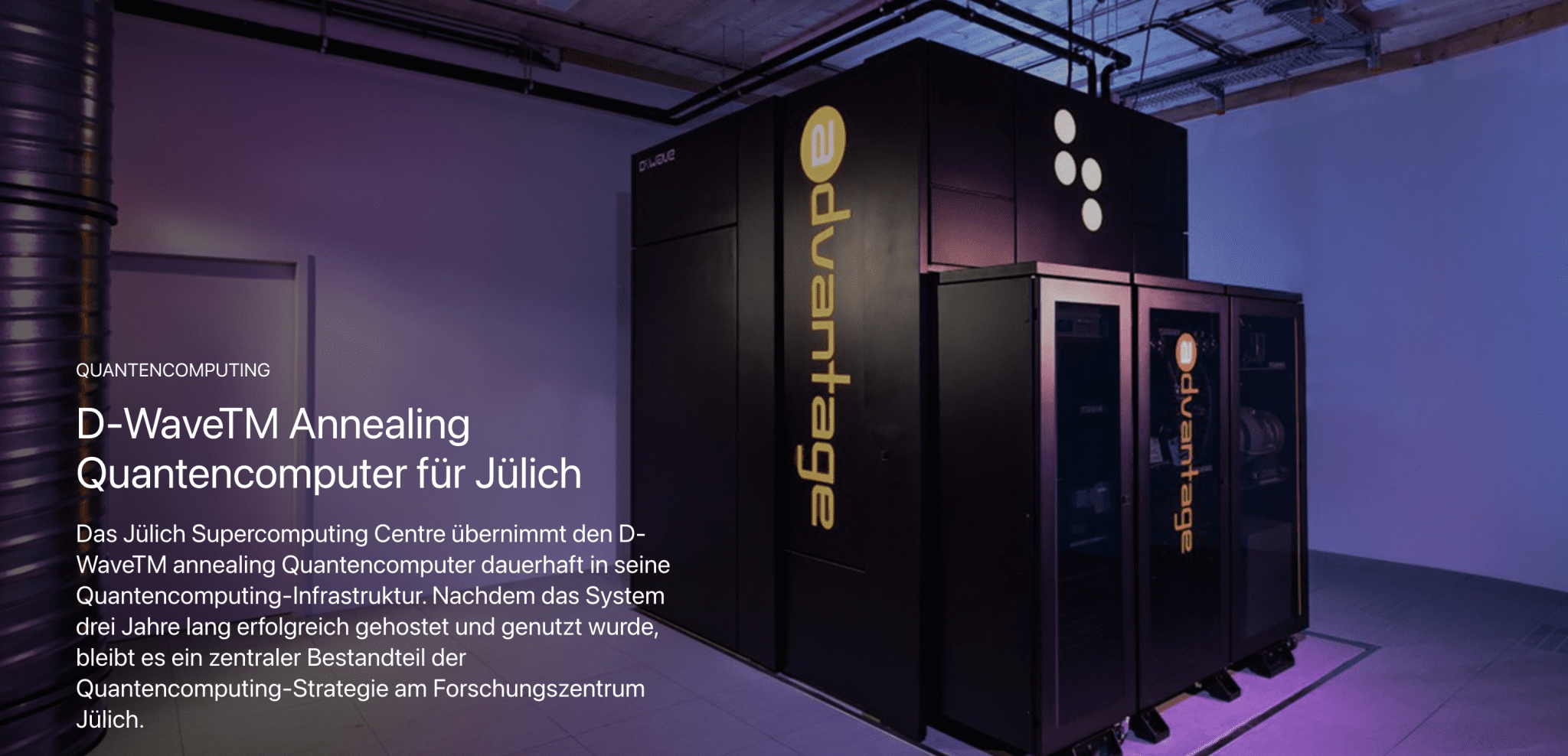
Forschungszentrum Jülich (FZJ) has become the first high-performance computing (HPC) center in the world to own a D-Wave Advantage™ quantum annealing system. The acquisition, announced jointly by FZJ and D-Wave Quantum Inc., marks a significant milestone in quantum computing integration within supercomputing environments. This system, which features over 5,000 qubits and 15-way connectivity, will be incorporated into the Jülich Unified Infrastructure for Quantum Computing (JUNIQ), a public quantum computing facility. The primary goal is to explore quantum optimization applications and leverage the system for advanced scientific research.
One of the most notable aspects of this development is the planned integration of the D-Wave quantum system with JUPITER, Europe’s first and only exascale supercomputer. JUPITER, currently under construction at FZJ, is expected to achieve more than one quintillion calculations per second. This will be the first instance of coupling an annealing quantum computer with an exascale HPC system, potentially revolutionizing problem-solving in artificial intelligence (AI), quantum optimization, and materials science. The ability to modify system parameters and directly integrate the quantum processor with JUPITER will allow researchers to explore novel computational approaches for complex challenges.
JSC’s D-Wave system will be upgraded to the next-generation Advantage2™ quantum processor once it becomes available. The upcoming Advantage2 system is anticipated to offer significant improvements, including increased coherence, enhanced connectivity, and a 40% increase in the energy scale for solving computational problems. These advancements are expected to expand the range of scientific and industrial applications that can benefit from quantum computing. Experts at JUNIQ and JSC have already demonstrated the potential of D-Wave’s technology, applying it to various scientific fields, including condensed matter physics and biochemistry.
Past research at JSC using the D-Wave system has led to notable breakthroughs. In 2022, a collaboration with Lund University successfully applied quantum annealing to protein folding simulations, offering insights into diseases such as Alzheimer’s and Parkinson’s. More recently, in 2024, JSC scientists and Slovenian researchers demonstrated that D-Wave’s system could accurately model electron interactions in materials, a finding published in Nature Communications. Additionally, a multinational team from JSC, the University of Leeds, and the Institute of Science and Technology Austria employed D-Wave’s technology to study quantum processes in early universe formation, with results presented in Nature Physics. These examples illustrate the system’s potential for fundamental scientific discovery.
By integrating quantum computing with traditional HPC, JSC is positioning itself at the forefront of computational research. This initiative aligns with FZJ’s broader mission of advancing digital science, sustainable energy, and bio-economy research. As a member of the Helmholtz Association, FZJ continues to provide European researchers with cutting-edge computing resources. With this acquisition, JSC strengthens its role as a global leader in quantum-HPC hybrid computing, paving the way for future breakthroughs in science and industry.
External Link: Click Here For More


