

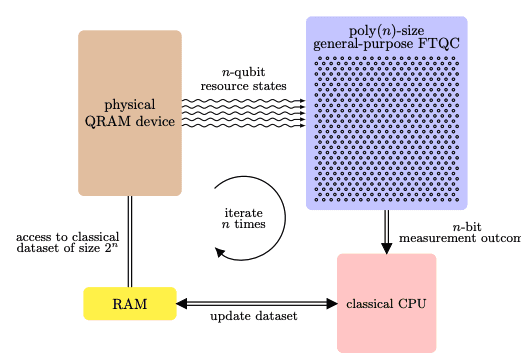
A protocol achieves fault-tolerant quantum random access memory (QRAM) utilising a noisy device, circumventing active error correction on all components. The method requires querying the QRAM a number of times and leverages a new gate-efficient purity amplification technique, though it introduces substantial classical computational overhead.
Quantum Random Access Memory (QRAM) represents a pivotal, yet elusive, component in the architecture of a scalable quantum computer. Its function – to provide quantum processors with efficient access to classical data – has remained a significant challenge due to the inherent difficulties in maintaining quantum coherence and implementing error correction. Researchers have now demonstrated a protocol that circumvents the need for comprehensive error correction within the QRAM device itself, utilising a distillation-teleportation approach to achieve fault-tolerant operation. This work, detailed in a paper by Alexander M. Dalzell (AWS Center for Quantum Computing), András Gilyén (HUN-REN Alfréd Rényi Institute of Mathematics), Connor T. Hann (AWS Center for Quantum Computing), Sam McArdle (AWS Center for Quantum Computing), Grant Salton (Amazon Quantum Solutions Lab), Quynh T. Nguyen (Harvard University), Aleksander Kubica (Yale Quantum Institute), and Fernando G.S.L. Brandão (Institute for Quantum Information and Matter, Caltech), presents “A distillation-teleportation protocol for fault-tolerant QRAM”. The protocol accepts a specialised, noisy QRAM and, through a series of queries and processing, delivers fault-tolerant access to classical data, even with a device fidelity as low as 0.72.
Advances in Quantum Random Access Memory and Resource Optimisation
Quantum computation continues to progress through concurrent developments in algorithms, hardware and error mitigation. A notable trend involves combining the strengths of both quantum and classical computational paradigms, acknowledging the limitations of present and near-term quantum devices.
Algorithm refinement remains central to progress. Researchers are continually improving the accuracy and efficiency of quantum algorithms applicable to fields such as chemistry, materials science and machine learning. Algorithms like the Variational Quantum Eigensolver (VQE) and Quantum Phase Estimation (QPE) are being refined for increasingly precise simulations of molecular systems and energy calculations. Investigations also extend to quantum analogues of classical algorithms – for example, adapting the Metropolis algorithm – to accelerate sampling and optimisation processes.
A significant challenge lies in the substantial resource demands of many quantum algorithms. Consequently, research focuses on minimising qubit counts and gate complexity. Circuit optimisation techniques and classical methods, such as tensor networks, are employed to reduce the computational burden and enhance feasibility. Investigations also encompass specialised areas like quantum amplitude amplification – for accelerating search algorithms – and quantum annealing – for tackling optimisation problems. Quantum communication and cryptography continue to be active areas, with ongoing development of secure communication protocols and quantum key distribution systems.
Recent work details a protocol for implementing fault-tolerant logical random access memory (QRAM). QRAM allows quantum algorithms to access and process large datasets, analogous to classical RAM, but utilising quantum principles. This new protocol leverages a specialised, noisy QRAM device and achieves fault-tolerance without actively correcting errors within the entire QRAM. Instead, the protocol generates a sequence of ‘resource states’ by querying the noisy QRAM a limited number of times. These states are then processed on a general-purpose quantum processor equipped with error correction.
Specifically, researchers prepare these resource states and transfer them to the processor for encoding within a quantum error correction (QEC) code. Subsequent distillation and fault-tolerant teleportation dramatically reduce the demand for fault-tolerant resources. This approach significantly lowers the requirements for logical qubits (the quantum equivalent of bits, but protected from errors), logical gates, and error correction cycles, making fault-tolerant QRAM implementation more feasible with current and near-term hardware.
A gate-efficient streaming version of purity amplification further optimises the protocol, reducing computational overhead and improving performance. Researchers demonstrate that high fidelity can be achieved even with relatively noisy QRAM devices, broadening the range of viable hardware options.
However, the protocol introduces a substantial classical computational overhead. It requires frequent updates to a large classical dataset and efficient communication with the QRAM. This presents a practical implementation challenge, necessitating careful optimisation of classical algorithms and communication protocols.
The research provides a rigorous conceptual demonstration of the protocol’s feasibility, with a detailed analysis of its performance and resource requirements. This analysis indicates that high fidelity can be achieved with modest resources, making it a viable option for near-term quantum computers. The work also identifies key areas for future optimisation, including reducing the classical computational overhead and improving the efficiency of the error correction code.
This approach represents a promising pathway towards realising the full potential of quantum computation, establishing a new paradigm for quantum memory implementation that prioritises resource optimisation and practical considerations.
👉 More information
🗞 A distillation-teleportation protocol for fault-tolerant QRAM
🧠 DOI: https://doi.org/10.48550/arXiv.2505.20265


