The pursuit of scalable quantum computation necessitates rapid and accurate methods for reading out the state of qubits, the fundamental units of quantum information. Current limitations in readout speed significantly impede progress, creating a bottleneck in complex quantum circuits. Researchers are now exploring novel approaches leveraging the unique properties of Andreev spins, quasiparticle excitations occurring at the interface between a superconductor and a semiconductor, to address this challenge.
A collaborative team comprising Michèle Jakob, Katharina Laubscher, Patrick Del Vecchio, Anasua Chatterjee, Valla Fatemi, and Stefano Bosco, affiliated with institutions including QuTech, Delft University of Technology, the University of Maryland, and Cornell University, detail a protocol for fast, high-fidelity readout of spin qubits in germanium quantum dots using electrically-tunable coupling to Andreev spins, as presented in their article, “Fast readout of quantum dot spin qubits via Andreev spins”. Their work proposes a method to overcome existing limitations and potentially enable mid-circuit measurements, a crucial step towards more complex and powerful quantum processors.
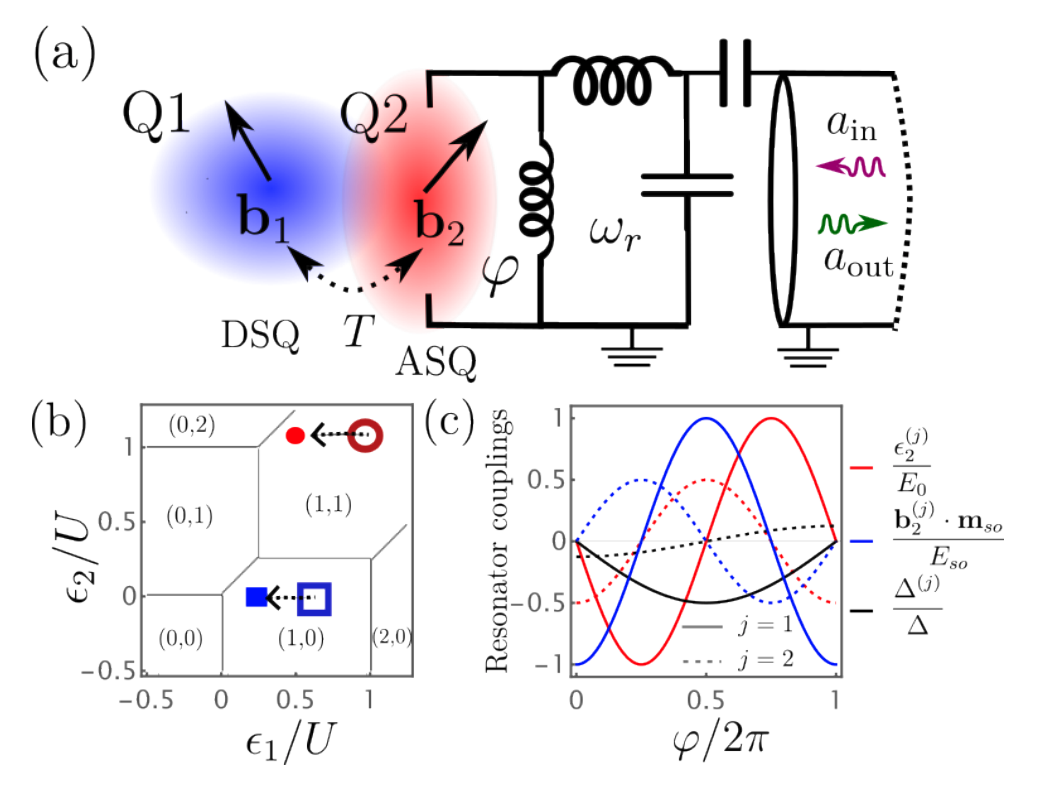
Numerical simulations demonstrate precise manipulation of spin states within a double quantum dot (DQD) through coupling to an asymmetric superconducting quantum dot (ASQ). A DQD consists of two closely spaced semiconductor nanocrystals, each confining a single electron, allowing for controlled quantum behaviour. Researchers establish that the ASQ effectively screens the spin residing on one of the DQD’s dots, inducing a transition from a doublet to a singlet ground state as the coupling strength increases. This represents a pathway to control and modify electron spin behaviour within semiconductor quantum dots, with potential applications in spintronics and quantum information processing.
The study reveals a pronounced influence of the
The study reveals a pronounced influence of the superconducting phase difference on the energy levels and spin states of the coupled system, establishing a critical link between superconductivity and spin manipulation. The superconducting phase difference refers to the relative phase of the Cooper pairs, bound pairs of electrons that carry supercurrent in a superconductor. Simulations demonstrate a phase-dependent splitting of both singlet and triplet states, indicative of an effective exchange interaction arising from the hybridization between the DQD and ASQ. Hybridization describes the mixing of electronic states between the two quantum dots, and this exchange interaction provides a potential mechanism for external control and tuning of the system’s quantum properties.
Researchers highlight the emergence of an effective exchange interaction between the spins within the DQD and the ASQ, demonstrating a strong interplay between the quantum dots and the superconducting environment. This interaction, modulated by the superconducting phase, directly impacts the energy level splitting observed in both the (0,1) and (1,1) sectors, offering a means to engineer specific spin configurations crucial for quantum computation. The (0,1) and (1,1) sectors refer to the charge states of the DQD, indicating the number of electrons on each dot.
Scientists acknowledge the limitations inherent in the zero-bandwidth approximation (ZBA) employed in these simulations. The ZBA simplifies calculations by assuming the superconducting leads have infinite impedance, effectively decoupling the energy levels of the superconductor from the quantum dots. While this simplifies the calculations, it represents an idealization of the superconducting leads and may not fully capture the system’s behaviour at larger interdot tunneling rates, where electrons can move more freely between the dots. Future work should investigate the impact of relaxing the ZBA to provide a more complete and accurate description of the coupled system, enhancing the reliability and predictive power of the simulations.
Researchers plan to explore the dynamic behaviour of
Researchers plan to explore the dynamic behaviour of this coupled system, including the effects of finite temperature and decoherence mechanisms. Decoherence refers to the loss of quantum information due to interactions with the environment. Investigating the feasibility of utilizing this system for quantum information processing, particularly in the context of fast and high-fidelity spin readout, represents a promising direction for future research. The compatibility with germanium-based devices, as noted in related work, suggests potential for scalable quantum computing architectures leveraging heterogeneous implementations, offering a pathway towards practical quantum technologies.
Scientists intend to expand the simulations to include more realistic device parameters and geometries, assessing the practical viability of this approach. Investigating the tunability and control of the coupling between the DQD and ASQ, potentially through gate voltages or other external stimuli, will further enhance the system’s functionality and versatility. Ultimately, a deeper understanding of the interplay between superconductivity and spin in these hybrid quantum dot structures will unlock the potential for advancements in quantum technologies.
🗞 Fast readout of quantum dot spin qubits via Andreev spins
🧠 DOI: https://doi.org/10.48550/arXiv.2506.19762