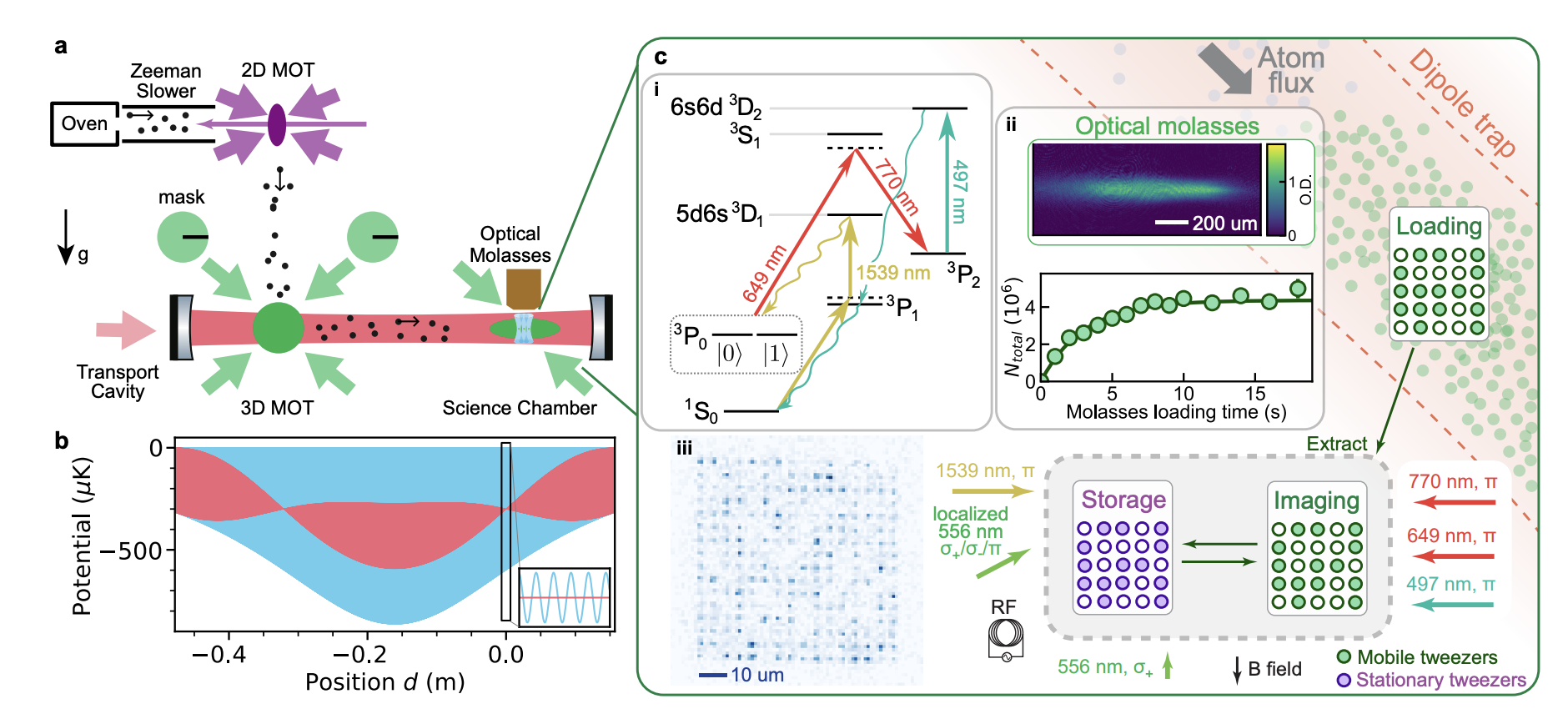
Researchers demonstrate rapid, continuous replacement of atoms in a neutral atom processor, achieving rates of up to 500 replacements per second. This process, utilising metastable ytterbium qubits, allows for the creation of new qubit arrays at a rate of 30 times per second without disturbing existing qubits, enabling circuits of unlimited depth and advancing fault-tolerant quantum computing.
The pursuit of scalable quantum computation necessitates robust methods for maintaining qubit integrity throughout complex calculations. Atom loss represents a significant source of error in neutral atom quantum processors, limiting circuit depth and hindering progress towards fault-tolerant computing. Researchers at Princeton University now present a solution to this challenge, demonstrating a system capable of rapidly replacing lost atoms within a qubit array without disrupting existing quantum information. Yiyi Li, Yicheng Bao, Michael Peper, Chenyuan Li, and Jeff D Thompson detail their findings in a forthcoming publication titled “Fast, continuous and coherent atom replacement in a neutral atom qubit array”, outlining a technique utilising a continuously loaded reservoir of ytterbium atoms and optical tweezers to achieve replacement rates of up to 500 atoms per second, and complete array preparation at 30 times per second, all while preserving the coherence of existing qubits.
Yiyi Li, Yicheng Bao, Michael Peper, Chenyuan Li, and Jeff D Thompson detail their findings in a forthcoming publication, demonstrating a significant advancement in neutral atom quantum computing. Their research addresses a critical limitation in scaling circuit depth by enabling rapid, continuous atom replacement within a quantum processor, achieving replacement rates of up to 500 atoms per second and complete array preparation at 30 times per second while preserving the delicate quantum state of existing qubits.
Neutral atom processors represent a promising architecture for scalable computing, but atom loss currently limits the implementation of deep circuits, contributing a substantial fraction of all errors. Existing solutions either cannot replace lost atoms mid-circuit – restricting circuit depth – or require replacement times significantly longer than gate and measurement operations. The team overcomes these challenges by maintaining a continuously loaded reservoir of metastable Ytterbium qubits and isolating them from cooling and imaging light, establishing a complete solution for implementing fast circuits with unlimited depth. A qubit, or quantum bit, is the basic unit of quantum information, analogous to a bit in classical computing.
The core innovation lies in the ability to
The core innovation lies in the ability to maintain qubit fidelity while dynamically replenishing lost atoms, a feat previously unattainable with existing technologies. Prior approaches suffered from either an inability to replace atoms mid-circuit or excessively slow replacement times, severely limiting the complexity of quantum algorithms that could be executed. The team circumvents these issues by carefully controlling laser parameters and utilizing a unique cooling technique, establishing a pathway towards implementing arbitrarily deep quantum circuits – a crucial step for realising fault-tolerant quantum computation with neutral atoms. Fault-tolerance refers to the ability of a quantum computer to maintain accurate computations despite the presence of errors.
Referencing the NIST Atomic Spectra Database ensures accurate laser tuning to specific Ytterbium energy levels, a vital step for both trapping and manipulating the atoms with optical tweezers. Optical tweezers use highly focused laser beams to hold and move microscopic objects, such as atoms. This precision, combined with the use of ‘gray molasses’ cooling, further slows the atoms, increasing the efficiency of trapping and reducing unwanted motion. Gray molasses cooling involves using laser beams tuned slightly to the red of an atomic transition, effectively creating a viscous medium that slows the atoms down, enhancing the stability of the qubit array. An atomic transition refers to the change in energy level of an atom when it absorbs or emits a photon.
The demonstrated capability of preparing new qubit arrays at 30 times per second, including single-atom preparation, non-destructive imaging, and initialization, represents a substantial improvement in the field. Non-destructive imaging, achieved through techniques like fluorescence imaging, allows researchers to observe the atoms without altering their quantum state, ensuring the integrity of the qubit array. By continuously replenishing the qubit array, this method effectively removes a major roadblock to building fault-tolerant quantum computers with neutral atoms.
The team meticulously optimised laser parameters and cooling
The team meticulously optimised laser parameters and cooling techniques to achieve these high replacement and preparation rates, demonstrating a deep understanding of atomic physics and quantum control. This optimisation process involved extensive simulations and experimental validation, ensuring the reliability and reproducibility of the results.
The demonstrated technology effectively removes a major roadblock to scalable neutral atom quantum computing, opening up new possibilities for quantum algorithm development and implementation. By enabling continuous atom replacement, the research paves the way for building larger, more complex quantum processors capable of executing algorithms requiring extended circuit depths. The successful implementation of this system suggests a viable path towards overcoming decoherence and error rates that currently limit the performance of neutral atom quantum computers. Decoherence refers to the loss of quantum information due to interactions with the environment.
Further development and optimisation of this technology promise to unlock the full potential of this promising quantum computing platform. The team plans to explore new cooling techniques and laser control schemes further to improve the performance and scalability of the system, and is actively collaborating with other researchers to explore the applications of this technology in various fields, including materials science, drug discovery, and financial modelling.
🗞 Fast, continuous and coherent atom replacement in a neutral atom qubit array
🧠 DOI: https://doi.org/10.48550/arXiv.2506.15633