
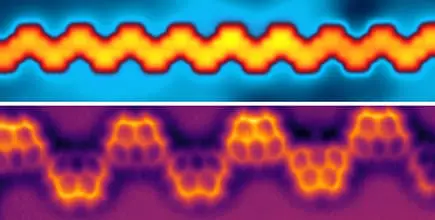
Empa researchers have successfully recreated a fundamental quantum spin model using nanographene molecules, advancing the development of a material platform for quantum research. By employing Olympicene, a five-ring carbon molecule resembling the Olympic rings, they constructed a homogeneous Heisenberg chain, demonstrating precise control over quantum properties. This achievement, detailed in Nature Materials, highlights their synthetic approach to studying quantum models and paves the way for exploring complex spin systems, potentially enhancing quantum technologies in communication, computing, and measurement.
Quantum Spin Model Made From Nanographene Molecules
Empa researchers have successfully utilized nanographenes—minute carbon molecules—to recreate a quantum spin model, advancing the field of quantum physics. Their work involves constructing both alternating and homogeneous Heisenberg models, each with distinct properties.
The alternating Heisenberg model exhibits spins connected in a pattern of strong and weak couplings, resulting in an energy gap and shorter correlations. Conversely, the homogeneous model features evenly connected spins, leading to strong entanglement and long-range correlations without an energy gap. These findings were confirmed through experiments with nanographenes, specifically Olympicene for the homogeneous chain.
The significance of this research lies in its potential to enhance our understanding of quantum effects, thereby facilitating advancements in quantum technologies such as communication and computing systems. The ability to manipulate material properties through synthetic approaches underscores the versatility of nanographene-based systems in advancing quantum physics research.
Future Directions In Quantum Spin Lattice Research
Empa researchers have developed a synthetic bottom-up approach using nanographenes—minute fragments of graphene—to construct quantum spin models. This method allows precise manipulation of quantum physical properties by controlling the shape and structure of these carbon-based molecules. The approach enables the experimental realization of both alternating and homogeneous Heisenberg models, each exhibiting distinct characteristics.
In the alternating model, spins are connected through a pattern of strong and weak couplings, resulting in an energy gap and shorter-range correlations. This contrasts with the homogeneous model, where evenly connected spins lead to strong entanglement and long-range correlations without an energy gap. These properties were confirmed through experiments involving specific nanographenes, such as Olympicene for the homogeneous chain.
The synthetic bottom-up approach provides a tangible platform for studying theoretical quantum models, offering insights into complex phenomena like spin excitations and topological phases. This work not only advances fundamental research but also lays the groundwork for potential applications in quantum technologies, including communication and computing systems.
Looking ahead, researchers plan to investigate ferrimagnetic spin chains and two-dimensional lattices, which may reveal new phases such as topological states. This work highlights the importance of continued exploration into these complex systems, emphasizing their role in advancing both fundamental understanding and practical applications in quantum physics.
More information
External Link: Click Here For More