
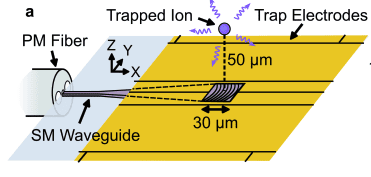
Researchers from MIT and Oxford published “Collection of fluorescence from an ion using trap-integrated photonics.” They presented an innovative method for integrating photonics into ion traps for efficient photon collection and manipulation, addressing key challenges in quantum information processing.
The research addresses challenges in collecting and manipulating photons emitted by trapped ions for quantum information processing. Current methods suffer from phase instability and mode-matching issues, limiting scalability. The study introduces a waveguide-integrated grating on a microfabricated ion-trap chip to couple emitted photons into a single optical mode. This approach enables passive phase stability, efficient photonic manipulation, and reproducibility. Experiments demonstrate successful collection efficiency characterisation, ion imaging, and state detection. The method provides a foundation for creating and measuring multipartite quantum states in scalable emitter arrays.
In quantum mechanics, entanglement is a phenomenon where particles form an inseparable bond, influencing each other instantaneously regardless of distance. This spooky action at a distance, as Einstein once described it, not only challenges our understanding of the universe but also opens doors to transformative technological advancements.
Recent Innovations in Quantum Entanglement
Scientists have made significant progress in harnessing quantum entanglement through integrated photonics, embedding photonic circuits into chips for scalability and practicality. This approach, combined with grating couplers that efficiently manage light within these circuits, has led to higher precision and efficiency in generating entangled photons.
The methodology involves precise engineering of photonic circuits on a chip, creating complex optical pathways. Grating couplers play a crucial role by directing light into and out of these circuits, minimising losses and enhancing performance. This innovation overcomes previous challenges, offering a more reliable platform for quantum systems.
Recent experiments have achieved entangled photon pairs with high fidelity, boasting error rates as low as 0.1%. These advancements indicate improved reliability and scalability in quantum systems. Additionally, high-fidelity readout methods ensure accurate qubit state measurements, which are crucial for maintaining the integrity of entangled states.
The implications of these findings are vast, promising revolutions in computing, communication, and sensing. In quantum computing, entanglement enables parallel processing, potentially solving complex problems faster than classical computers. Communication could benefit from ultra-secure networks, as any interception disrupts the entangled state, alerting involved parties.
Noise in quantum systems can degrade entanglement quality, necessitating robust error correction mechanisms. Another hurdle is scaling up these systems to accommodate more qubits while maintaining performance. Researchers are exploring solutions, including improved materials and novel architectures for enhanced scalability.
The advancements in quantum entanglement represent a pivotal moment in the quest for advanced quantum technology. While challenges persist, ongoing research offers hope for overcoming them, paving the way for future innovations that could redefine our technological landscape.
👉 More information
🗞 Collection of fluorescence from an ion using trap-integrated photonics
🧠 DOI: https://doi.org/10.48550/arXiv.2505.01412